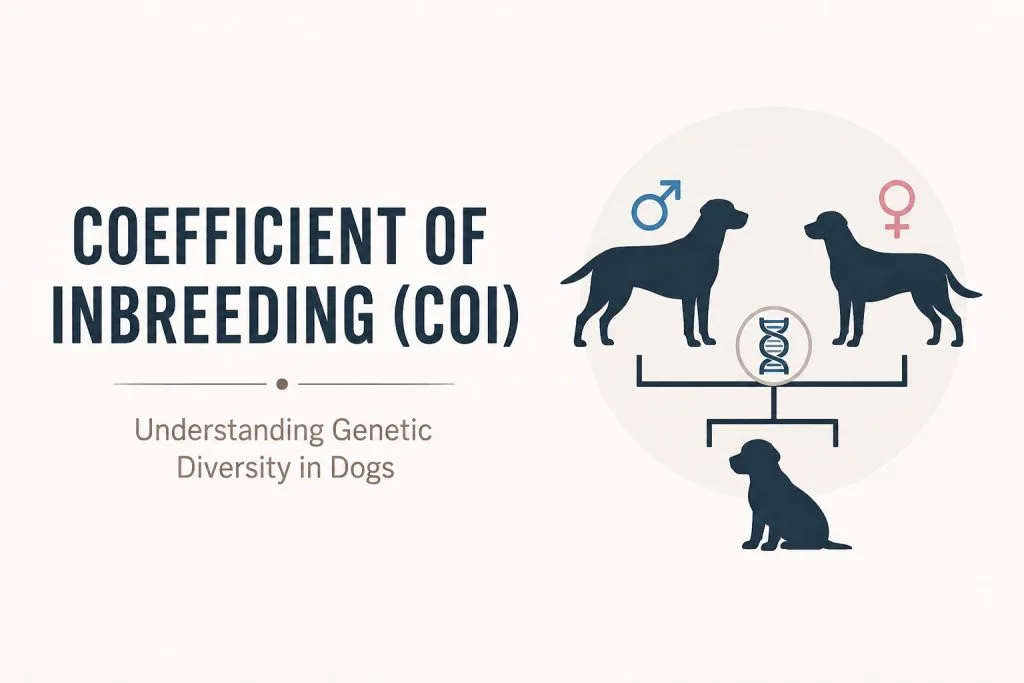
The Coefficient of Inbreeding (COI) is a percentage that estimates how genetically related a dog’s parents are. It represents the probability that a puppy inherits two identical copies of the same gene from a common ancestor. Responsible breeders use COI alongside health testing, pedigree analysis, temperament assessments, and genetic screening to make informed breeding decisions. While a lower COI generally indicates greater genetic diversity, it does not guarantee a healthy dog, just as a higher COI does not automatically mean a dog will develop inherited diseases.
Table of Contents
What Is the Coefficient of Inbreeding (COI)?
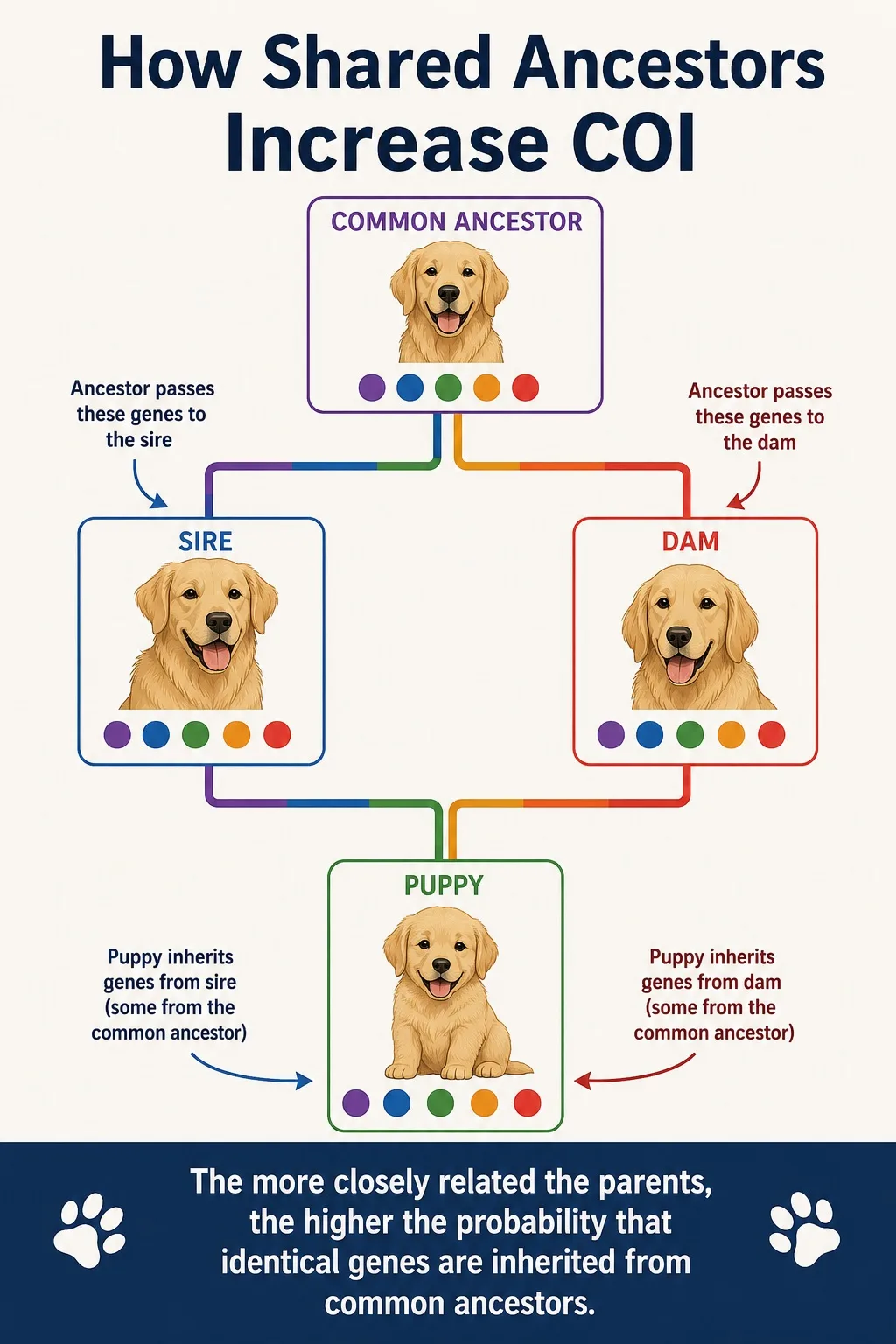
The Coefficient of Inbreeding (COI) is a mathematical measure of genetic relatedness within a pedigree. It estimates the likelihood that a puppy receives identical copies of the same gene because both parents inherited that gene from a shared ancestor.
In simple terms, the closer two breeding dogs are related, the higher the COI of their offspring is likely to be.
Imagine a family tree. If both parents share grandparents, great-grandparents, or other ancestors, some of the genes passed to their puppies may be identical simply because they originated from the same dog. COI measures the probability of this occurring.
The concept was first described by the renowned geneticist Sewall Wright in the early 20th century and remains one of the most widely used methods for evaluating genetic diversity in domestic animals, including dogs.
Today, many responsible breeders calculate COI before planning a litter to help preserve long-term breed health and reduce the likelihood of inherited genetic disorders.
At a Glance
| Feature | Details |
|---|---|
| Full Name | Coefficient of Inbreeding |
| Abbreviation | COI |
| Expressed As | Percentage (%) |
| Measures | Genetic relatedness between parents |
| Lower COI | Greater genetic diversity |
| Higher COI | Increased homozygosity and potentially greater inherited disease risk |
| Used By | Responsible breeders, geneticists, breed clubs, researchers |
| Calculated From | Pedigrees, DNA testing, or both |
| Should It Be Used Alone? | No—always alongside health testing, temperament, and breed-specific considerations |
What Does COI Actually Measure?
Many people mistakenly believe COI measures “how inbred” a dog is. In reality, it measures the probability of homozygosity due to shared ancestry.
Every puppy inherits one copy of each gene from its mother and one from its father. These copies may be:
- Different versions of the gene (heterozygous), contributing to genetic diversity.
- Identical versions inherited from a common ancestor (homozygous by descent).
A higher COI means there is a greater chance that the puppy inherits identical copies of certain genes because both parents inherited those genes from the same ancestor.
This is important because while many identical genes are harmless, some recessive genetic mutations only cause disease when a puppy inherits two copies—one from each parent.
Why COI Matters
COI is not simply a number on paper. It provides valuable insight into the genetic diversity of a planned litter and helps breeders balance consistency with long-term breed health.
Higher levels of inbreeding can increase the likelihood of inherited recessive diseases becoming expressed. Over time, excessive inbreeding within a population may also contribute to a phenomenon known as inbreeding depression, where overall biological fitness declines.
Potential effects associated with high levels of inbreeding include:
- Reduced fertility
- Smaller litter sizes
- Increased puppy mortality
- Higher frequency of inherited disorders
- Reduced immune system diversity
- Shorter average lifespan in some populations
- Reduced adaptability to environmental changes
However, it is equally important to understand that COI is only one piece of the puzzle. A litter with a relatively high COI can still produce healthy puppies if the breeding dogs have undergone comprehensive health testing and carry few harmful genetic variants. Likewise, a litter with a very low COI is not automatically free from inherited disease if the parents share the same disease-causing mutation.
This is why modern breeding decisions increasingly combine pedigree analysis, DNA testing, health screening, and knowledge of breed-specific risks rather than relying on COI alone.
Understanding COI Percentages: What Do the Numbers Mean?
One of the most common questions among dog breeders and puppy buyers is, “What is a good COI?” The answer is not always straightforward.
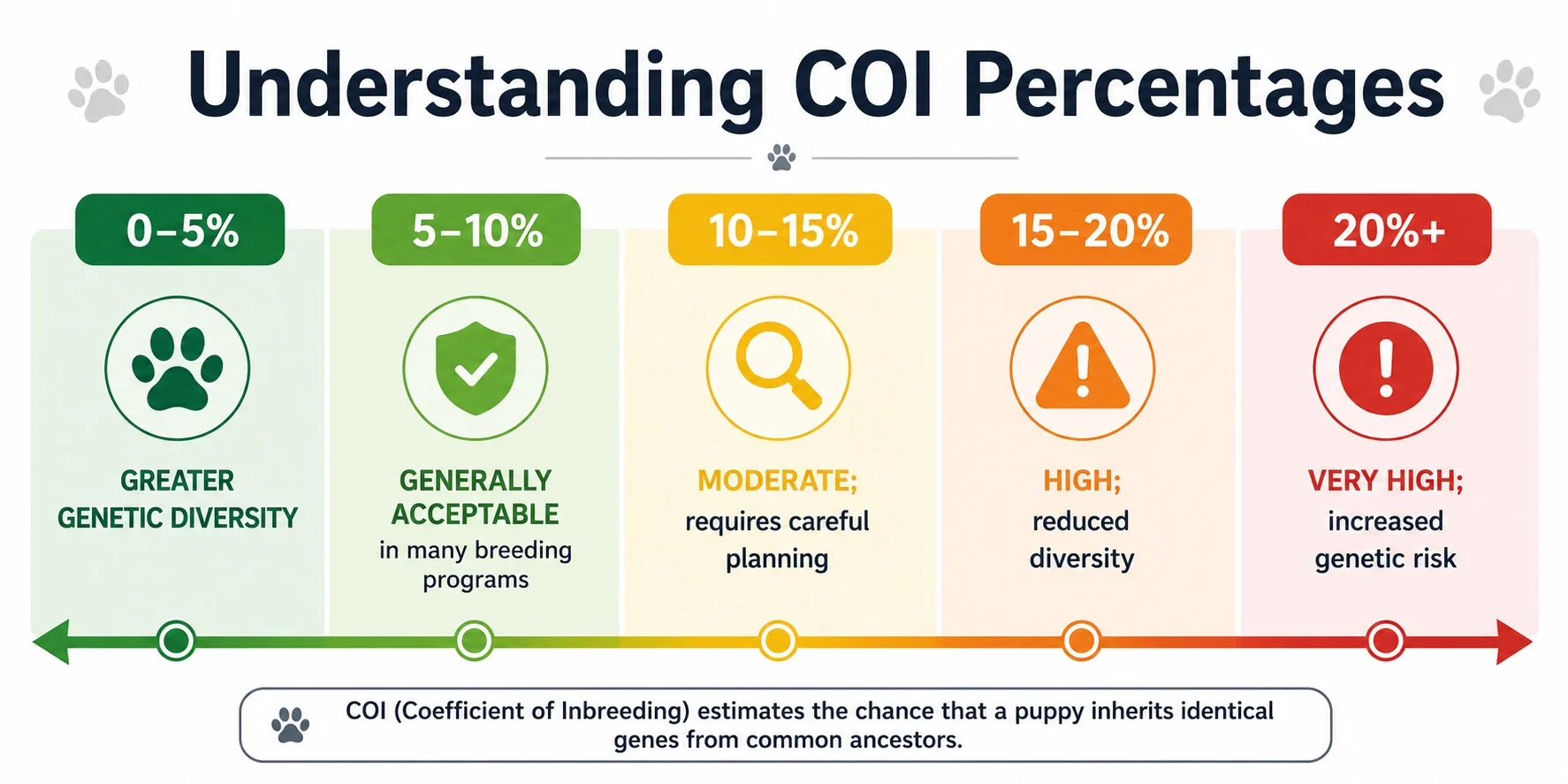
A COI percentage does not tell you whether a litter will be healthy or unhealthy. Instead, it estimates the probability that a puppy inherits identical copies of genes from common ancestors. As the percentage increases, genetic diversity generally decreases, and the likelihood of inherited recessive traits being expressed may increase.
Think of COI as a risk indicator, not a health score.
COI Percentage Explained
The table below provides a general interpretation of COI values. Keep in mind that there is no universally accepted “ideal” COI, and acceptable values may vary depending on the breed, population size, and breeding objectives.
| COI Percentage | General Interpretation | What It Means |
|---|---|---|
| 0% | Very low | Parents are not known to share common ancestors within the pedigree analyzed. Maximum pedigree diversity for that calculation. |
| 0–5% | Low | Excellent genetic diversity in many breeding programs. Often a desirable target where practical. |
| 5–10% | Moderate-Low | Common in many purebred populations and may be acceptable when paired with appropriate health testing. |
| 10–15% | Moderate | Requires thoughtful breeding decisions and consideration of the breed's average COI and health risks. |
| 15–20% | High | Greater likelihood of reduced genetic diversity. Breeders should carefully evaluate health testing, pedigree, and breeding goals. |
| Above 20% | Very High | Indicates close genetic relationships and may increase the risk of inherited problems and inbreeding depression over time. |
Important: These ranges are general guidelines. Breed clubs, geneticists, and kennel organizations may interpret COI differently depending on the breed’s available gene pool.
Simple Examples of COI
Understanding percentages becomes much easier when you see what they represent in real breeding scenarios.
Example 1: COI = 0%
A puppy with a 0% COI has no identified common ancestors within the pedigree depth used for the calculation.
This does not mean the dog has no shared ancestors somewhere in history—it simply means none were found within the number of generations analyzed.
Characteristics:
- Maximum pedigree diversity for that analysis
- Lower probability of inheriting identical genes from common ancestors
- Often seen in carefully planned outcrosses or breeds with broad genetic diversity
Example 2: COI = 6.25%
A 6.25% COI represents a relatively low level of relatedness.
This level may occur when the parents share a more distant common ancestor, such as a great-grandparent, depending on the pedigree.
Many responsible breeders consider values around this range reasonable, particularly when combined with:
- DNA testing
- Breed-specific health screening
- Good temperament
- Sound structure
- Strong longevity within the family line
Example 3: COI = 12.5%
A 12.5% COI represents a noticeably closer genetic relationship.
This percentage may be seen in certain linebreeding programs where breeders aim to preserve desirable characteristics from outstanding ancestors.
While linebreeding can help maintain consistency in traits, it also increases homozygosity. Because of this, breeders should carefully evaluate:
- Health history across the pedigree
- Known inherited conditions
- DNA test results
- Population diversity within the breed
Example 4: COI = 25%
A 25% COI is considered high.
This level can occur in very close matings, such as parent-to-offspring or full sibling pairings. Such matings are controversial and are prohibited or discouraged by many kennel clubs, breed organizations, and animal welfare authorities due to the increased risk of inherited genetic problems.
High COI levels can increase the chance that harmful recessive mutations become expressed, although they do not guarantee that health problems will occur.
Does a Lower COI Always Mean a Healthier Dog?
Not necessarily.
This is one of the biggest misconceptions about canine genetics.
Consider these two examples:
Puppy A
- COI: 2%
- Both parents unknowingly carry the same inherited disease mutation.
- Puppies may still inherit that disease.
Puppy B
- COI: 10%
- Parents have extensive DNA testing.
- Both are clear of important inherited disorders.
- Excellent health history across multiple generations.
Despite having the higher COI, Puppy B may actually have a lower risk of certain inherited diseases because the breeding decision considered much more than COI alone.
This illustrates why responsible breeders never rely solely on a single percentage.
Can COI Be Too Low?
In most situations, increasing genetic diversity is beneficial. However, COI should not become the only breeding objective.
Selecting mates solely to achieve the lowest possible COI may unintentionally compromise other important breeding goals, such as:
- Breed type and conformation
- Stable temperament
- Working ability
- Performance traits
- Preservation of valuable bloodlines
- Elimination of inherited diseases through informed selection
The healthiest breeding programs seek a balance between maintaining genetic diversity and preserving the characteristics that define the breed.
Why Breed Average Matters
Comparing COI values across different breeds can be misleading.
For example:
- A rare breed with a limited global population may naturally have a higher average COI.
- A popular breed with a large breeding population may have lower average values.
This means a 10% COI could be considered relatively low in one breed but comparatively high in another.
Responsible breeders often compare a planned litter’s COI with the average COI for their specific breed, rather than relying on a universal target.
Key Takeaways
- COI measures genetic relatedness, not overall health.
- Lower COI generally means greater genetic diversity.
- High COI may increase the likelihood of inherited recessive conditions but does not guarantee disease.
- Very low COI does not automatically ensure healthy puppies.
- Responsible breeders interpret COI alongside DNA testing, health screening, pedigree analysis, and breed-specific considerations.
Pedigree COI vs. DNA COI: What’s the Difference?
As canine genetics has advanced, breeders now have two main ways to estimate a dog’s level of inbreeding:
- Pedigree COI
- DNA COI
Although both aim to measure genetic relatedness, they do so in very different ways. Understanding the difference helps breeders interpret results more accurately and make better breeding decisions.
What Is Pedigree COI?
Pedigree COI is calculated using a dog’s family tree (pedigree).
It estimates the probability that two copies of a gene are identical because both parents inherited them from the same ancestor listed in the pedigree.
The calculation is based on:
- Number of generations analyzed
- Shared ancestors
- Relationship between those ancestors
- Frequency of repeated ancestors within the pedigree
For example:
If the same champion dog appears several times within five generations, the puppy’s pedigree COI will generally be higher than if every ancestor appears only once.
Pedigree COI has been used by breeders for decades and remains one of the most widely accepted planning tools.
Advantages of Pedigree COI
✔ Easy to calculate using registered pedigrees
✔ Useful for planning future matings
✔ Helps monitor genetic diversity within breeding programs
✔ Can identify repeated influential ancestors
✔ Often available through kennel clubs, breed clubs, or pedigree software
Limitations of Pedigree COI
Pedigree COI is only as accurate as the information available.
Its limitations include:
- Missing or incomplete pedigree records
- Recording errors
- Unknown parentage
- Imported dogs with limited pedigree information
- The number of generations analyzed
Perhaps the biggest limitation is that pedigree COI estimates probability rather than measuring the dog’s actual DNA.
Two littermates from the same parents may have identical pedigree COIs but inherit different combinations of genes through normal genetic recombination.
What Is DNA COI?
DNA COI is calculated using a dog’s actual genetic material rather than its pedigree.
Instead of estimating relatedness based on family trees, DNA testing examines thousands of genetic markers across the genome to determine how much of the dog’s DNA is homozygous—that is, where both copies of a gene are the same.
Many laboratories report this using Runs of Homozygosity (ROH).
What Are Runs of Homozygosity (ROH)?
A Run of Homozygosity (ROH) is a long stretch of DNA where both chromosome copies are nearly identical.
Longer and more frequent ROH generally indicate:
- More recent shared ancestry
- Greater homozygosity
- Reduced genetic diversity
Because DNA testing measures the dog’s actual genome, it can detect inherited similarities that may not be obvious from a pedigree alone.
Advantages of DNA COI
✔ Measures the dog’s actual DNA
✔ Does not rely on pedigree records
✔ Can detect hidden inbreeding
✔ Often more accurate in mixed or incomplete pedigrees
✔ Useful for evaluating genetic diversity within an individual dog
Limitations of DNA COI
Like any genetic tool, DNA COI also has limitations.
These include:
- Requires laboratory DNA testing
- Results may vary slightly between testing companies because of different methods and marker panels
- DNA COI is not directly interchangeable with pedigree COI
- Interpretation still requires knowledge of breed-specific genetics
Most importantly, DNA COI alone cannot predict whether a dog will develop a disease. It is one piece of a broader health assessment.
Pedigree COI vs. DNA COI
| Feature | Pedigree COI | DNA COI |
|---|---|---|
| Based On | Family tree | Genetic testing |
| Uses Actual DNA | ❌ No | ✅ Yes |
| Requires Registered Pedigree | ✅ Yes | ❌ No |
| Detects Hidden Relatedness | Limited | Better |
| Useful Before Breeding | ✅ Yes | ✅ Yes |
| Depends on Number of Generations | ✅ Yes | ❌ No |
| Measures Actual Homozygosity | ❌ No | ✅ Yes |
Why Can Pedigree COI and DNA COI Be Different?
This surprises many breeders.
A dog may have:
- Pedigree COI: 4%
- DNA COI: 12%
Or the opposite.
How is that possible?
Because inheritance is random.
Every puppy receives a unique combination of genes from its parents.
Even full siblings can inherit different amounts of identical DNA.
Imagine two brothers.
Both have the same parents.
One inherits more identical DNA segments from both parents than the other.
Their pedigree COI is identical because their family tree is identical.
Their DNA COI may differ because their genomes are different.
This is one reason DNA testing has become increasingly valuable in modern breeding programs.
Which Is Better?
The answer isn’t “pedigree” or “DNA.”
The best breeding programs use both.
Pedigree COI helps breeders:
- Plan future matings
- Maintain long-term genetic diversity
- Understand family history
DNA COI helps breeders:
- Assess an individual dog’s genetic diversity
- Identify hidden homozygosity
- Complement pedigree analysis with direct genetic evidence
Together, they provide a more complete picture than either method alone.
How Is COI Calculated?
Although the mathematics behind COI can become complex, the basic idea is straightforward.
The calculation estimates the probability that both copies of a gene originate from the same common ancestor.
The more often ancestors appear within a pedigree—and the closer those relationships are—the higher the calculated COI tends to be.
Modern breeders rarely calculate COI by hand. Instead, they use:
- Pedigree software
- Breed club databases
- Kennel club tools (where available)
- Commercial canine genetics laboratories
- Dedicated breeding management software
These tools automatically analyze pedigrees or DNA data and generate COI estimates.
Can COI Change?
This is another common question.
The COI of an individual dog does not change during its lifetime because its genetic makeup remains the same.
However, the calculated pedigree COI may change if:
- More generations become available in the pedigree.
- Previously unknown ancestors are added.
- Pedigree records are corrected or expanded.
Similarly, breeders calculate a new COI for every planned mating, as each pairing produces a unique estimate for the resulting litter.
How Responsible Breeders Use COI
The most ethical breeders do not use COI as a pass-or-fail test. Instead, they use it as one tool within a much broader breeding strategy.
Their goal is to produce puppies that are healthy, physically sound, mentally stable, and representative of the breed while preserving sufficient genetic diversity for future generations.
Before planning a mating, experienced breeders typically evaluate:
- The proposed litter’s COI
- DNA test results
- Breed-specific health screening
- Orthopedic evaluations (where appropriate)
- Eye, heart, or other specialist examinations
- Temperament
- Structure and conformation
- Working ability or performance
- Longevity and health history of relatives
- Overall compatibility of the pairing
Rather than focusing on achieving the lowest possible COI, responsible breeders aim for a balanced breeding decision that considers the complete genetic picture.
Can COI Prevent Genetic Diseases?
No.
This is one of the biggest misunderstandings surrounding COI.
A low COI does not prevent inherited diseases, and a high COI does not guarantee them.
Instead, COI influences the probability that inherited recessive mutations may be expressed.
For example:
Imagine two unrelated dogs.
Neither has a close relationship, so their puppies have a very low COI.
However, both parents carry the same recessive mutation for a hereditary eye disease.
Despite the low COI, affected puppies could still be born.
Now consider another breeding pair with a moderately higher COI.
Both parents have undergone extensive DNA testing and are clear for the disease.
Although the COI is higher, those puppies would not inherit that particular condition from those parents.
This illustrates why breeders combine COI with genetic testing rather than relying on COI alone.
COI and Inbreeding Depression
One reason breeders pay attention to COI is the potential risk of inbreeding depression.
Inbreeding depression refers to a gradual decline in the overall health and biological fitness of a population when genetic diversity becomes too limited over many generations.
Possible effects include:
- Smaller litter sizes
- Reduced fertility
- Higher puppy mortality
- Lower immune diversity
- Reduced reproductive success
- Increased frequency of inherited disorders
- Reduced lifespan in some populations
It’s important to note that inbreeding depression affects populations over time, not just individual litters. Its severity varies among breeds depending on their history, population size, and breeding practices.
COI Is Especially Important in Rare Breeds
Some dog breeds have relatively small global populations.
When there are fewer unrelated breeding dogs available, maintaining genetic diversity becomes much more challenging.
Breeders of rare breeds often face difficult decisions, such as balancing:
- Preserving breed type
- Avoiding excessive inbreeding
- Retaining valuable bloodlines
- Reducing inherited disease risk
- Expanding the available gene pool where possible
In these situations, COI can be particularly valuable for long-term breed management.
Common Myths About COI
Myth 1: Lower COI Always Means a Healthier Dog
Reality: A low COI generally indicates greater genetic diversity, but it does not eliminate the possibility of inherited diseases. Health testing remains essential.
Myth 2: High COI Means the Puppies Will Be Sick
Reality: A higher COI increases the probability of homozygosity but does not predict the health of individual puppies. Many other genetic and environmental factors influence outcomes.
Myth 3: COI Is the Only Number That Matters
Reality: Responsible breeding decisions also consider health testing, temperament, structure, longevity, and breed-specific concerns.
Myth 4: DNA COI and Pedigree COI Are Identical
Reality: They measure related concepts using different methods. DNA COI evaluates the dog’s genome directly, while pedigree COI estimates relatedness based on ancestry.
Myth 5: All Breeds Should Have the Same COI
Reality: Every breed has its own history and genetic diversity. A COI that is typical in one breed may be unusual in another.
Questions Puppy Buyers Should Ask Breeders
If you’re buying a puppy, COI can be a useful discussion point—but it shouldn’t be the only question you ask.
Consider asking:
- What is the estimated COI of this litter?
- Is the COI based on pedigree records or DNA testing?
- What health tests have both parents completed?
- Have the parents been screened for breed-specific inherited diseases?
- How do you maintain genetic diversity in your breeding program?
- Have previous litters from this pairing had any known health concerns?
- Can you explain why you chose this particular mating?
A reputable breeder should be willing to discuss these topics openly and explain how COI fits into their overall breeding decisions. Check out the most important questions you should ask a breeder.
Red Flags to Watch For
While COI is not a standalone measure of breeder quality, certain warning signs deserve attention.
Potential red flags include:
- The breeder refuses to discuss health testing.
- Only COI is promoted while other health information is ignored.
- No documentation is available for genetic testing.
- Close matings are performed without clear justification or health evidence.
- The breeder cannot explain how mating decisions are made.
Conversely, a responsible breeder is likely to discuss the strengths and limitations of COI, provide health records, and answer questions transparently.
Key Takeaways
- COI is a valuable indicator of genetic relatedness—not a guarantee of health or disease.
- Responsible breeders use COI alongside DNA testing, health screening, pedigree analysis, and knowledge of their breed.
- Lower COI generally supports greater genetic diversity, but breeding decisions should never be based on COI alone.
- Puppy buyers should evaluate the breeder’s overall health program rather than focusing solely on a single percentage.
- Preserving genetic diversity is important for the long-term health and sustainability of every breed.
Frequently Asked Questions
What is considered a good COI in dogs?
There is no single ideal percentage for every breed. In general, lower COI values indicate greater genetic diversity, but the most appropriate level depends on the breed’s average COI, available gene pool, and overall breeding goals.
Is a 10% COI high?
A COI of around 10% is often considered moderate. Whether it is appropriate depends on the breed, the health status of the parents, and the breeder’s long-term breeding strategy.
Can two healthy dogs produce puppies with inherited diseases?
Yes. If both parents carry the same recessive genetic mutation, affected puppies may be born even if the parents appear healthy. This is why DNA testing and breed-specific health screening are important.
Is DNA COI more accurate than pedigree COI?
DNA COI measures the dog’s actual genetic makeup and can identify homozygosity that may not be evident from a pedigree. However, pedigree COI remains valuable for planning matings and understanding family history. The two methods are complementary rather than competing.
Can COI change after a dog is born?
A dog’s genetic makeup does not change, so its DNA COI remains the same. However, a pedigree COI calculation may change if additional generations or corrected pedigree information become available.
Should puppy buyers avoid every litter with a higher COI?
Not necessarily. COI should be considered alongside health testing, genetic screening, temperament, and the breeder’s overall practices. A well-planned litter with a moderately higher COI may be a better choice than a poorly planned litter with a very low COI.
Conclusion
The Coefficient of Inbreeding (COI) is one of the most useful tools available for understanding genetic diversity in dogs, but it should never be viewed in isolation. It provides insight into the likelihood of shared ancestry and helps breeders make informed decisions that balance breed preservation with long-term health.
Modern responsible breeding combines COI, DNA testing, breed-specific health screening, pedigree analysis, temperament evaluation, and sound breeding practices. No single measurement can predict the future health of a puppy, but together these tools help reduce risk and support healthier generations.
For puppy buyers, asking thoughtful questions about COI—and understanding what it can and cannot tell you—is an excellent way to identify breeders who prioritize transparency, genetic health, and the long-term welfare of their dogs.