If your dog snores loudly, seems to struggle for air while sleeping, or occasionally appears to stop breathing for a few seconds, you may wonder whether a CPAP machine could help.
CPAP—continuous positive airway pressure—is widely used in human medicine to keep the airway open during sleep. However, its use in dogs is considerably different.
Veterinarians can use CPAP in dogs, particularly as a form of non-invasive respiratory support in certain hospital and perioperative situations. However, CPAP is not currently a routine at-home treatment for canine sleep apnea in the same way that it is for people.
Most importantly, you should never place your own CPAP machine or mask on your dog without consulting a veterinarian. Dogs experiencing abnormal breathing during sleep need to be evaluated for the underlying cause rather than treated with a human CPAP setup at home.
Table of Contents
Quick Answer: Can Dogs Use CPAP Machines?
Yes, CPAP can be used in dogs under veterinary supervision. However, dogs generally do not use household CPAP machines as a routine treatment for sleep apnea.
Veterinary studies have evaluated continuous positive airway pressure in dogs, including brachycephalic dogs recovering from anesthesia and dogs experiencing postoperative hypoxemia. CPAP can help maintain positive airway pressure and improve oxygenation in appropriately selected patients.
This does not mean that a human CPAP machine is a suitable treatment for a snoring or breathing-impaired dog at home.
If a dog has repeated breathing pauses, severe snoring, disturbed sleep, choking or gasping episodes, or difficulty breathing while awake, a veterinarian should determine what is causing the problem.
Treatment may involve managing an underlying airway disorder, weight management, surgery in appropriate cases, oxygen or other respiratory support in a veterinary hospital, or treatment of another disease affecting breathing.
Veterinary Disclaimer: This article is for general educational purposes and does not replace veterinary diagnosis or treatment. Never use a human CPAP machine, oxygen equipment, or homemade positive-pressure system on your dog unless specifically prescribed and supervised by a veterinarian. Difficulty breathing is a veterinary emergency.
What Is a CPAP Machine?
CPAP stands for continuous positive airway pressure.
The basic principle is relatively straightforward: a CPAP system maintains positive pressure in the airway while the patient breathes spontaneously.
In human medicine, CPAP is particularly well known as a treatment for obstructive sleep apnea. A person typically wears a nasal or face mask connected to the CPAP machine while sleeping. The positive airway pressure helps prevent the upper airway from repeatedly collapsing.
CPAP is different from a ventilator.
With CPAP, the patient is still breathing spontaneously. The system provides continuous positive airway pressure rather than taking over the entire process of breathing.
That distinction becomes particularly important when discussing veterinary respiratory care.
Are There CPAP Machines for Dogs?
It is more accurate to say that CPAP can be administered to dogs than to think of veterinary CPAP as simply a canine version of the home CPAP machine used by people with sleep apnea.
Veterinary researchers and clinicians have used specialized interfaces to provide CPAP to dogs.
For example, a 2024 study involving brachycephalic dogs recovering from general anesthesia evaluated CPAP delivered through a pediatric helmet. Dogs receiving oxygen combined with CPAP showed improvements in several measures of oxygenation compared with dogs receiving standard oxygen supplementation alone.
More recently, a 2026 randomized clinical trial evaluated dogs that developed low blood oxygen levels after anesthesia. Researchers compared:
- Face-mask oxygen
- High-flow nasal cannula oxygen
- CPAP
All three approaches restored normal oxygenation in the dogs that completed the study, while CPAP restored normal oxygenation more quickly on average.
These studies demonstrate an important point:
CPAP is a legitimate veterinary respiratory-support technique.
However, its documented veterinary use should not be confused with routine home CPAP therapy for canine sleep apnea.
The equipment, interface, pressure settings, oxygen concentration, patient selection, monitoring, and reason for treatment all matter. These decisions belong in the hands of veterinary professionals.
Can You Use a Human CPAP Machine on a Dog?
You should not use your own CPAP machine on your dog unless a veterinarian specifically directs and manages its use.
Human CPAP equipment is designed around human anatomy, respiratory requirements, masks, pressure settings, and medical conditions.
Simply placing a human CPAP mask over a dog’s muzzle can create several problems.
The mask may not fit correctly or form an appropriate seal. The dog may become frightened or stressed and attempt to remove it. More importantly, respiratory distress can have many causes, and applying positive airway pressure without understanding the underlying condition is not an appropriate substitute for diagnosis.
Veterinary CPAP also requires clinicians to consider factors such as:
- The dog’s respiratory condition
- Appropriate airway pressure
- Oxygen requirements
- The interface used to deliver pressure
- The dog’s tolerance of the equipment
- Oxygen saturation and other clinical measurements
- Whether CPAP is appropriate at all
A dog struggling to breathe should therefore be assessed by a veterinarian rather than placed on an improvised home CPAP system.
When Do Veterinarians Use CPAP in Dogs?
Continuous positive airway pressure (CPAP) can be used as a form of non-invasive respiratory support in dogs that are still breathing on their own.
Rather than taking over breathing, CPAP maintains positive pressure within the respiratory system throughout the breathing cycle. This can help keep airways and alveoli—the tiny air sacs within the lungs—open and improve oxygenation in appropriately selected patients.
Veterinary CPAP is primarily a clinical respiratory-support technique, not the routine at-home sleep apnea treatment familiar to many people.
A veterinarian may consider CPAP when a dog has inadequate oxygenation but is still able to breathe spontaneously and does not immediately require invasive mechanical ventilation.
Veterinary studies have investigated CPAP in situations including:
- Low blood oxygen levels following anesthesia
- Respiratory support during recovery from anesthesia
- Brachycephalic dogs at increased risk of postoperative airway and oxygenation problems
- Selected cases where positive airway pressure may improve oxygenation without immediately proceeding to invasive ventilation
Whether CPAP is appropriate depends on the dog’s condition. A dog with severe respiratory failure, inability to protect its airway, extreme distress, or another serious complication may require a different form of respiratory support.
How Does CPAP Work in Dogs?
Normally, pressure within the respiratory system changes as an animal breathes in and out.
CPAP changes this by maintaining a predetermined level of positive airway pressure throughout both inspiration and expiration while the dog continues breathing spontaneously.
One important effect occurs within the lungs.
The lungs contain millions of microscopic air sacs called alveoli, where oxygen enters the bloodstream and carbon dioxide leaves it. When some alveoli collapse or fail to remain adequately inflated, gas exchange can become less effective.
Positive airway pressure can help recruit and maintain open alveoli in certain patients.
This may:
- Improve oxygenation
- Increase functional lung volume
- Help prevent some alveoli from collapsing
- Reduce some of the work required to breathe
- Potentially avoid or delay invasive ventilation in appropriately selected cases
However, CPAP does not treat every cause of breathing difficulty.
It is a supportive therapy. The underlying disease or problem still needs to be identified and treated.
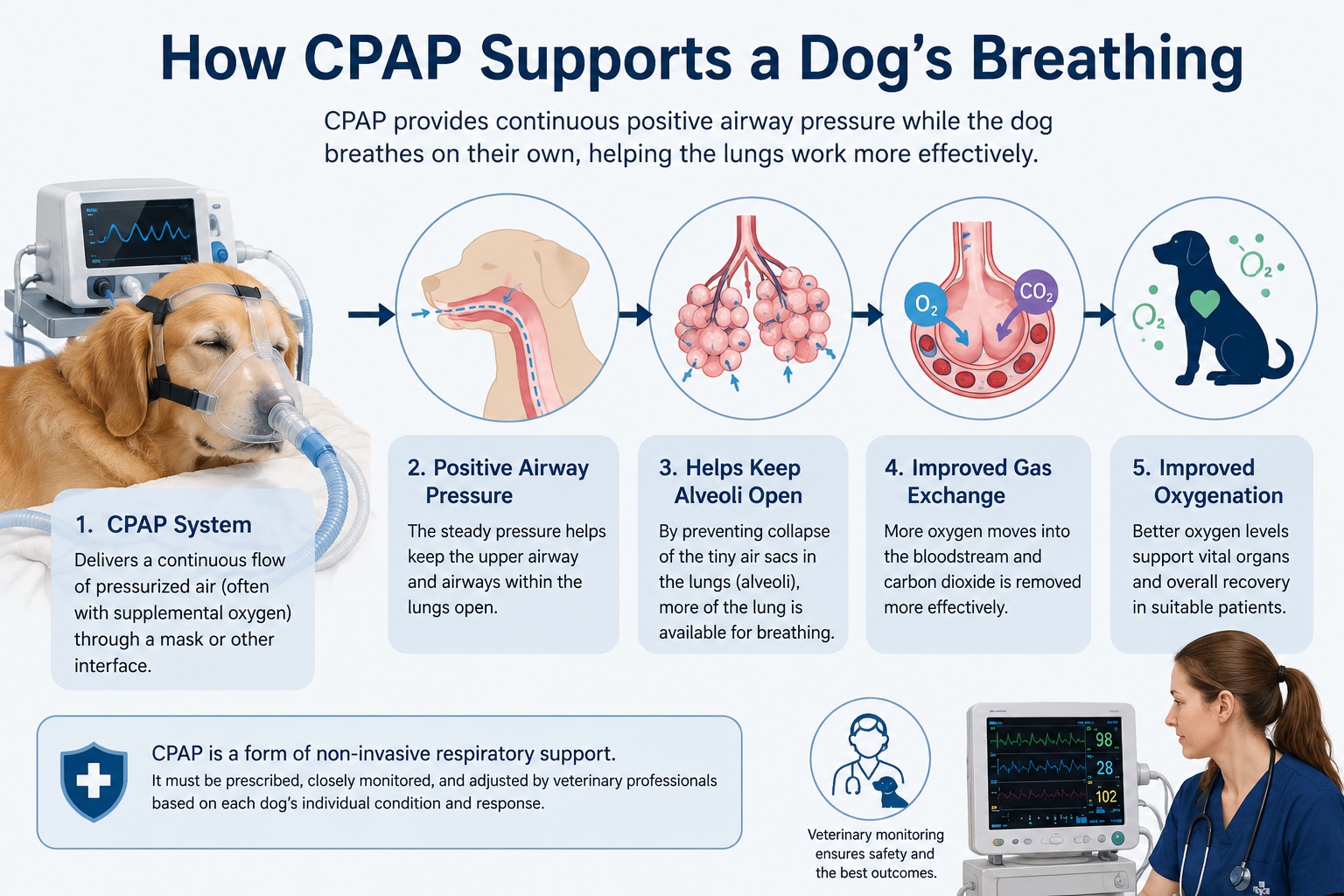
What Does a CPAP Setup for a Dog Look Like?
Veterinary CPAP does not necessarily resemble the familiar bedside machine and nasal mask used by a person with obstructive sleep apnea.
Different methods can be used to create positive airway pressure in veterinary patients.
Depending on the clinical setting and equipment available, a CPAP system may involve:
- A source of pressurized gas
- Supplemental oxygen when required
- Tubing and breathing circuits
- Pressure-control components
- A suitable patient interface
- Equipment for monitoring the dog’s response
The interface is particularly important because human CPAP masks are designed around human facial anatomy.
Dogs have dramatically different head and muzzle shapes. A mask that could potentially fit a Pug would be very different from one required for a Greyhound.
Veterinary researchers have therefore investigated several approaches to delivering non-invasive respiratory support.
Face Masks
A suitably fitted face mask can be placed over a dog’s muzzle to deliver respiratory support.
The mask must fit adequately to minimize air leakage while allowing the dog to breathe safely.
Tolerance can be a challenge.
Unlike a person who understands why a CPAP mask is being worn, a conscious dog may become frightened or attempt to remove an unfamiliar mask. Stress can increase oxygen demand and breathing effort, potentially undermining the purpose of respiratory support.
Helmet CPAP
Researchers have also investigated helmet-based CPAP in dogs.
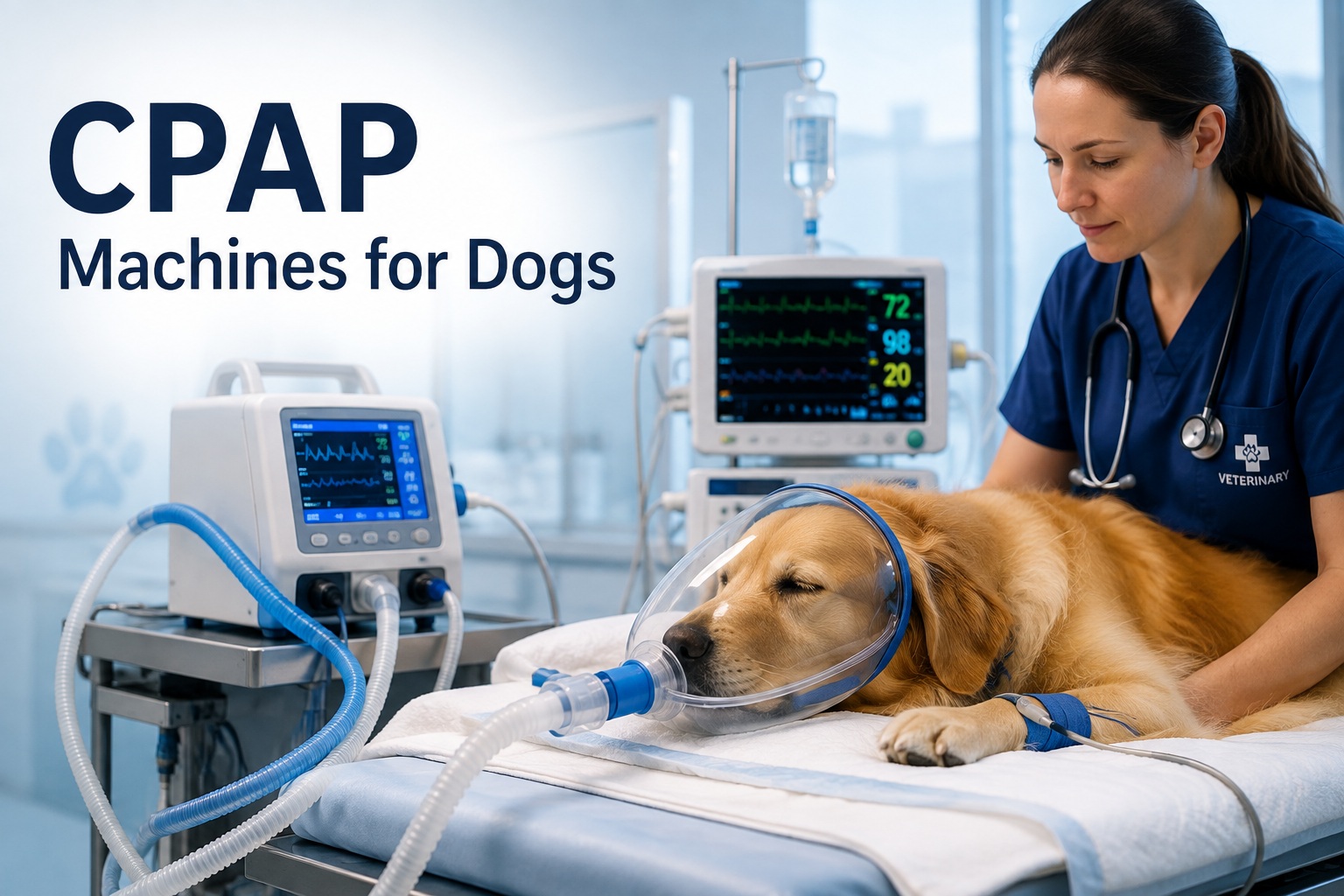
Instead of placing a tight-fitting mask directly over the muzzle, the dog’s head is enclosed within an appropriately designed transparent helmet or hood through which positive airway pressure and oxygen can be delivered.
Helmet CPAP is particularly interesting in veterinary medicine because differences in canine facial anatomy can make conventional mask interfaces difficult.
Research involving brachycephalic dogs recovering from anesthesia has demonstrated that CPAP can be administered through a pediatric helmet system.
This should not be interpreted as evidence that owners can improvise a helmet CPAP system at home. Veterinary CPAP requires appropriate equipment, pressure control and patient monitoring.
Does Veterinary CPAP Include Oxygen?
CPAP and oxygen therapy are related but not the same treatment.
CPAP refers to the application of continuous positive airway pressure.
Supplemental oxygen refers to increasing the concentration of oxygen available for the animal to breathe.
A veterinary CPAP system may deliver an oxygen-enriched gas mixture when the patient requires additional oxygen.
This means a dog receiving CPAP may receive both positive airway pressure and supplemental oxygen simultaneously.
The distinction is important because oxygen alone does not necessarily create the same positive airway pressure produced by CPAP.
Likewise, positive pressure does not eliminate the need for supplemental oxygen when a dog’s blood oxygen level is inadequate.
The veterinarian determines what combination is appropriate for the individual patient.
CPAP vs. Oxygen Therapy for Dogs
Dogs requiring respiratory support do not automatically need CPAP.
Simple supplemental oxygen is commonly used in veterinary medicine and can be delivered in several ways, including an oxygen cage, face mask, nasal catheter or other appropriate delivery system.
The main difference can be summarized as follows:
| Respiratory Support | Main Purpose | Dog Breathes Spontaneously? | Positive Airway Pressure? |
|---|---|---|---|
| Supplemental oxygen | Increase available oxygen | Yes | Usually no |
| CPAP | Maintain continuous positive airway pressure and support oxygenation | Yes | Yes |
| High-flow nasal oxygen | Deliver warmed, humidified oxygen at high flow rates | Yes | May generate some positive airway pressure |
| Mechanical ventilation | Provide controlled respiratory support when spontaneous breathing is inadequate | Not necessarily | Yes |
These treatments are not interchangeable.
The best method depends on the severity and cause of the dog’s respiratory problem.
CPAP vs. High-Flow Nasal Oxygen
High-flow nasal cannula (HFNC) therapy is another form of non-invasive respiratory support increasingly used in veterinary critical care.
With HFNC, warmed and humidified gas containing a controlled concentration of oxygen is delivered through nasal cannulas at relatively high flow rates.
High-flow therapy can improve oxygen delivery and may generate a degree of positive airway pressure, but HFNC is not the same as CPAP.
CPAP is specifically designed to maintain a defined continuous positive airway pressure.
Veterinary researchers have compared these approaches.
A 2026 randomized clinical trial involving dogs with postoperative hypoxemia compared face-mask oxygen, high-flow nasal cannula therapy and CPAP.
All three approaches successfully restored normal oxygenation in the dogs that completed the study. However, CPAP produced normalization of oxygenation more rapidly on average in that particular group of patients.
This does not mean CPAP is always superior.
The appropriate method depends on the individual dog, the severity and cause of hypoxemia, patient tolerance, available equipment, and the veterinarian’s clinical judgment.
CPAP vs. Mechanical Ventilation
CPAP should also be distinguished from mechanical ventilation.
With CPAP, the dog continues to breathe spontaneously. The system maintains positive pressure but does not routinely deliver mandatory breaths in the way a mechanical ventilator can.
Mechanical ventilation provides much more extensive respiratory support.
A dog requiring invasive mechanical ventilation is generally anesthetized or heavily sedated, an endotracheal tube is placed into the airway, and a ventilator assists or controls breathing.
Mechanical ventilation may be necessary when a dog cannot maintain adequate ventilation or oxygenation using less invasive approaches.
CPAP may sometimes offer an intermediate level of respiratory support in appropriately selected patients.
A simplified way to think about the difference is:
Oxygen therapy → increases oxygen availability
CPAP → adds continuous positive airway pressure while the dog breathes
Mechanical ventilation → actively assists or controls ventilation
The actual progression of treatment is not always this simple, and veterinarians choose respiratory support according to the patient’s condition rather than following a fixed sequence.
What Are the Potential Benefits of CPAP for Dogs?
The potential advantages of CPAP depend on why it is being used.
In appropriately selected veterinary patients, possible benefits include:
Improved Oxygenation
Maintaining positive pressure can help improve gas exchange and blood oxygen levels in some dogs.
This is one of the primary reasons CPAP has been investigated for dogs experiencing hypoxemia.
Keeping Alveoli Open
Positive airway pressure can help prevent or reverse collapse of some alveoli.
Keeping more alveoli available for gas exchange can improve the efficiency with which oxygen moves into the bloodstream.
Non-Invasive Respiratory Support
One major attraction of CPAP is that it can potentially provide meaningful respiratory support without placing an endotracheal tube and initiating invasive mechanical ventilation.
Avoiding intubation can have advantages when the patient is an appropriate candidate for non-invasive support.
Maintaining Spontaneous Breathing
The dog continues to breathe on its own while CPAP supports the respiratory system.
Rapid Adjustment
Veterinary staff can evaluate the dog’s response and adjust respiratory support according to clinical measurements and tolerance.
What Are the Limitations of CPAP in Dogs?
Despite its potential benefits, CPAP is not suitable for every dog.
Dogs May Not Tolerate the Interface
A conscious dog may dislike a mask, helmet or other respiratory interface.
Anxiety, struggling and attempts to remove the equipment can make treatment difficult.
Air Leaks Can Reduce Effectiveness
Maintaining appropriate pressure requires an adequately functioning system.
Leaks around a poorly fitting interface can interfere with the pressure being delivered.
This is particularly challenging in dogs because canine head shapes vary enormously between breeds.
CPAP Does Not Treat the Underlying Disease
CPAP provides respiratory support.
It does not, by itself, cure pneumonia, remove an airway obstruction, correct BOAS anatomy, treat heart disease or resolve another underlying cause of respiratory compromise.
Veterinarians must investigate and treat the primary condition alongside respiratory support.
Some Dogs Need More Intensive Support
A severely compromised dog may not be able to maintain adequate spontaneous breathing despite CPAP.
In these circumstances, invasive mechanical ventilation or another intervention may be necessary.
Are There Risks or Side Effects of CPAP in Dogs?
Positive-pressure respiratory support needs to be used carefully.
Potential complications can include:
- Stress or anxiety associated with the interface
- Air leakage
- Discomfort
- Excessive airway pressure
- Effects on blood pressure and circulation
- Gastric distension if air enters the stomach
- Lung injury when inappropriate pressures are applied
- Delayed escalation to mechanical ventilation if an inadequate treatment is continued too long
Positive pressure within the chest can influence cardiovascular function because it can affect blood returning to the heart.
Excessive pressure can also damage lung tissue.
For these reasons, CPAP pressure should not be guessed or copied from the settings prescribed for a human patient.
How Is a Dog Monitored While Receiving CPAP?
Monitoring is a fundamental part of veterinary CPAP.
Veterinary staff need to determine whether respiratory support is actually helping and whether the dog is tolerating it safely.
Depending on the dog’s condition and facility, monitoring may include:
- Respiratory rate
- Respiratory effort
- Heart rate
- Oxygen saturation
- Blood pressure
- Gum and mucous-membrane color
- Level of consciousness
- Patient comfort
- Blood gas measurements when appropriate
Clinicians also watch for deterioration.
If oxygenation or breathing effort does not improve sufficiently—or the dog’s condition worsens—the respiratory-support plan may need to change.
This monitoring requirement is one of the strongest reasons CPAP should not be improvised at home using a person’s machine.
A pressure setting that is appropriate for one patient or condition may be inappropriate for another.
Can I Buy a CPAP Machine for My Dog?
You may find human CPAP machines, masks, oxygen equipment and various respiratory devices for sale online, but that does not mean they are appropriate for treating a dog.
There is currently an important distinction between:
CPAP being a legitimate technique used in veterinary respiratory medicine
and
CPAP being a routine consumer home therapy prescribed to dogs in the same way it is prescribed to people with obstructive sleep apnea.
These are not the same thing.
If your dog has a condition severe enough that you believe CPAP might be necessary, the appropriate first step is veterinary evaluation.
Do not purchase a human machine, estimate pressure settings or construct a homemade mask or helmet system.
Can Dogs Use CPAP at Home?
For the typical pet owner, CPAP should not be considered a DIY home treatment.
Most documented veterinary applications involve controlled clinical settings where professionals can select the interface, regulate pressure and oxygen delivery, and monitor the dog’s response.
There may be unusual cases in which a veterinary specialist develops an individualized respiratory-support plan for a particular animal. If home equipment is ever considered, its use should be specifically prescribed and supervised by the veterinary team.
That is very different from adapting a family member’s CPAP machine for a dog.
Never Use Your Own CPAP Settings for Your Dog
Human CPAP pressure is prescribed according to a person’s particular medical requirements.
Those settings tell us nothing about what would be appropriate or safe for a dog.
Dogs differ enormously in:
- Body size
- Lung capacity
- Airway anatomy
- Skull and muzzle shape
- Respiratory disease
- Oxygen requirements
- Ability to tolerate an interface
A pressure prescribed for a human should therefore never be assumed to be safe for a dog.
If a dog is struggling to breathe, the priority is veterinary assessment—not experimenting with respiratory equipment at home.
Can CPAP Help Dogs With Sleep Apnea?
Potentially, but this needs some context.
Dogs can experience sleep-disordered breathing, including obstructive respiratory events during sleep. Research has found these problems particularly in brachycephalic dogs, such as French Bulldogs, English Bulldogs and Pugs.
However, CPAP is not currently the standard at-home treatment for canine obstructive sleep-disordered breathing in the way it is commonly used for human obstructive sleep apnea.
In dogs, treatment generally focuses on identifying and addressing the cause of airway obstruction.
For a brachycephalic dog with clinically significant brachycephalic obstructive airway syndrome (BOAS), for example, treatment may involve weight management when appropriate and surgical correction of relevant anatomical abnormalities.
Therefore, an owner who notices snoring or apparent pauses in breathing should not assume that buying a CPAP machine is the next step.
The dog needs a veterinary assessment first.
Does My Dog Need a CPAP Machine?
This is ultimately a question for a veterinarian.
CPAP is generally considered a form of respiratory support rather than something owners select based on symptoms alone.
A veterinarian may consider different forms of respiratory support when a dog is experiencing inadequate oxygenation or respiratory compromise.
Depending on the cause and severity, options might include:
- Supplemental oxygen
- High-flow nasal oxygen
- CPAP or another form of non-invasive positive-pressure support
- Invasive mechanical ventilation
The veterinarian will also treat the underlying condition whenever possible.
A dog with pneumonia, for example, requires treatment directed at the disease in addition to any respiratory support that may be necessary. A dog with an anatomical upper-airway obstruction requires a very different approach.
The fact that a dog is breathing noisily does not automatically mean CPAP is needed.
What Should I Do If My Dog Stops Breathing During Sleep?
An occasional change in breathing pattern while sleeping is not enough to diagnose sleep apnea.
However, repeated episodes in which a dog appears unable to breathe, wakes gasping or choking, or shows obvious respiratory effort deserve veterinary attention.
If possible, record a short video of the episode to show your veterinarian—but only when the dog is otherwise stable and recording does not delay care.
Your veterinarian can determine whether the behavior is related to upper-airway obstruction, sleep-disordered breathing or another respiratory problem.
When Breathing Difficulty Is an Emergency
Seek urgent veterinary care if your dog:
- Is struggling to breathe
- Is breathing with pronounced effort
- Cannot settle because it cannot breathe comfortably
- Develops blue, gray or purple gums or tongue
- Collapses
- Becomes severely weak or unresponsive
- Develops sudden severe respiratory distress
- Has significant breathing difficulty following heat exposure or exercise
Do not attempt to manage a respiratory emergency by placing your own CPAP mask on the dog.
How Much Does CPAP for a Dog Cost?
There is no meaningful universal price for “dog CPAP” because veterinary CPAP is generally part of hospital respiratory or critical-care treatment, rather than a standardized consumer product prescribed for routine home use.
The total cost can depend on:
- The reason respiratory support is required
- Length of hospitalization
- Emergency or specialist consultation fees
- Diagnostic testing
- Oxygen requirements
- Monitoring
- Medications
- Treatment of the underlying disease
- Whether intensive care is required
- Whether more advanced ventilation becomes necessary
Costs can also vary substantially between countries and veterinary hospitals.
If your veterinarian recommends advanced respiratory support, ask for an estimate covering both the respiratory therapy and treatment of the underlying condition.
Do All Veterinary Hospitals Offer CPAP?
No.
A general veterinary practice may be able to provide supplemental oxygen but may not have equipment or facilities for more advanced non-invasive respiratory support.
CPAP, high-flow nasal oxygen and mechanical ventilation are more likely to be available through veterinary emergency hospitals, referral centers, university veterinary hospitals and specialist critical-care facilities.
Availability varies considerably.
If advanced respiratory support is necessary, your regular veterinarian may recommend transfer to an appropriately equipped hospital.
Can You Make a Homemade CPAP Machine for a Dog?
You should not attempt to construct a homemade CPAP system for your dog.
Effective CPAP requires more than simply blowing air into a mask or enclosed space.
The system must provide appropriate pressure while allowing safe gas exchange. Clinicians also need to consider oxygen concentration, airflow, leakage, carbon dioxide clearance, patient tolerance and the effect of positive pressure on the lungs and cardiovascular system.
An incorrectly designed system could fail to provide adequate respiratory support or potentially harm the dog.
This is particularly important with enclosed masks, hoods or improvised helmets, where inadequate ventilation could create additional risks.
Veterinary helmet CPAP described in clinical research involves controlled medical equipment and professional monitoring. It should not be recreated using household materials.
Can I Use My CPAP Machine on My Dog in an Emergency?
No.
If your dog develops respiratory distress, do not delay veterinary treatment while trying to adapt your CPAP machine.
The cause may be completely different from the condition for which your CPAP was prescribed.
Potential causes of respiratory distress in dogs include airway obstruction, pneumonia, pulmonary edema, trauma, heat-related illness, pleural disease and numerous other emergencies.
Different conditions require different treatments.
Applying an unfamiliar mask may also cause a distressed dog to panic or struggle, increasing its oxygen requirements.
Contact an emergency veterinarian and arrange prompt transportation instead.
Frequently Asked Questions
Are CPAP machines made specifically for dogs?
CPAP can be administered to dogs using veterinary respiratory equipment and appropriately selected interfaces. However, there is not a widely used consumer “dog CPAP machine” equivalent to the home CPAP systems routinely prescribed to people with obstructive sleep apnea.
Can dogs wear CPAP masks?
Dogs can receive positive-pressure respiratory support through suitable interfaces, including masks. Researchers have also investigated helmet-based CPAP systems. Interface fit and patient tolerance are important considerations, which is one reason veterinary supervision is necessary.
Can I use a human CPAP mask on my dog?
You should not independently use a human CPAP mask or machine on a dog. Human masks are designed for human facial anatomy, and CPAP pressure settings must be appropriate for the individual patient and medical condition.
Is CPAP the same as giving a dog oxygen?
No. Supplemental oxygen increases the concentration of oxygen available to breathe. CPAP maintains continuous positive airway pressure. A CPAP system can also deliver supplemental oxygen when required, so a dog may receive both at the same time.
Is CPAP the same as a ventilator?
No. During CPAP, the dog continues to breathe spontaneously while continuous positive pressure is maintained.
Mechanical ventilation can actively assist or control breathing and is generally used when more extensive respiratory support is necessary.
Can CPAP prevent a dog from needing a ventilator?
In appropriately selected patients, non-invasive respiratory support may sometimes provide sufficient assistance without proceeding immediately to invasive mechanical ventilation.
However, CPAP cannot replace mechanical ventilation when a dog is unable to maintain adequate breathing or oxygenation with non-invasive support.
Veterinary staff must monitor the patient carefully so that escalation of respiratory support is not delayed when it becomes necessary.
Can CPAP help a French Bulldog or Pug breathe?
CPAP can provide respiratory support in certain clinical situations, and veterinary research has specifically investigated positive airway pressure in brachycephalic dogs.
However, CPAP does not permanently correct anatomical abnormalities associated with BOAS.
A French Bulldog, Pug or other brachycephalic dog with chronic breathing problems should be assessed for the underlying airway abnormalities and appropriate long-term treatment.
Can dogs sleep while receiving CPAP?
A dog receiving CPAP may rest or sleep while respiratory support is being provided, depending on the clinical situation and how well the interface is tolerated.
This does not make veterinary CPAP equivalent to routine overnight home CPAP therapy in people.
Do dogs get sleep apnea?
Dogs can experience sleep-disordered breathing, including obstructive respiratory events during sleep. Evidence indicates that brachycephalic dogs and dogs with clinically significant BOAS are particularly susceptible, while excess body weight can also increase risk.
Snoring alone does not establish a diagnosis.
Can a dog use CPAP every night?
Routine nightly home CPAP is not an established standard treatment for dogs comparable to human CPAP therapy.
A dog repeatedly experiencing breathing difficulty during sleep should undergo veterinary evaluation to identify the underlying cause rather than automatically being placed on nightly CPAP.
Is veterinary CPAP safe?
CPAP can be useful when appropriately selected, administered and monitored by veterinary professionals.
Like other forms of positive-pressure respiratory support, however, it is not risk-free. Excessive pressure, poor tolerance, air leakage and effects on the lungs or cardiovascular system are among the issues clinicians must consider.
The Bottom Line
CPAP can be used in dogs, but veterinary CPAP is very different from simply putting a human CPAP machine on a pet.
In veterinary medicine, CPAP is primarily a form of non-invasive respiratory support. It maintains positive airway pressure while the dog continues breathing spontaneously and may help improve oxygenation in appropriately selected patients.
Veterinary studies have evaluated CPAP in dogs with postoperative hypoxemia and in brachycephalic dogs recovering from anesthesia, demonstrating that CPAP has legitimate clinical applications.
However, it is not currently a routine consumer treatment that dog owners should purchase and administer themselves for snoring or suspected sleep apnea.
If your dog has breathing problems, the most important step is identifying the cause.
Never use your own CPAP machine, pressure settings, mask or a homemade CPAP system on your dog unless its use has been specifically prescribed and managed by a veterinarian.
And if your dog is actively struggling to breathe, treat the situation as a veterinary emergency rather than attempting respiratory treatment at home.