Table of Contents
Quick Answer
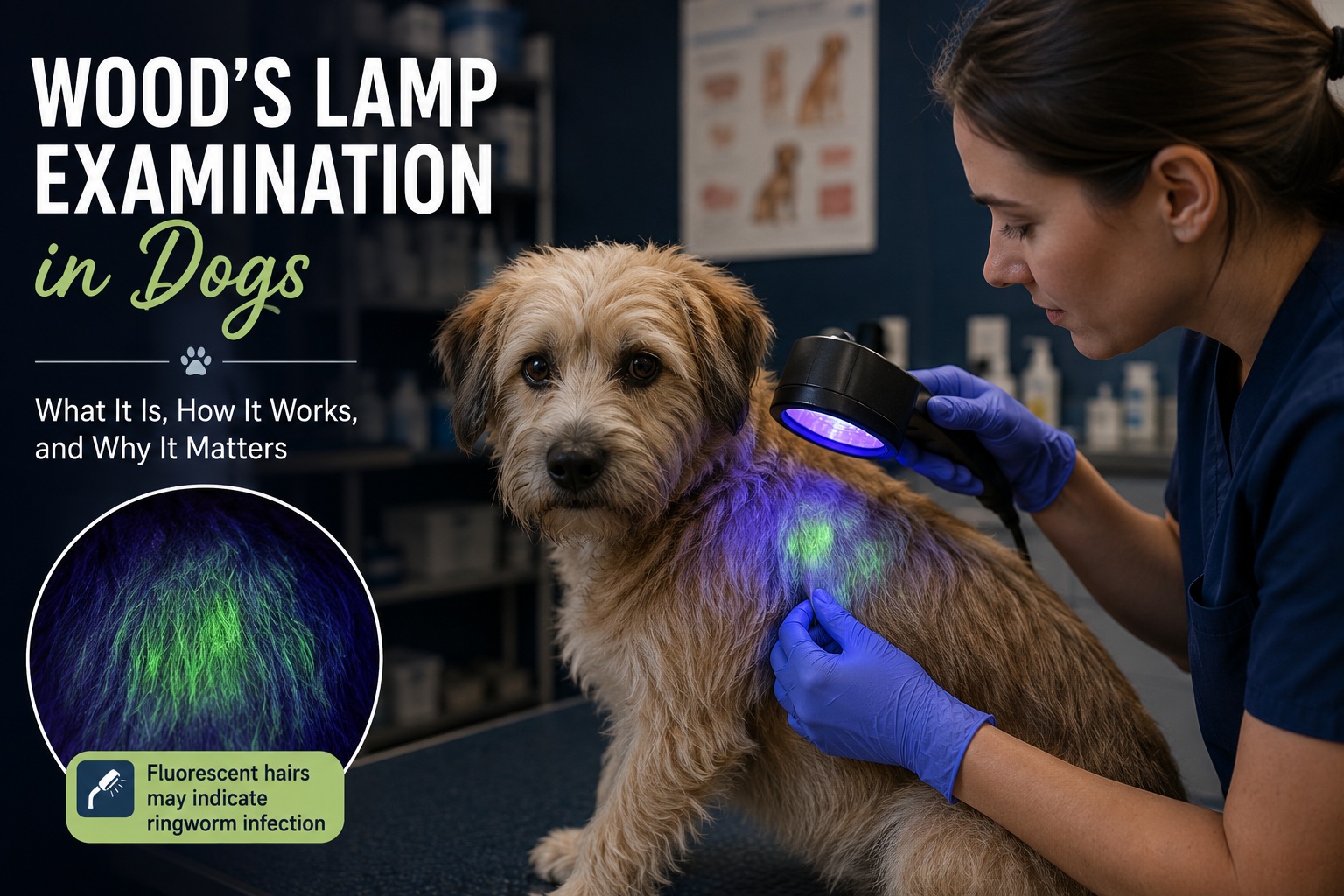
A Wood’s lamp examination is a quick, painless diagnostic test veterinarians use to examine a dog’s skin and coat under a special ultraviolet (UV) light. Certain strains of the fungus that cause ringworm—most notably some Microsporum canis infections—may produce an apple-green fluorescence under the lamp. However, many ringworm infections do not glow, so a Wood’s lamp cannot confirm or rule out the disease by itself. Veterinarians typically use it as a screening tool alongside tests such as fungal culture, PCR, or microscopic examination.
Key Takeaways
- A Wood’s lamp emits long-wave ultraviolet (UV-A) light that helps veterinarians examine the skin and hair.
- The examination is painless, non-invasive, and usually takes less than five minutes.
- Only some ringworm infections fluoresce under a Wood’s lamp, so a negative result does not rule out the disease.
- Fluorescing hairs can help veterinarians collect better samples for fungal culture or PCR testing.
- False-positive fluorescence can occur from certain topical products, fibers, or debris, making professional interpretation important.
- A Wood’s lamp is only one part of diagnosing skin conditions and should be combined with other veterinary tests when necessary.
What Is a Wood’s Lamp?
A Wood’s lamp is a handheld diagnostic device that produces long-wave ultraviolet (UV-A) light, often called a “black light.” In veterinary medicine, it helps veterinarians evaluate the skin, coat, ears, and claws for abnormalities that may not be visible under normal lighting.
Although many pet owners associate a Wood’s lamp exclusively with ringworm, veterinarians use it for several dermatological assessments. The examination can reveal fluorescent hairs, highlight certain skin changes, and help identify the most appropriate areas for additional diagnostic testing.
Unlike X-rays or other imaging techniques, a Wood’s lamp does not look beneath the skin. Instead, it illuminates the surface of the hair and skin, allowing naturally fluorescent materials to become visible in a darkened room.
The examination is:
- Completely non-invasive
- Painless
- Safe for puppies and adult dogs
- Performed without sedation in most cases
- Usually completed within a few minutes
Because the test is so quick, it is often one of the first diagnostic steps when a veterinarian suspects a fungal skin infection.
Why Do Veterinarians Perform a Wood’s Lamp Examination?
Veterinarians may recommend a Wood’s lamp examination whenever a dog develops unexplained skin or coat changes. While the test is most commonly associated with ringworm, it can also help guide the diagnostic process for other dermatological conditions.
A veterinarian may perform the examination if your dog has:
- Circular patches of hair loss
- Red, scaly, or crusty skin
- Broken hairs
- Persistent itching
- Recurrent skin infections
- Lesions affecting the face, ears, paws, or tail
- Skin changes in puppies or shelter dogs, where ringworm is more common
The examination is particularly useful before collecting hair samples for laboratory testing. If fluorescent hairs are present, the veterinarian can target those hairs for fungal culture or PCR, improving the likelihood of obtaining an accurate sample.
A Wood’s lamp may also be used to screen dogs that have been exposed to another infected animal, especially in multi-dog households, breeding kennels, shelters, or rescue organizations where ringworm can spread more easily.
How Does a Wood’s Lamp Work?
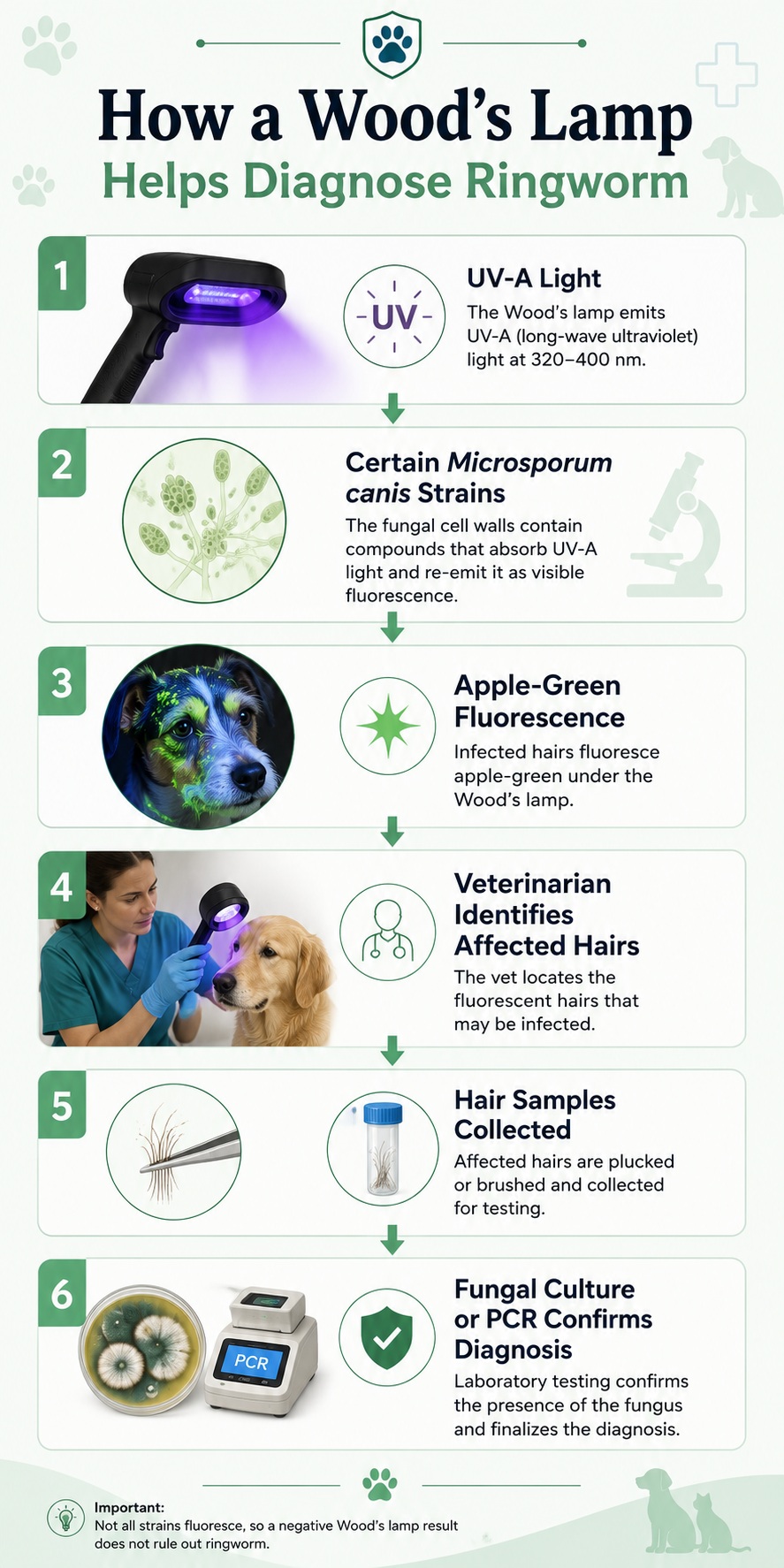
A Wood’s lamp emits ultraviolet-A (UV-A) light with a wavelength that causes certain substances to fluoresce. Fluorescence occurs when a material absorbs ultraviolet light and then emits visible light of a different color.
Some strains of the fungus Microsporum canis produce fluorescent compounds within infected hair shafts. When these hairs are examined under a Wood’s lamp in a dark room, they may glow a distinctive apple-green color.
The process generally works like this:
- The examination room is darkened.
- The veterinarian allows the Wood’s lamp to warm up for optimal performance.
- The dog’s coat is examined slowly section by section.
- If fluorescent hairs are detected, they are carefully collected.
- Those hairs are submitted for additional diagnostic tests such as fungal culture or PCR.
It’s important to understand that the hair shaft, rather than the surrounding skin, is what typically fluoresces. This distinction helps veterinarians identify which hairs are most useful for laboratory testing.
Because many fungal species do not produce fluorescence, the absence of glowing hairs should never be interpreted as proof that a dog does not have ringworm.
Does Ringworm Always Glow Under a Wood’s Lamp?
One of the biggest misconceptions about ringworm is that every infection glows under a Wood’s lamp. In reality, this is not true.
While the examination is a valuable screening tool, only certain strains of the fungus responsible for ringworm produce the characteristic fluorescence. This means a veterinarian cannot diagnose or rule out ringworm based solely on whether the skin or hair glows.
Why Doesn’t Every Ringworm Infection Fluoresce?
Ringworm is not caused by a single organism. Instead, it refers to a group of fungi known as dermatophytes. Different dermatophyte species behave differently under ultraviolet light.
The species most commonly associated with fluorescence is Microsporum canis, which is also the most frequent cause of canine ringworm in many parts of the world. However, even among M. canis infections, not every case will fluoresce.
Other dermatophytes commonly found in dogs, such as:
- Microsporum gypseum
- Trichophyton mentagrophytes
typically do not fluoresce under a Wood’s lamp.
As a result, many infected dogs will have a completely negative Wood’s lamp examination despite having active ringworm.
What Does a Negative Result Mean?
A negative examination simply means that no fluorescence was detected. It does not mean your dog is free from fungal infection.
If your veterinarian still suspects ringworm based on your dog’s symptoms, they will usually recommend additional tests, such as:
- Fungal culture
- PCR testing
- Microscopic examination of hairs (trichography)
- Cytology or skin scrapings when other skin diseases are suspected
This combination of tests provides a much more accurate diagnosis than relying on ultraviolet light alone.
Why Do Veterinarians Still Use It?
Despite its limitations, a Wood’s lamp remains extremely useful because it can:
- Quickly identify potentially infected hairs.
- Help veterinarians collect better-quality samples.
- Reduce unnecessary sampling from healthy areas.
- Provide immediate information during the consultation.
- Assist with monitoring some known ringworm cases during treatment.
Think of it as an effective screening tool, not a stand-alone diagnostic test.
Key Point: A positive Wood’s lamp examination supports the suspicion of ringworm, while a negative examination does not exclude it.
What Color Does Ringworm Glow?
When fluorescence occurs, veterinarians look for a very specific colour.
Healthy hair normally does not produce the characteristic glow associated with ringworm. Instead, infected hairs from certain Microsporum canis infections may emit a bright apple-green or yellowish-green fluorescence.
This glow is produced by fungal metabolites coating the infected hair shaft rather than by the skin itself.
Colours Veterinarians Look For
| Fluorescence Colour | What It May Indicate |
|---|---|
| ✅ Bright apple-green | Characteristic fluorescence seen in some Microsporum canis infections |
| Pale yellow-green | May occasionally be seen but requires further testing |
| Blue | Usually normal fluorescence or environmental contamination |
| Purple or violet | Not considered diagnostic for ringworm |
| White | Hair reflections, lint, or dust rather than fungal infection |
| Orange or red | Usually unrelated to ringworm and may come from topical products or debris |
Because many materials naturally fluoresce under ultraviolet light, veterinarians carefully distinguish true fungal fluorescence from other sources.
False Fluorescence Can Occur
Several substances may glow under UV light without indicating a fungal infection, including:
- Soap residue
- Certain shampoos
- Ointments
- Topical medications
- Lint or fabric fibres
- Dust
- Skin scales
- Plant material
- Household cleaning products
This is another reason why the examination should always be interpreted by a trained veterinarian.
What Happens During a Wood’s Lamp Examination?
A Wood’s lamp examination is one of the quickest and least stressful diagnostic procedures performed in veterinary dermatology. Most dogs tolerate it well because it is completely painless and does not involve needles, clipping, or invasive procedures.
Step 1: Medical History
Your veterinarian will begin by asking questions about your dog’s symptoms, including:
- When the skin lesions first appeared
- Whether your dog is scratching or licking excessively
- Recent exposure to other pets
- Visits to kennels, grooming salons, shelters, or dog parks
- Previous skin treatments or medications
This information helps determine whether ringworm or another skin condition is likely.
Step 2: The Examination Room Is Darkened
To improve visibility, the lights in the examination room are turned off or dimmed.
A darker environment makes faint fluorescence much easier to detect.
Many veterinary Wood’s lamps are also allowed to warm up briefly before use to ensure optimal illumination.
Step 3: The Coat Is Examined
The veterinarian slowly scans your dog’s body using the Wood’s lamp, paying close attention to:
- Face
- Ears
- Around the eyes
- Neck
- Legs
- Paws
- Tail
- Areas of hair loss or scaling
Rather than quickly waving the lamp over the coat, veterinarians inspect each region carefully because fluorescence may only appear in a few infected hairs.
Step 4: Suspicious Hairs Are Collected
If glowing hairs are found, they are gently removed using sterile forceps or a hemostat.
These hairs are then submitted for additional testing, which may include:
- Fungal culture
- PCR testing
- Microscopic examination
Targeting fluorescent hairs increases the likelihood of obtaining a useful diagnostic sample.
Step 5: Additional Tests May Be Recommended
Depending on the findings, your veterinarian may also perform:
- Skin scrapings to check for mites
- Cytology to identify bacteria or yeast
- Tape preparations
- Skin biopsies in unusual or chronic cases
- Blood tests if an underlying disease is suspected
A Wood’s lamp examination is therefore often the beginning of the diagnostic process rather than the final step.
Is the Examination Painful?
No. A Wood’s lamp examination is considered safe, painless, and non-invasive for dogs of all ages.
The ultraviolet light used during the test does not burn the skin or cause discomfort when used appropriately by a veterinarian.
Most dogs simply stand or sit while the veterinarian examines their coat.
The examination is generally suitable for:
- Puppies
- Adult dogs
- Senior dogs
- Pregnant dogs
- Dogs recovering from illness
Sedation is rarely required unless a dog is extremely anxious or cannot be safely handled for any examination.
In most veterinary clinics, the entire Wood’s lamp examination takes less than five minutes, although additional diagnostic tests may extend the appointment if samples need to be collected.
How Accurate Is a Wood’s Lamp Examination?
A Wood’s lamp examination is a valuable screening tool, but it is not considered a definitive diagnostic test for ringworm or other fungal skin infections.
While it can quickly identify hairs that may be infected, it has important limitations. Some infected hairs will not fluoresce at all, while certain substances unrelated to ringworm can produce fluorescence that mimics a positive result.
For this reason, veterinarians almost always interpret the findings alongside your dog’s medical history, physical examination, and laboratory tests.
Advantages of a Wood’s Lamp Examination
A Wood’s lamp offers several practical benefits in a veterinary setting:
- Provides immediate results during the consultation.
- Non-invasive and painless.
- Helps locate hairs that are most suitable for laboratory testing.
- May reduce unnecessary sampling from healthy areas.
- Useful for screening animals in shelters, breeding facilities, and multi-pet households.
- Can assist in monitoring some confirmed ringworm cases during treatment.
Limitations
Despite its usefulness, a Wood’s lamp has several limitations:
- Many ringworm infections do not fluoresce.
- Some fungal species never glow under UV light.
- Dust, lint, topical medications, and skin products can create false-positive fluorescence.
- Recently bathed or medicated dogs may be more difficult to evaluate.
- The examination depends on proper technique and a dark environment.
- A negative result cannot rule out ringworm.
Because of these limitations, veterinarians avoid making treatment decisions based solely on the Wood’s lamp examination.
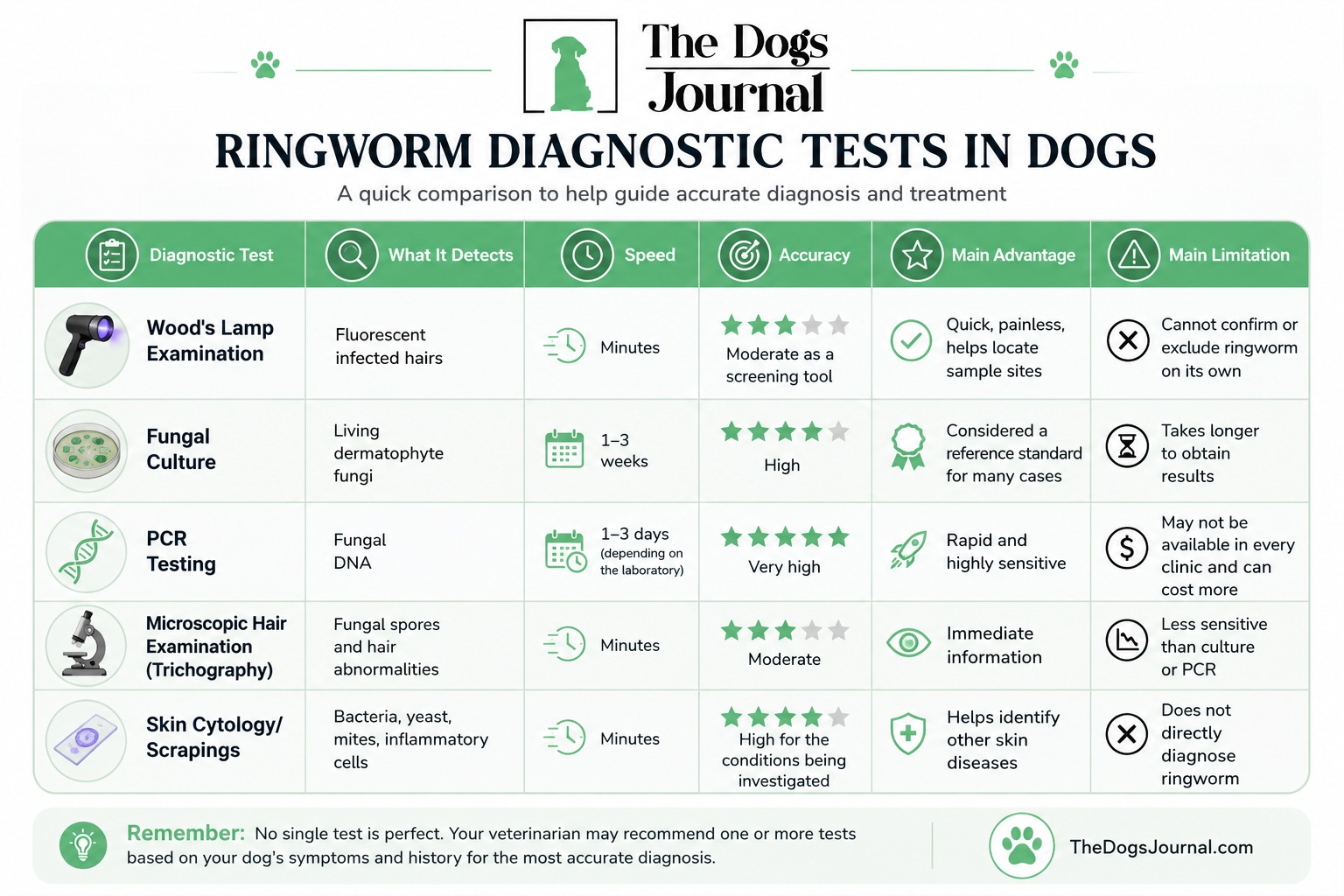
Wood’s Lamp vs. Other Diagnostic Tests
Different tests provide different types of information. In many cases, veterinarians use more than one method to reach a diagnosis.
Which Test Is the Most Accurate?
For most suspected ringworm cases, fungal culture and PCR testing provide the strongest evidence for confirming infection.
The Wood’s lamp plays an important supporting role by helping veterinarians decide where to collect samples, rather than replacing laboratory confirmation.
What Other Conditions Can a Wood’s Lamp Help Detect?
Although a Wood’s lamp is most commonly associated with ringworm, veterinarians may also use it to assist in evaluating other dermatological conditions.
However, it is important to understand that the lamp does not diagnose these conditions by itself. Instead, it provides additional clues that help guide further testing.
A Wood’s lamp may assist with:
Certain Bacterial Skin Infections
Some bacterial organisms or their by-products may fluoresce under ultraviolet light, although this is less common than with ringworm.
If unusual fluorescence is observed, additional diagnostic tests such as cytology or bacterial culture may be recommended.
Coat and Skin Debris
Ultraviolet light can highlight:
- Dead skin flakes
- Crusts
- Greasy deposits
- Dirt
- Plant material
- Fabric fibres
These findings are not diagnostic but may help veterinarians examine affected areas more closely.
Hair Shaft Abnormalities
Examining hairs under UV light can occasionally make broken or damaged hairs easier to identify, helping veterinarians determine where to collect samples for microscopic examination.
Monitoring Confirmed Ringworm Cases
In dogs already diagnosed with certain fluorescent Microsporum canis infections, repeat Wood’s lamp examinations may help monitor whether fluorescent hairs are becoming less common during treatment.
This should always be interpreted alongside laboratory results rather than as proof that the infection has resolved.
What Happens If Your Dog’s Hair Glows?
Seeing glowing hairs under a Wood’s lamp can be alarming, but it does not automatically mean your dog has ringworm.
Instead, fluorescence indicates that further investigation is warranted.
Your veterinarian will usually:
- Identify the fluorescent hairs.
- Collect samples using sterile forceps.
- Submit the hairs for fungal culture or PCR testing.
- Evaluate the results alongside your dog’s clinical signs.
- Develop a treatment plan if ringworm or another condition is confirmed.
If ringworm is diagnosed, treatment may involve:
- Oral antifungal medication.
- Medicated shampoos or rinses.
- Environmental cleaning and disinfection.
- Temporary isolation from other susceptible pets.
- Follow-up examinations to monitor recovery.
Early diagnosis helps reduce the risk of spreading ringworm to other animals and, in some cases, to people.
Can You Buy a Wood’s Lamp for Home Use?
Yes. Wood’s lamps designed for dermatological screening are widely available online, and some pet owners choose to purchase one if their dog has a history of recurrent skin problems.
However, using a Wood’s lamp at home has significant limitations.
Unlike veterinarians, most owners have limited experience distinguishing true fungal fluorescence from harmless reflections or contamination.
Additionally, many commercially available UV flashlights are not equivalent to veterinary-grade Wood’s lamps and may not produce the appropriate wavelength or intensity for reliable screening.
If you’re interested in learning more about your dog’s skin between veterinary visits, a veterinary-style Wood’s lamp can be useful for educational home screening. Keep in mind, however, that it cannot diagnose ringworm on its own, and any suspicious findings should always be evaluated by a veterinarian.
- Rechargeable Portable UV Wood’s Lamp. Check price on Amazon.
When a Home Wood’s Lamp May Be Helpful
A home Wood’s lamp may be useful for:
- Monitoring a dog with a previously diagnosed fluorescent Microsporum canis infection under veterinary guidance.
- Checking whether suspicious hairs appear fluorescent before scheduling a veterinary appointment.
- Examining pet bedding, grooming tools, or surfaces for educational purposes (although this cannot diagnose contamination).
When It Should Not Replace Veterinary Care
A home examination should never replace a professional veterinary evaluation if your dog has:
- Circular patches of hair loss.
- Persistent itching.
- Red or scaly skin.
- Crusts or sores.
- Worsening skin lesions.
- Multiple pets with similar symptoms.
Because false positives and false negatives are common, treatment should never be started or stopped based solely on what you see under a UV light.
How to Prepare Your Dog for a Wood’s Lamp Examination
Fortunately, preparing your dog for a Wood’s lamp examination is simple. Unlike many diagnostic procedures, there is usually no special preparation required.
However, a few precautions can help improve the accuracy of the examination and reduce the chance of misleading results.
Before Your Appointment
If possible:
- Avoid applying creams, ointments, or sprays to the affected area unless instructed by your veterinarian.
- Skip medicated shampoos immediately before the appointment unless your veterinarian has recommended otherwise.
- Don’t trim or shave the affected hair before the examination.
- Bring a list of any medications or skin products your dog is currently using.
- Inform your veterinarian if another pet or person in your household has recently been diagnosed with ringworm.
Does My Dog Need to Fast?
No.
Unlike procedures involving anesthesia or sedation, a Wood’s lamp examination does not require fasting.
Your dog can eat, drink, and take prescribed medications normally unless your veterinarian advises otherwise.
Can I Bathe My Dog Before the Appointment?
In most cases, it’s best not to bathe your dog immediately before the examination.
Certain shampoos, conditioners, or topical treatments may leave residues that fluoresce under ultraviolet light, making interpretation more difficult.
If your dog has already been treated with antifungal products, tell your veterinarian before the examination.
Should Puppies Be Examined Differently?
No.
Wood’s lamp examinations are safe for puppies.
In fact, veterinarians often perform them on puppies because young dogs are more susceptible to dermatophytosis (ringworm), especially if they come from:
- Animal shelters
- Rescue organizations
- Breeding kennels
- Multi-puppy households
Because puppies have close contact with littermates, early screening can help reduce the spread of infection.
Limitations of a Wood’s Lamp Examination
Although a Wood’s lamp is an excellent screening tool, it has important limitations that every dog owner should understand.
Not Every Ringworm Infection Glows
This is the most important limitation.
Many dermatophyte species never fluoresce, and even some infections caused by Microsporum canis may fail to produce the characteristic apple-green glow.
A dog can therefore have ringworm despite a completely normal Wood’s lamp examination.
False-Positive Results Can Occur
Several non-fungal materials may fluoresce under ultraviolet light, including:
- Shampoo residue
- Soap
- Ointments
- Skin creams
- Certain medications
- Carpet fibres
- Cotton fibres
- Dust
- Plant material
- Dried skin flakes
An experienced veterinarian knows how to distinguish these from the characteristic fluorescence seen in infected hairs.
It Cannot Identify the Exact Fungus
Even when fluorescence is present, a Wood’s lamp cannot determine:
- Which fungal species is involved
- How severe the infection is
- Whether the fungus is still alive
- Which medication will be most effective
Laboratory testing is still needed to answer these questions.
Operator Experience Matters
Proper technique is essential.
Veterinarians typically:
- Perform the examination in a dark room.
- Allow the Wood’s lamp to warm up before use.
- Examine the coat slowly rather than scanning quickly.
- Inspect individual hairs rather than just the skin.
Using the lamp incorrectly can increase the likelihood of missing fluorescent hairs.
It Doesn’t Diagnose Every Skin Disease
Many skin conditions cause hair loss, redness, crusting, or itching but will not produce fluorescence.
Examples include:
- Allergic dermatitis
- Flea allergy dermatitis
- Demodectic mange
- Sarcoptic mange
- Bacterial skin infections
- Yeast dermatitis
- Autoimmune skin diseases
- Hormonal disorders such as hypothyroidism or Cushing’s disease
This is why veterinarians often perform several diagnostic tests during the same appointment.
Are There Alternatives to a Wood’s Lamp Examination?
A Wood’s lamp is a useful first-line screening tool, but it is not the only method veterinarians use to investigate skin problems. Depending on your dog’s symptoms, your veterinarian may recommend more advanced diagnostic tests to confirm or rule out ringworm and other skin conditions.
Common Alternatives
| Diagnostic Tool | Primary Purpose | When It's Used |
|---|---|---|
| Fungal Culture | Grows dermatophyte fungi to confirm infection | Considered one of the most reliable methods for diagnosing ringworm |
| PCR Testing | Detects fungal DNA | Provides faster confirmation than culture in many cases |
| Microscopic Hair Examination (Trichography) | Examines hair shafts for fungal spores and damage | Often performed alongside a Wood's lamp examination |
| Skin Cytology | Detects bacteria, yeast, and inflammatory cells | Used when bacterial or yeast infections are suspected |
| Skin Scraping | Identifies mites such as Demodex and Sarcoptes | Recommended for dogs with intense itching or suspected mange |
| Dermatoscopy (Dermoscopy) | Magnified examination of the skin and hair coat | Helps evaluate hair loss, skin lesions, and follicle abnormalities in some cases |
Which Test Is Best?
There is no single “best” test for every skin condition.
A Wood’s lamp is valued because it is quick, painless, and provides immediate information, making it an excellent screening tool during the initial examination. However, if your veterinarian suspects ringworm despite a negative Wood’s lamp examination—or needs to confirm a diagnosis—they may recommend fungal culture, PCR testing, or microscopic examination.
For other skin diseases, such as mange, bacterial infections, allergies, or hormonal disorders, different diagnostic tests are often more appropriate.
Takeaway: A Wood’s lamp is an important part of the diagnostic process, but it works best when combined with other veterinary tests rather than used on its own.
Frequently Asked Questions
Can a Wood’s lamp diagnose ringworm by itself?
No.
A Wood’s lamp can only identify fluorescence that may be associated with certain ringworm infections. Because many infections do not fluoresce, veterinarians usually confirm the diagnosis with fungal culture, PCR testing, or microscopic examination.
How long does a Wood’s lamp examination take?
The examination itself usually takes less than five minutes.
If additional tests are performed, such as collecting hairs for fungal culture or PCR, the appointment may take a little longer.
Is a Wood’s lamp examination safe for puppies?
Yes.
The procedure is painless, non-invasive, and generally safe for puppies, adult dogs, and senior dogs when performed by a veterinarian.
Can humans catch ringworm from an infected dog?
Yes.
Ringworm is a zoonotic disease, meaning it can spread between animals and people.
Children, older adults, and individuals with weakened immune systems may be more susceptible.
If your dog is diagnosed with ringworm, follow your veterinarian’s recommendations regarding hygiene, environmental cleaning, and limiting close contact until the infection is under control. Learn more about the spread of ringworms at the CDC’s guide about Ringworm Prevention.
Can a regular black light replace a veterinary Wood’s lamp?
Not reliably.
Many consumer black lights produce different wavelengths or lower-quality illumination than veterinary-grade Wood’s lamps.
Even with the correct equipment, interpreting fluorescence requires experience, so a home examination should never replace veterinary diagnosis.
Will my dog need more tests after a Wood’s lamp examination?
Possibly.
If ringworm is suspected, your veterinarian may recommend:
- Fungal culture
- PCR testing
- Microscopic examination of hairs
- Skin cytology
- Skin scrapings
- Additional blood work if another underlying condition is suspected
These tests help determine the exact cause of your dog’s skin problem and guide appropriate treatment.
Conclusion
A Wood’s lamp examination is a fast, safe, and valuable screening tool that helps veterinarians evaluate dogs with suspected fungal skin infections, particularly ringworm. By using ultraviolet light to identify fluorescent hairs, the test can guide sample collection and provide immediate information during a consultation.
However, it’s important to remember that a Wood’s lamp is not a stand-alone diagnostic test. Many ringworm infections do not fluoresce, while some non-fungal materials can create misleading fluorescence. For this reason, veterinarians often combine the examination with fungal culture, PCR testing, or microscopic evaluation to reach a definitive diagnosis.
If your dog develops unexplained hair loss, circular skin lesions, scaling, or persistent itching, schedule a veterinary examination promptly. Early diagnosis not only improves the chances of successful treatment but also helps reduce the risk of spreading contagious skin diseases to other pets and, in the case of ringworm, to people.