

Choosing the right hidden dog fence is an important decision for any pet owner who wants to give their dog more freedom while keeping them safely contained. Two of the most recognized brands in the industry are DogWatch and Invisible Fence, both of which offer professionally installed underground containment systems designed to create secure boundaries without traditional fencing.
At first glance, the two systems appear very similar. Both rely on underground boundary wires, receiver collars, and structured training programs to teach dogs where they can safely roam. However, they differ in several important areas, including battery life, collar features, user controls, warranty options, dealer support, pricing, and long-term ownership costs.
In this comprehensive comparison, we’ll examine how DogWatch and Invisible Fence perform in real-world situations, discuss their strengths and limitations, compare their key features, and help you determine which system is the better choice for your home, property, and dog.
Table of Contents
Quick Answer
Both DogWatch and Invisible Fence are reputable hidden fence systems that can effectively contain dogs when professionally installed and paired with consistent training. DogWatch is often favored for its user-adjustable receiver settings and long battery life on many models, while Invisible Fence is known for its extensive dealer network and structured professional installation and training. The better choice depends on your property, your dog’s temperament, the features you value, and the quality of local dealer support.
DogWatch vs Invisible Fence at a Glance
| Feature | DogWatch | Invisible Fence |
|---|---|---|
| Installation | Professional | Professional |
| Underground Wired System | ✅ | ✅ |
| GPS-Based | ❌ | ❌ |
| User Adjustable Collar | ✅ On many models | Usually dealer adjusted |
| Waterproof Receiver | ✅ | ✅ |
| Multiple Dog Support | ✅ | ✅ |
| Professional Training | Usually Included | Usually Included |
| Battery Life | Often longer depending on model | Varies by model |
| Indoor Boundary Options | ✅ | ✅ |
| Dealer Network | Extensive | Extensive |
| Mobile App | Limited (model dependent) | Limited (model dependent) |
Comparison Summary
| Category | Winner |
|---|---|
| Ease of Adjustment | DogWatch |
| Dealer Availability | Tie |
| Battery Life | DogWatch (many models) |
| Professional Training | Tie |
| Multi-Dog Homes | Tie |
| Indoor Avoidance Zones | Tie |
| Brand Reputation | Tie |
| Long-Term Reliability | Tie |
Neither system is objectively better for every owner. The most suitable option often depends on your dog’s personality, your property’s layout, and the level of ongoing support provided by your local dealer.
What is DogWatch?
DogWatch is a professionally installed hidden dog fence system that has been protecting pets for decades. The company specializes in underground electronic containment systems that use a buried wire to establish a customizable boundary around a property.
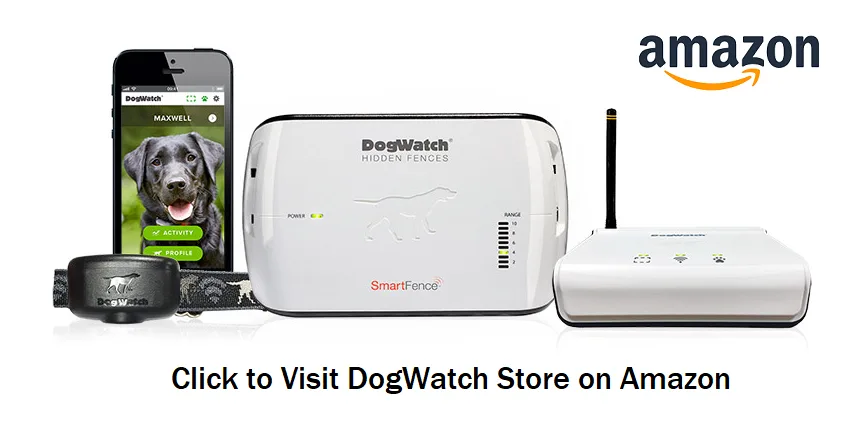
When the dog approaches the boundary, the receiver collar first emits an audible warning. If the dog continues toward the boundary, the collar delivers a correction designed to discourage crossing. The correction level is selected during setup and reinforced through structured training.
DogWatch systems are commonly chosen by homeowners who want:
- A clean, invisible alternative to traditional fencing
- Customizable boundary layouts
- Long battery life on compatible collars
- Professional installation
- Indoor avoidance zones for off-limit areas
One feature often highlighted by DogWatch is that many of its receiver collars allow owners to adjust settings without requiring a dealer visit, although available features vary by model.
What is Invisible Fence?
Invisible Fence is another well-established brand in the electronic pet containment industry. Like DogWatch, it uses an underground wire and receiver collar to establish a virtual boundary around the property.
Invisible Fence places a strong emphasis on professional installation, customized boundary design, and structured owner education. Many dealerships include supervised training sessions to help dogs learn the system safely and confidently.
Depending on the system selected, Invisible Fence products may also offer:
- Indoor boundary transmitters
- Multi-pet compatibility
- Waterproof receiver collars
- Different correction levels
- Boundary customization for complex properties
Many adjustments and service tasks are handled through the local dealer, which some owners appreciate because it provides ongoing professional support.
How Do Hidden Dog Fences Work?
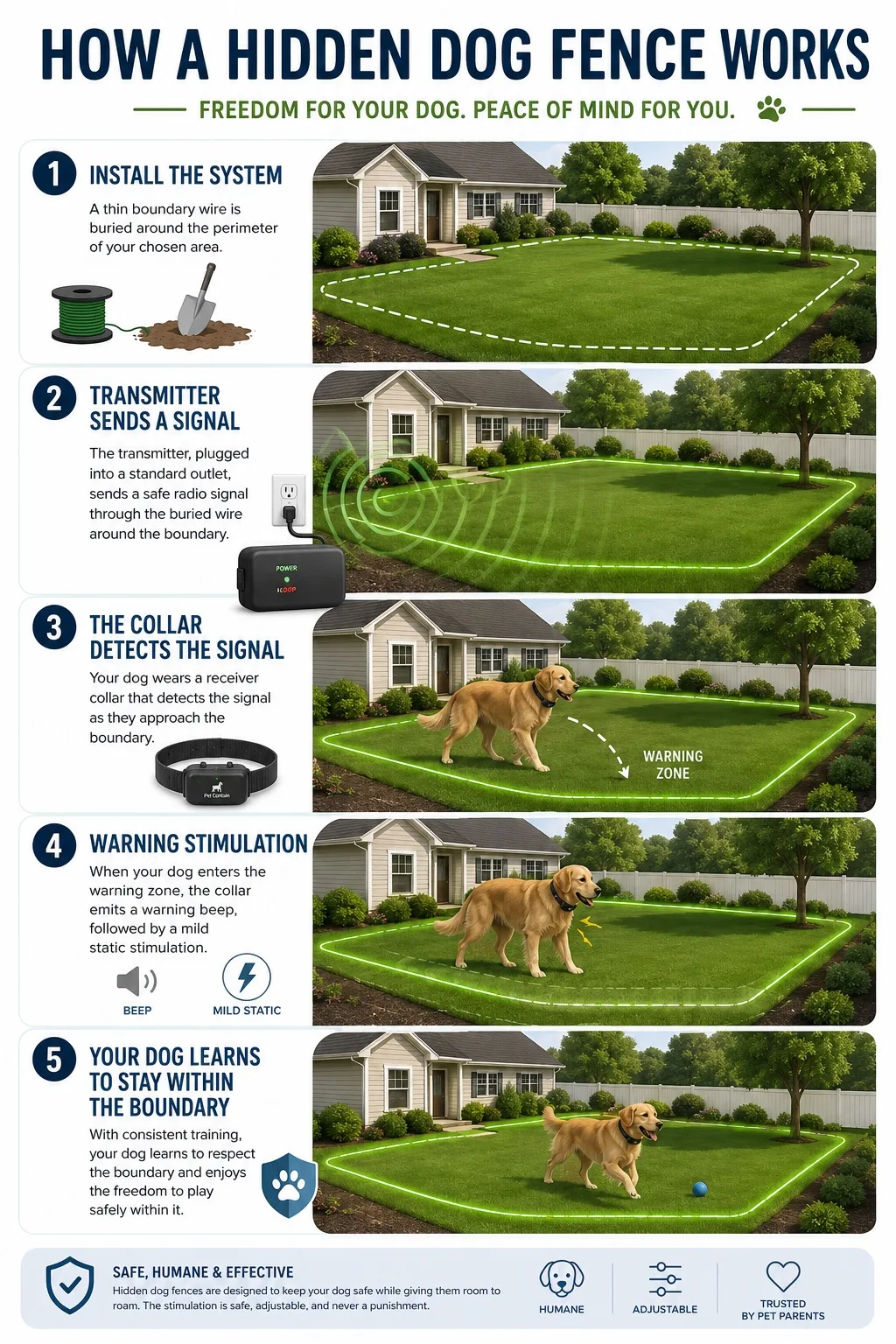
Despite differences between brands, both systems operate using the same basic principle.
Step 1: Boundary Installation
A wire is buried around the perimeter of the property or installed along an existing fence line. This wire creates the invisible boundary.
Step 2: Signal Transmission
A transmitter sends a radio signal through the underground wire.
Step 3: Receiver Collar
The dog wears a lightweight receiver collar that detects the boundary signal as the dog approaches it.
Step 4: Warning Zone
As the dog nears the boundary, the collar typically emits an audible tone or vibration, depending on the model.
Step 5: Correction Zone
If the dog continues beyond the warning area, the collar delivers a static correction designed to interrupt the behavior. The intensity is determined during setup and training.
Step 6: Training Reinforcement
Over time, most dogs learn to associate the warning signal with the boundary and turn back before entering the correction zone.
The effectiveness of either system depends not only on the equipment but also on consistent training, positive reinforcement, and owner supervision, especially during the initial learning period.
Similarities Between DogWatch and Invisible Fence
Although owners often compare these brands as competitors, they share many core characteristics.
Both systems:
- Use professionally installed underground boundary wires
- Create customizable containment areas
- Offer waterproof receiver collars
- Support multiple dogs on a single property
- Include audible warning zones before correction
- Can create indoor avoidance areas
- Require structured training for the best results
- Are designed for long-term residential use
For many homeowners, both systems are capable of providing reliable containment when properly installed and maintained.
Key Differences
While the systems are similar in concept, several practical differences may influence your buying decision.
DogWatch
- User-adjustable settings on many receiver collars
- Long battery life on several models
- Greater owner control over some features
- Batteries are often owner-replaceable
Invisible Fence
- Strong emphasis on dealer-managed setup and adjustments
- Comprehensive professional training programs
- Wide dealer support network
- Many owners prefer the ongoing professional assistance
Neither approach is inherently better. Some owners appreciate the flexibility of making adjustments themselves, while others prefer having a trained technician manage system settings and maintenance.
Detailed Feature Comparison
Although DogWatch and Invisible Fence use similar technology, the differences become more noticeable when you compare their features side by side. Factors such as installation, receiver collars, battery life, training, and ease of ownership can significantly influence your long-term satisfaction.
Installation Process
Both DogWatch and Invisible Fence are designed as professionally installed systems. A trained dealer typically visits your property, discusses your containment goals, and designs a custom boundary that suits your landscape.
The boundary wire can usually be installed:
- Around the perimeter of your property
- Along existing fences
- Around gardens or swimming pools
- To exclude specific outdoor areas
- Around driveways or landscaping features
The installation process generally includes:
- Property assessment
- Boundary design
- Wire installation
- Transmitter setup
- Collar fitting
- Initial owner education
- Dog training instructions
DogWatch
Many DogWatch dealers bury the wire using specialized equipment that minimizes lawn disruption. Installation time depends on property size and complexity.
Invisible Fence
Invisible Fence dealers follow a similar process and often include a structured training program as part of the installation package.
Verdict
🏆 Tie
The overall installation experience depends more on the expertise and service quality of your local dealer than on the brand itself.
Receiver Collar Comparison
The receiver collar is the most important part of any hidden fence system because it communicates with your dog whenever it approaches the boundary.
A good receiver should be:
- Lightweight
- Comfortable
- Waterproof
- Durable
- Adjustable
- Reliable
DogWatch Receiver Collars
Many DogWatch receiver collars offer:
- Multiple correction levels
- Audible warning
- Waterproof construction
- Replaceable batteries
- User-adjustable settings on compatible models
Some owners appreciate being able to adjust certain settings without scheduling a dealer visit.
Invisible Fence Receiver Collars
Invisible Fence collars generally include:
- Audible warning tones
- Waterproof construction
- Multiple correction levels
- Professional fitting and setup
- Dealer-managed programming on many systems
This approach may appeal to owners who prefer ongoing professional support rather than making adjustments themselves.
Verdict
🏆 DogWatch (Slight Edge)
For owners who value greater control over compatible receiver settings, DogWatch often has an advantage. However, those who prefer dealer assistance may appreciate Invisible Fence’s approach.
Tip: Also use GPS dog collars for extra peace of mind. Check out some of the best GPS dog collars on Amazon.
Battery Life
Battery life affects both convenience and long-term ownership costs.
DogWatch
Many DogWatch collars are known for long battery life, with some compatible models operating for up to two years before replacement is needed.
Invisible Fence
Battery life varies depending on the collar model, but many systems require battery replacement more frequently, often every few months.
Always check the specifications of the exact model offered by your local dealer.
Verdict
🏆 DogWatch
Longer battery life can reduce maintenance and replacement costs over time.
Boundary Accuracy
Both systems use underground wired technology rather than GPS.
This offers several advantages:
- Stable boundary lines
- Reliable performance
- Consistent correction zones
- Less dependence on satellite signals
- No GPS drift
Unlike GPS-based fences, underground systems generally provide precise boundaries once professionally installed.
Verdict
🏆 Tie
Both systems provide excellent boundary accuracy when installed correctly.
Correction Levels
Every dog has a different personality and sensitivity level.
An effective containment system should allow correction settings to be tailored to the individual dog.
Both brands generally provide:
- Audible warning
- Multiple static correction levels
- Progressive training approach
- Adjustable sensitivity
The goal is not punishment but communication, helping the dog understand where the boundary is located.
Owners should always begin with the lowest effective correction level and follow the training program provided by the installer.
Verdict
🏆 Tie
Both systems offer sufficient flexibility for most dogs.
Waterproof Performance
Since dogs play in rain, mud, and wet grass, waterproof collars are essential.
Both DogWatch and Invisible Fence offer waterproof receiver collars suitable for everyday outdoor use.
They generally withstand:
- Rain
- Wet grass
- Snow
- Mud
- Puddles
However, owners should always follow the manufacturer’s recommendations regarding swimming or prolonged water exposure, as water-resistance ratings can vary by model.
Verdict
🏆 Tie
Multi-Dog Homes
Many households own more than one dog.
Fortunately, both systems can usually accommodate multiple dogs using a single boundary wire.
Each dog wears its own receiver collar, and settings can often be customized for each pet.
Benefits include:
- Shared boundary
- Individual collar programming
- Cost savings compared with separate systems
Verdict
🏆 Tie
Both brands perform well in multi-dog households.
Indoor Avoidance Zones
Many owners don’t realize that hidden fence technology can also be used inside the home.
Optional indoor transmitters can help keep dogs away from:
- Trash cans
- Kitchen counters
- Fireplaces
- Baby cribs
- Home offices
- Holiday decorations
- Furniture
- Pet food areas
Availability depends on the specific product package offered by your dealer.
Verdict
🏆 Tie
Training Process
Even the best hidden fence system will not work effectively without proper training.
Neither DogWatch nor Invisible Fence is designed as a “plug-and-play” solution.
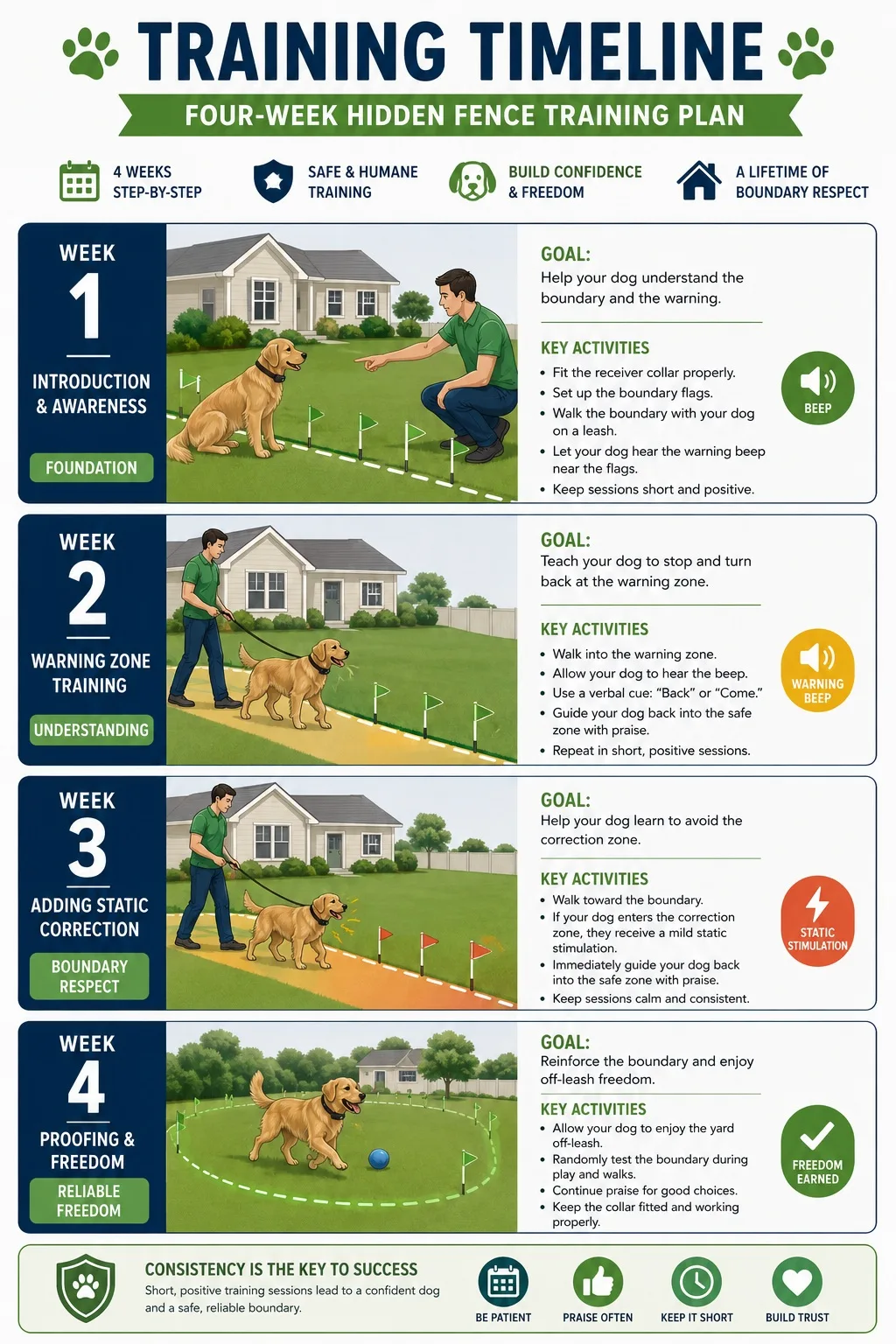
Most dogs require several weeks of consistent training before they fully understand the invisible boundary.
A typical training program includes:
Week 1
- Introduce boundary flags
- Teach warning tone recognition
- Reward turning away from the boundary
Week 2
- Supervised leash training – view long training leash on Amazon
- Gradually increase distractions
- Reinforce desired behavior
Week 3
- Longer supervised off-leash sessions
- Continue positive reinforcement
- Reduce reliance on visual flags
Week 4
- Test reliability under controlled conditions
- Continue occasional refresher sessions
Many dealers for both brands include professional guidance during this process.
Verdict
🏆 Tie
The quality of training depends more on the owner’s consistency and the local dealer than on the equipment itself.
Reliability
Both DogWatch and Invisible Fence have been on the market for decades and have established reputations for dependable wired containment systems.
Reliability is influenced by factors such as:
- Proper installation
- Routine maintenance
- Battery replacement
- Wire integrity
- Correct collar fit
Regular system checks and prompt repairs help ensure continued performance.
Verdict
🏆 Tie
Feature Comparison Scorecard
| Category | Winner |
|---|---|
| Installation | Tie |
| Collar Features | DogWatch |
| Battery Life | DogWatch |
| Boundary Accuracy | Tie |
| Waterproof Design | Tie |
| Multi-Dog Support | Tie |
| Indoor Avoidance | Tie |
| Training | Tie |
| Reliability | Tie |
Cost Comparison
For many buyers, price is just as important as features. However, comparing DogWatch and Invisible Fence isn’t always straightforward because both systems are sold through local dealers rather than at a fixed nationwide price.
The final cost depends on several factors, including:
- Property size
- Boundary length
- Number of dogs
- Receiver collar model
- Indoor avoidance zones
- Installation complexity
- Dealer pricing in your area
For this reason, it’s usually best to request quotes from local dealers for both brands before making a decision.
Typical Initial Costs
| Expense | DogWatch | Invisible Fence |
|---|---|---|
| Professional Installation | Varies | Varies |
| Boundary Wire | Included in most installations | Included in most installations |
| Receiver Collar | Included with system | Included with system |
| Additional Dog Collar | Extra cost | Extra cost |
| Indoor Avoidance Transmitters | Optional | Optional |
Rather than choosing based on the lowest quote, consider the overall value, including warranty, training, support, and future maintenance.
Long-Term Ownership Costs
The purchase price is only part of the total investment.
Over the life of the system, you may also pay for:
- Replacement batteries
- Additional receiver collars
- Wire repairs
- Service calls
- Replacement transmitters (if needed)
- System upgrades
- Training refreshers
Although these costs are usually modest compared to the initial installation, they are worth considering if you plan to use the system for many years.
Warranty
Warranty coverage varies by both brand and dealer, so it’s important to review the details before purchasing.
Questions to ask include:
- How long is the equipment warranty?
- Is labor covered?
- Are batteries included?
- Does the warranty transfer if you move?
- What happens if the boundary wire is accidentally damaged?
- Are lightning-related issues covered?
Some dealers also offer extended service plans or maintenance packages.
Tip: Compare the dealer’s reputation and after-sales support—not just the warranty length.
Customer Support and Dealer Network
Unlike many consumer electronics, hidden fence systems rely heavily on local dealer support.
A knowledgeable dealer can help with:
- Property planning
- Installation
- Initial training
- Collar adjustments
- Troubleshooting
- Future upgrades
- Replacement parts
Both DogWatch and Invisible Fence have established dealer networks, but coverage and service quality vary by location.
Before purchasing, consider:
- Dealer reviews
- Years in business
- Response time
- Availability of emergency repairs
- Ongoing customer support
A highly rated local dealer may provide a better overall experience than simply choosing one brand over the other.
Ease of Maintenance
Hidden fence systems require relatively little maintenance, but a few routine tasks help ensure reliable performance.
- Regular Maintenance Checklist
- Replace collar batteries as recommended.
- Check the receiver collar for damage or wear.
- Test the system periodically using the manufacturer’s instructions.
- Keep vegetation trimmed around above-ground equipment.
- Inspect boundary flags during the training period.
- Contact your dealer if the system indicates a wire break or malfunction.
Routine maintenance takes only a few minutes and can help prevent unexpected issues.
Hidden Fence vs. Traditional Fence
Many homeowners wonder whether an invisible fence is better than a physical fence.
| Feature | Hidden Fence | Traditional Fence |
|---|---|---|
| Preserves the view | ✅ Yes | ❌ No |
| Property appearance | Minimal visual impact | Visible structure |
| Installation cost | Often lower for large properties* | Can be higher, depending on materials |
| Keeps your dog contained | ✅ Usually, with proper training | ✅ Yes |
| Keeps stray animals out | ❌ No | ✅ Usually |
| Privacy | ❌ No | ✅ Yes |
| Requires dog training | ✅ Yes | Minimal |
*Costs vary significantly depending on property size, terrain, local labor rates, and fencing materials.
Which Is Better?
A traditional fence provides a physical barrier that can keep both your dog in and unwanted animals out.
A hidden fence offers greater aesthetic appeal and may be a practical solution where installing a physical fence is impractical or restricted.
Some owners even combine both systems for added peace of mind.
Hidden Fence vs. GPS Dog Fence
GPS dog fences have become increasingly popular, but they operate differently from wired systems.
| Feature | Wired Hidden Fence | GPS Fence |
|---|---|---|
| Boundary Accuracy | Very precise | Can vary with satellite conditions |
| Installation | Professional | Usually self-installed |
| Property Changes | Requires wire changes | Easily adjusted in an app |
| Large Properties | Excellent | Excellent |
| Small Yards | Excellent | May be less suitable |
| Subscription Fees | Usually none | Often required |
Choose a Wired Fence If You:
- Want a permanent boundary
- Have a defined property line
- Prefer consistent boundary accuracy
- Don’t want to rely on GPS signals
Choose a GPS Fence If You:
- Travel frequently with your dog
- Need portable containment
- Have multiple properties
- Want to create virtual boundaries without burying wire
Which Dogs Are Good Candidates?
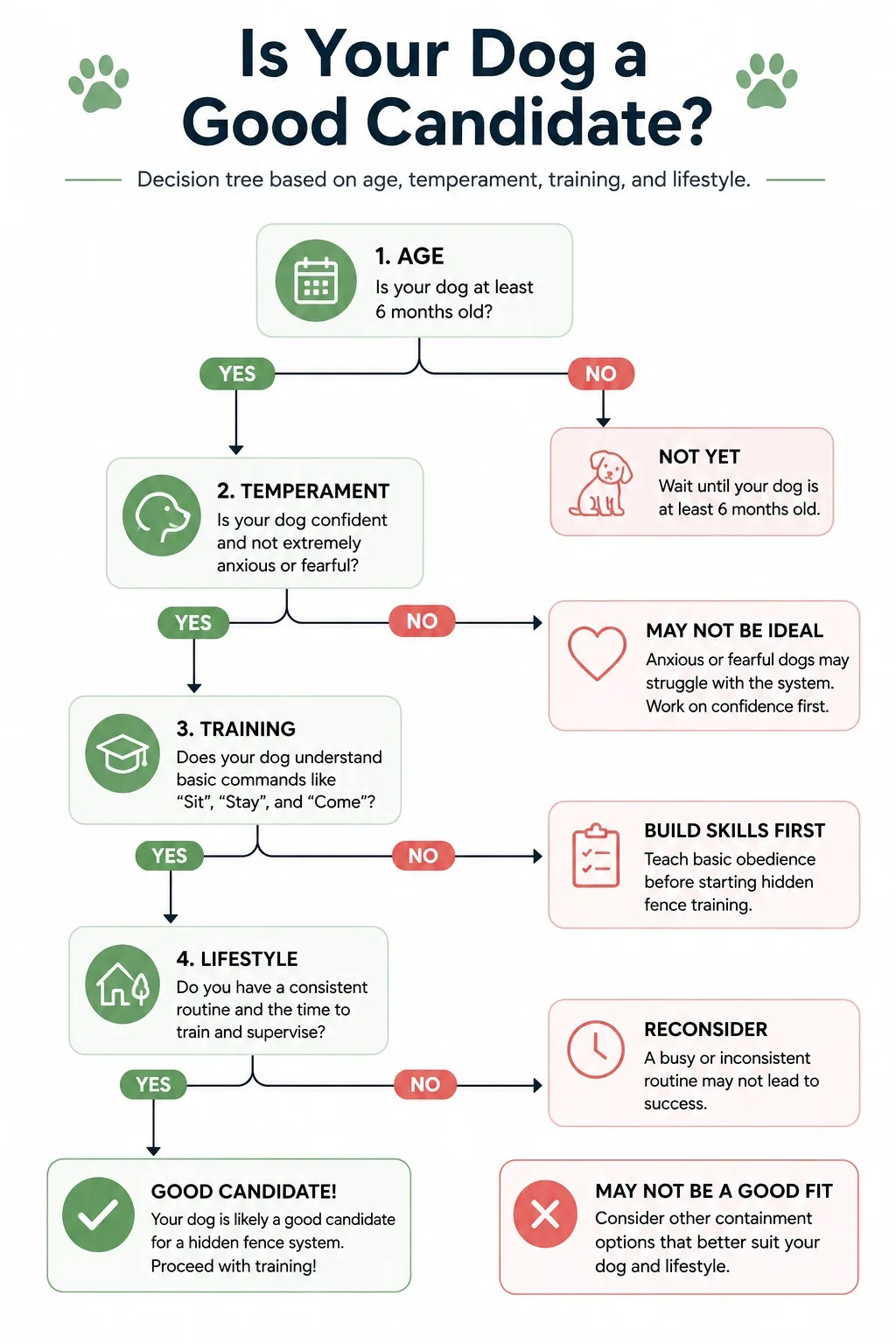
Hidden fences work best for dogs that are:
- Healthy and physically active
- Comfortable learning through structured training
- Motivated by rewards
- At least the minimum age recommended by the manufacturer or trainer
- Living in a stable home environment
They are generally less suitable for:
- Very young puppies still learning basic obedience
- Dogs with severe anxiety or extreme fearfulness
- Dogs with a history of escaping due to intense prey drive
- Dogs with certain medical or behavioral conditions unless advised by a veterinarian or qualified trainer
A professional trainer or veterinarian can help determine whether a hidden fence is appropriate for your individual dog.
Is a Hidden Fence Safe?
When installed correctly and paired with consistent, humane training, hidden fence systems can be an effective containment option for many dogs.
However, they are not a substitute for responsible supervision.
Owners should remember that:
- Training is essential.
- No containment system is completely escape-proof.
- Hidden fences do not prevent people, wildlife, or other dogs from entering your property.
- Regular maintenance helps ensure reliable operation.
The safest approach is to use the system as one part of an overall responsible pet management plan.
Pros and Cons
Both DogWatch and Invisible Fence have earned strong reputations over the years, but neither system is perfect. Understanding their strengths and limitations can help you choose the one that best fits your property, your dog, and your budget.
DogWatch Pros and Cons
Pros
- User-adjustable receiver settings on many compatible models
- Long battery life on several receiver collars
Professionally installed for accurate boundary placement - Waterproof collars suitable for everyday outdoor use
- Supports multiple dogs on one system
- Indoor avoidance transmitters available
- Strong reputation for reliability
- Suitable for properties of various sizes
Cons
- Professional installation is required
- Initial cost may be higher than DIY systems
- Feature availability varies by model
- Dealer quality differs by location
- Requires ongoing training and maintenance
Invisible Fence Pros and Cons
Pros
- Well-established brand with decades of experience
- Extensive dealer network in many regions
- Professional installation and customized boundary design
- Structured training programs are often included
- Waterproof receiver collars
- Supports multiple dogs
- Indoor avoidance options available
Cons
- Many collar adjustments require dealer assistance
- Battery replacement frequency varies by model
- Professional installation increases upfront cost
- Performance depends heavily on local dealer support
- Like all hidden fences, it does not prevent outside animals from entering your property
Who Should Choose DogWatch?
DogWatch may be the better option if you:
- Prefer greater control over compatible receiver settings
- Value longer battery life
- Like handling routine adjustments yourself
- Want fewer dealer visits for compatible models
- Have a large property requiring customized boundaries
Who Should Choose Invisible Fence?
Invisible Fence may be a better fit if you:
- Prefer a professionally managed setup
- Want ongoing dealer support
- Value structured training assistance
- Feel more comfortable having technicians make adjustments
- Have an experienced, highly rated local Invisible Fence dealer
Alternatives to DogWatch and Invisible Fence
If neither system seems like the right fit, several other containment options are worth considering.
GPS Dog Fences
GPS-based systems create virtual boundaries without underground wires, making them popular for travelers, large rural properties, or owners with multiple locations.
Potential advantages include:
- Portable virtual boundaries
- No buried wire
- App-based management on many models
- Easy boundary adjustments
Potential drawbacks include:
- GPS accuracy can vary with terrain and satellite conditions.
- Some systems require ongoing subscription fees.
- Performance may not match wired systems on smaller properties.
Dogstra GPS Fence
It is one of the most popular GPS fences on Amazon. It has no monthly subscription and comes with a smartphone app.

DIY Wired Fence Systems
DIY systems can reduce installation costs but require homeowners to install the boundary wire themselves.
They may suit experienced DIY enthusiasts but often require more time and effort than professionally installed systems.
Physical Fencing
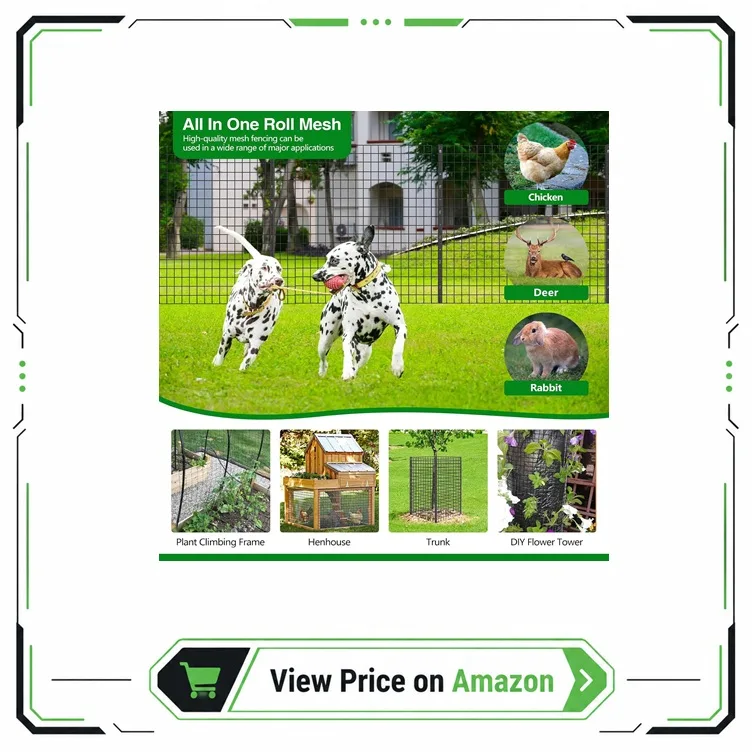
Traditional fencing remains one of the most secure options because it creates a visible physical barrier.
Advantages include:
- Helps keep other animals out
- No electronic collar required
- No correction-based training
Disadvantages include:
- Higher installation costs in many situations
- Local zoning or HOA restrictions
- Can obstruct views
- Requires ongoing maintenance
Frequently Asked Questions
Is DogWatch better than Invisible Fence?
Neither system is universally better. DogWatch may appeal to owners who prefer more control over compatible receiver settings, while Invisible Fence may suit those who value dealer-managed service and training.
Which hidden fence has longer battery life?
Battery life depends on the receiver model. Many DogWatch collars are known for longer battery life than comparable Invisible Fence models, but buyers should confirm the specifications of the exact system they are considering.
Can hidden dog fences keep other animals out?
No.
Hidden fences only communicate with your dog’s receiver collar. They do not stop wildlife, stray dogs, or people from entering your property.
Will my dog still need training?
Absolutely.
Training is essential for every hidden fence system.
Most dogs require several weeks of supervised practice before they reliably understand the boundary.
Can I install either system myself?
DogWatch and Invisible Fence are generally sold as professionally installed systems.
If you prefer a self-install option, consider a DIY wired system or certain GPS fence products.
Can multiple dogs use the same system?
Yes.
Both brands support multiple dogs by pairing additional receiver collars with the same boundary wire.
Are hidden fences humane?
When used according to the manufacturer’s instructions and combined with positive reinforcement training, hidden fence systems can be an effective containment solution for many dogs. Owners should choose the lowest effective correction level and focus on teaching the boundary rather than relying on corrections alone.
Final Verdict
DogWatch and Invisible Fence are both respected hidden dog fence systems with long histories of helping pet owners safely contain their dogs.
If you value owner flexibility, user-adjustable features (on compatible models), and longer battery life, DogWatch may have a slight advantage.
If you prefer professional support, dealer-managed adjustments, and guided training, Invisible Fence remains an excellent choice.
Rather than focusing solely on brand names, consider these factors before making your decision:
- The experience and reputation of your local dealer
- Your property’s size and layout
- Your dog’s temperament and training needs
- Available warranty and after-sales support
- Total ownership costs over time
For many families, the quality of installation, training, and ongoing support will have a greater impact on success than the logo printed on the receiver collar.
Which System Is Right for You?
| Your Priority | Recommended Option |
|---|---|
| Longer battery life | DogWatch |
| More owner control | DogWatch |
| Professional guidance | Invisible Fence |
| Strong dealer support | Invisible Fence |
| Large property | Either (depends on dealer assessment) |
| Multiple dogs | Either |
| Indoor avoidance zones | Either |
| Long-term reliability | Either |