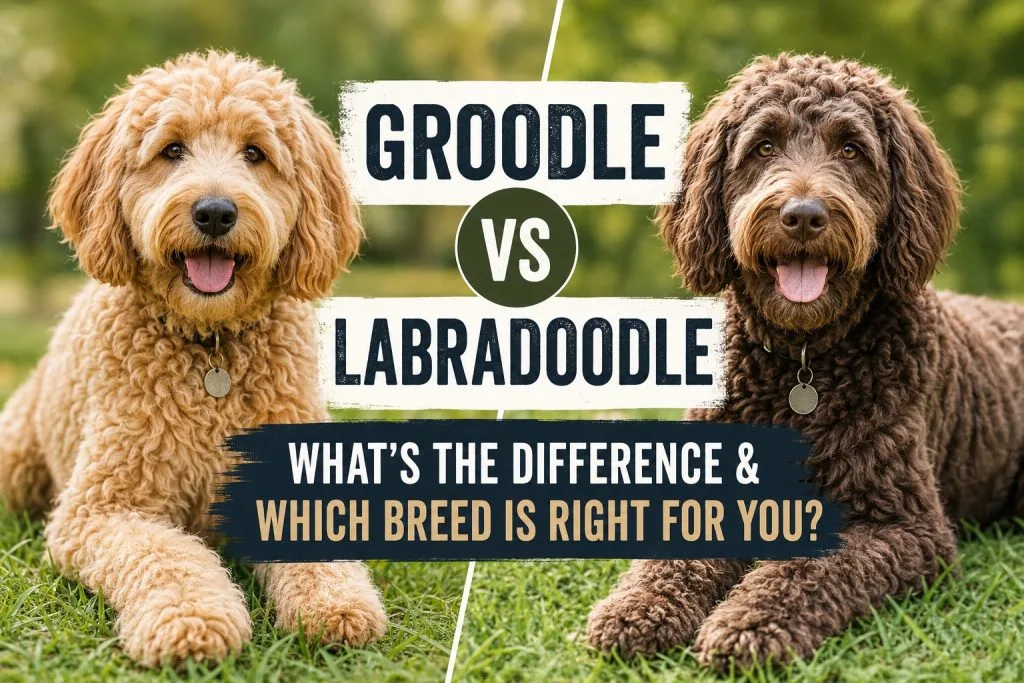
Choosing between a Groodle and a Labradoodle isn’t always easy. At first glance, these two popular Poodle mixes look remarkably similar. Both are intelligent, affectionate, and low-shedding companions that make wonderful family pets. However, when you take a closer look, you’ll find important differences in their temperament, energy levels, grooming needs, trainability, and overall lifestyle suitability.
One point that often causes confusion is the name itself. In Australia and New Zealand, the cross between a Golden Retriever and a Poodle is commonly called a Groodle, while in the United States, Canada, and much of Europe, the same dog is usually known as a Goldendoodle. Throughout this article, we’ll primarily use the term Groodle, but the information applies equally to Goldendoodles.
Labradoodles, on the other hand, are a cross between a Labrador Retriever and a Poodle. Originally developed in Australia as assistance dogs, they have become one of the world’s most sought-after designer breeds thanks to their friendly personalities, intelligence, and versatility.
So, which breed is the better choice?
The answer depends entirely on your lifestyle. While both breeds share many qualities inherited from the Poodle, the Golden Retriever and Labrador Retriever contribute distinct personality traits that can make one breed a better fit than the other.
In this comprehensive comparison, we’ll examine everything you need to know, including:
- Appearance and size
- Temperament and personality
- Intelligence and trainability
- Exercise and grooming requirements
- Health concerns
- Family suitability
- Cost of ownership
- Pros and cons
- Which breed is best for different lifestyles
By the end of this guide, you’ll have a much clearer understanding of whether a Groodle or a Labradoodle is the right companion for your home.
Table of Contents
Quick Answer: Groodle vs Labradoodle
If you’re looking for a quick overview, here’s how these two breeds compare.
| Feature | Groodle (Goldendoodle) | Labradoodle |
|---|---|---|
| Parent Breeds | Golden Retriever × Poodle | Labrador Retriever × Poodle |
| Origin | North America | Australia |
| Temperament | Gentle, affectionate, people-focused | Friendly, outgoing, energetic |
| Intelligence | ⭐⭐⭐⭐⭐ | ⭐⭐⭐⭐⭐ |
| Trainability | Excellent | Excellent |
| Energy Level | High | Very High |
| Grooming Needs | High | High |
| Shedding | Low to Minimal (varies by generation) | Low to Minimal (varies by generation) |
| Good with Children | Excellent | Excellent |
| Good with Other Pets | Excellent | Excellent |
| Apartment Living | Possible with sufficient exercise | Better suited to active homes |
| Lifespan | 10–15 years | 12–15 years |
| Best For | Families wanting a gentle companion | Active families and outdoor enthusiasts |
Bottom line: If you prefer a calmer, affectionate family dog, a Groodle may suit you better. If you enjoy an active lifestyle and want a highly energetic companion for adventures, a Labradoodle is often the stronger choice.
What Is a Groodle?
A Groodle (known internationally as a Goldendoodle) is a cross between a Golden Retriever and a Poodle. The breed was developed to combine the Golden Retriever’s friendly, dependable temperament with the Poodle’s intelligence and lower-shedding coat.
Today, Groodles are among Australia’s most popular family dogs. They are known for their affectionate nature, playful personality, and strong desire to be around people. Most Groodles thrive in family environments where they receive plenty of attention, exercise, and mental stimulation.
Depending on the size of the Poodle parent, Groodles can be found in Miniature, Medium, and Standard sizes.
What Is a Labradoodle?
A Labradoodle is a cross between a Labrador Retriever and a Poodle. Unlike many designer breeds, Labradoodles have a well-documented history, having been first developed in Australia during the late 1980s in an attempt to create an allergy-friendly assistance dog.
Although no dog is truly hypoallergenic, Labradoodles quickly became popular for their intelligence, trainability, and friendly personalities.
Like Groodles, Labradoodles are available in Miniature, Medium, and Standard sizes. They excel as family pets, therapy dogs, assistance dogs, and active companions thanks to their enthusiasm for learning and strong work ethic.
Related: If you’d like to learn more about each breed individually, be sure to read our comprehensive Labradoodle Breed Guide and Groodle Breed Guide.
Groodle vs Labradoodle at a Glance
| Characteristic | Groodle | Labradoodle |
|---|---|---|
| Parent Breeds | Golden Retriever × Poodle | Labrador Retriever × Poodle |
| Alternative Name | Goldendoodle | Labradoodle |
| Country of Development | North America | Australia |
| Sizes Available | Mini, Medium, Standard | Mini, Medium, Standard |
| Height | 35–65 cm (14–26 in) | 35–65 cm (14–26 in) |
| Weight | 7–36 kg (15–80 lbs) | 7–36 kg (15–80 lbs) |
| Coat Types | Straight, wavy, curly | Straight, wavy, curly |
| Common Colours | Cream, apricot, gold, red, chocolate, black, parti | Cream, apricot, caramel, chocolate, black, red, silver, parti, phantom and more |
| Shedding | Low to moderate | Low to moderate |
| Grooming | High | High |
| Intelligence | Excellent | Excellent |
| Energy Level | High | Very high |
| Trainability | Excellent | Excellent |
| Good with Children | Excellent | Excellent |
| Good with Other Pets | Excellent | Excellent |
| Apartment Friendly | Yes, with exercise | Better suited to homes with outdoor space |
| Lifespan | 10–15 years | 12–15 years |
| Best For | Families wanting a gentle, affectionate companion | Active owners seeking an energetic and highly trainable dog |
Appearance Comparison
Although Groodles and Labradoodles are often mistaken for one another, subtle differences in their appearance can become more noticeable as they mature. Their size, coat texture, facial expression, and even body shape are influenced by both the Poodle parent and the retriever breed in the mix.
If you’re choosing between the two based on looks alone, here’s what you can expect.
Size
Both breeds are available in Miniature, Medium, and Standard sizes, depending on whether they were bred with a Miniature, Moyen, or Standard Poodle.
| Size | Groodle | Labradoodle |
|---|---|---|
| Mini | 35–43 cm (14–17 in), 7–16 kg (15–35 lbs) | 35–43 cm (14–17 in), 7–16 kg (15–35 lbs) |
| Medium | 43–53 cm (17–21 in), 16–25 kg (35–55 lbs) | 43–53 cm (17–21 in), 16–25 kg (35–55 lbs) |
| Standard | 53–65 cm (21–26 in), 25–36 kg (55–80 lbs) | 53–65 cm (21–26 in), 25–36 kg (55–80 lbs) |
While there is significant overlap, Groodles often have a slightly more elegant, lean appearance inherited from the Golden Retriever, whereas Labradoodles tend to have a sturdier, more athletic build thanks to the Labrador Retriever.
Coat Types
Both breeds can inherit one of three main coat types:
- Straight coat
- Wavy (fleece) coat
- Curly (wool) coat
The wavy fleece coat is generally the most popular because it combines a soft texture with relatively low shedding and easier maintenance than a tightly curled coat.
Coat type depends on genetics rather than whether the dog is a Groodle or Labradoodle. Multi-generational breeding programs often produce more predictable coats than first-generation (F1) crosses.
Coat Colours
Both breeds come in an impressive range of colours, but there are some notable differences.
Common Groodle Colours
- Cream
- Golden
- Apricot
- Red
- Chocolate
- Black
- Parti
Common Labradoodle Colours
- Cream
- Chalk
- Apricot
- Caramel
- Gold
- Red
- Chocolate
- Black
- Blue
- Silver
- Lavender
- Cafe
- Parchment
- Phantom
- Parti
- Sable
Labradoodles, particularly Australian Labradoodles, generally display a wider variety of recognised coat colours and patterns due to decades of selective breeding.
Facial Features
Although both breeds have the characteristic “teddy bear” appearance that makes Poodle mixes so popular, there are subtle differences.
Groodle
- Softer facial expression
- Slightly longer muzzle
- Gentle eyes
- Feathered ears similar to a Golden Retriever
- Elegant overall appearance
Labradoodle
- Broader head
- Stronger muzzle
- Athletic body
- Expressive eyes
- Compact, sturdy frame
These differences are subtle and may vary depending on generation and breeding line, but experienced owners can often distinguish between the two.
Which Breed Looks More Like a Teddy Bear?
Both breeds can have the famous teddy bear appearance, especially when they inherit a wavy or curly fleece coat and receive regular professional grooming.
However, Groodles are often described as having a softer, more plush look due to the influence of the Golden Retriever, while Labradoodles may appear slightly more athletic and robust.
Ultimately, grooming style plays a bigger role in achieving the teddy bear look than breed alone.
Temperament Comparison
Both Groodles and Labradoodles are celebrated for their friendly personalities, but they aren’t identical. Their retriever heritage influences how they interact with people, respond to training, and adapt to different lifestyles.
Understanding these differences can help you choose the breed that best matches your household.
Friendliness
Both breeds are exceptionally friendly and are rarely suitable as guard dogs.
Groodles are known for their gentle, affectionate nature and often form deep emotional bonds with every member of the family. They typically greet strangers with enthusiasm rather than suspicion.
Labradoodles are equally sociable but tend to display a slightly more outgoing and exuberant personality. They often remain playful well into adulthood and are eager to make friends with almost everyone they meet.
Winner: Tie
Affection
If you’re looking for a dog that loves cuddles and constant companionship, both breeds excel.
Groodles often have a slightly calmer, more nurturing temperament inherited from the Golden Retriever. Many owners describe them as “velcro dogs” because they enjoy staying close to their family.
Labradoodles are also affectionate but usually express their love through play, interaction, and shared activities rather than simply lounging beside you.
Slight Advantage: Groodle
Energy Levels
This is one of the biggest differences between the two breeds.
Groodles are active dogs that enjoy long walks, swimming, hiking, and games of fetch, but they’re often content to relax indoors once their exercise needs have been met.
Labradoodles generally have higher energy levels and require more physical activity and mental stimulation to stay happy. Without enough exercise, they may become bored and develop unwanted behaviours such as chewing or excessive barking.
For owners who enjoy outdoor adventures, running, agility, or dog sports, Labradoodles often make enthusiastic partners.
Advantage: Labradoodle for highly active owners.
Independence
Neither breed enjoys being left alone for long periods, but Groodles often become more emotionally attached to their owners and may be slightly more prone to separation anxiety.
Labradoodles also crave companionship but often cope a little better when provided with adequate enrichment, exercise, and training.
Regardless of breed, early socialisation and gradual alone-time training are essential to help prevent anxiety-related behaviours.
Which Breed Has the Better Personality?
There isn’t a universal winner because personality preferences vary from one household to another.
Choose a Groodle if you prefer a dog that is:
- Gentle and affectionate
- Calm around the home after exercise
- Highly people-oriented
- Ideal for relaxed family life
Choose a Labradoodle if you prefer a dog that is:
- Extremely energetic
- Always ready for adventure
- Highly enthusiastic during training
- Well suited to active individuals and families
Both breeds inherit the intelligence and sociability that make Poodle crosses such outstanding companions, but the right choice ultimately depends on your lifestyle rather than which breed is objectively “better.”
Intelligence & Trainability
One reason both Groodles and Labradoodles consistently rank among the world’s most popular family dogs is their exceptional intelligence. Since both breeds inherit genes from the highly intelligent Poodle, they’re quick learners that enjoy solving problems and working closely with their owners.
However, there are subtle differences in their motivation and learning style.
Intelligence
Golden Retrievers, Labrador Retrievers, and Poodles are all renowned for their intelligence and willingness to please. As a result, both Groodles and Labradoodles excel in obedience training and can learn a wide range of commands and tasks.
They frequently succeed in:
- Basic obedience
- Advanced training
- Agility
- Rally obedience
- Scent work
- Therapy work
- Assistance dog programs
Neither breed has a clear advantage when it comes to raw intelligence.
Winner: Tie ⭐⭐⭐⭐⭐
Ease of Training
Both breeds respond best to positive reinforcement methods, including praise, treats, toys, and interactive games.
Groodles often have a slightly calmer temperament, making them easier for first-time owners to train. They generally enjoy pleasing their families and are patient learners.
Labradoodles are equally intelligent but often display higher enthusiasm and energy during training sessions. Their eagerness to work makes them excellent candidates for advanced obedience, agility, and service roles.
Consistency and early socialisation are essential regardless of which breed you choose.
Slight Advantage: Groodle for beginners.
Therapy and Service Dogs
Both breeds are commonly used as therapy and assistance dogs because they combine intelligence with friendly, people-oriented personalities.
Groodles are often chosen for:
- Emotional support
- Therapy visits
- Family companionship
Labradoodles frequently excel as:
- Assistance dogs
- Guide dogs
- Medical alert dogs
- Search and rescue dogs
- Canine sports competitors
The original Labradoodle breeding program was developed with assistance work in mind, and many modern Labradoodles continue to excel in these demanding roles.
Which Breed Is Better for First-Time Owners?
Both breeds are excellent choices for novice owners who are prepared to invest time in training, exercise, and grooming.
If you’re looking for a slightly calmer learning experience, a Groodle may be the better option.
If you enjoy structured training and want an energetic dog capable of learning complex tasks, a Labradoodle is hard to beat.
Exercise Requirements
Although both breeds are active, Labradoodles generally have higher exercise demands due to the Labrador Retriever’s energetic working heritage.
Failing to meet either breed’s exercise needs can lead to boredom, destructive chewing, digging, or excessive barking.
Groodle Exercise Needs
Most adult Groodles require approximately:
- 60–90 minutes of exercise per day
- Daily walks
- Fetch
- Swimming
- Interactive games
- Puzzle toys
After adequate exercise, many Groodles are content to relax with their family.
Labradoodle Exercise Needs
Most adult Labradoodles benefit from:
- 90–120 minutes of physical activity daily
- Long walks
- Running
- Hiking
- Swimming
- Agility training
- Advanced obedience
- Interactive play sessions
They also thrive on mental stimulation and enjoy learning new skills.
Without sufficient activity, Labradoodles may become restless and invent their own entertainment.
Apartment Living
Both breeds can adapt to apartment living, provided their exercise needs are consistently met.
Groodles often settle more easily indoors after daily exercise.
Labradoodles usually require additional physical and mental stimulation, making them better suited to homes with a secure yard or owners who lead very active lifestyles.
Which Breed Is Better for Active Families?
If your family enjoys:
- Hiking
- Running
- Camping
- Beach trips
- Long outdoor adventures
a Labradoodle is often the stronger match.
If you enjoy:
- Daily walks
- Weekend outings
- Moderate outdoor activities
a Groodle may fit your lifestyle perfectly.
Grooming Comparison
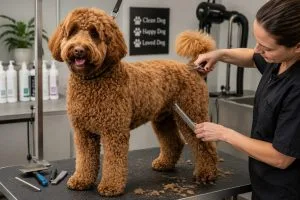
One of the biggest misconceptions about both Groodles and Labradoodles is that they are “low-maintenance” because they shed less than many other breeds.
In reality, both require regular grooming to keep their coats healthy and free of painful mats.
Brushing
Regardless of breed, most dogs benefit from brushing:
- Straight coats: 1–2 times per week
- Wavy fleece coats: 3–4 times per week
- Curly wool coats: Daily or almost daily
Neglecting brushing can quickly lead to matting, particularly behind the ears, under the legs, around the collar, and on the tail.
Professional Grooming
Most owners schedule professional grooming every:
- 6–8 weeks for fleece coats
- 4–6 weeks for curly coats
Regular trims help maintain comfort, hygiene, and the popular teddy bear appearance.
Ear Care
Both breeds have floppy ears that can trap moisture and reduce airflow.
Routine ear checks and cleaning help reduce the risk of:
- Ear infections
- Wax build-up
- Odour
- Yeast overgrowth
Dogs that swim frequently may require more frequent ear care.
Which Breed Is Easier to Groom?
Neither breed has a significant advantage.
Grooming requirements depend much more on:
- Coat type
- Coat length
- Grooming routine
- Genetics
A curly-coated Groodle may require more maintenance than a straight-coated Labradoodle, and vice versa.
Winner: Tie
Health Comparison
Both breeds are generally healthy when responsibly bred, but they can inherit certain genetic conditions from their parent breeds.
Choosing a breeder who performs comprehensive health testing can significantly reduce the risk of many inherited disorders.
Common Health Concerns in Groodles
Potential conditions include:
- Hip dysplasia
- Elbow dysplasia
- Progressive Retinal Atrophy (PRA)
- Cataracts
- Cancer
- Heart disease
- Allergies
- Ear infections
Common Health Concerns in Labradoodles
Potential conditions include:
- Hip dysplasia
- Elbow dysplasia
- Progressive Retinal Atrophy (PRA)
- Addison’s disease
- Ear infections
- Allergies
- Sebaceous adenitis
- Obesity
- Gastric dilatation-volvulus (bloat)
For a detailed breakdown of these conditions, symptoms, and prevention strategies, read our Labradoodle Health Problems guide.
Lifespan
With responsible breeding, a healthy diet, regular exercise, and routine veterinary care:
- Groodles typically live 10–15 years.
- Labradoodles typically live 12–15 years.
Many dogs exceed these averages with excellent lifelong care.
Which Breed Is Healthier?
Neither breed can be considered universally healthier.
Individual health depends on factors such as:
- Genetics
- Health testing (such as OFA testing)
- Responsible breeding
- Nutrition
- Weight management
- Preventive veterinary care
- Exercise
Rather than focusing solely on breed, choose a breeder who performs recommended health and genetic screening and is transparent about the health history of their breeding dogs.
Family Suitability
Both Groodles and Labradoodles are affectionate, social dogs that fit well into many households. However, one breed may suit your lifestyle better depending on your family, activity level, and living situation.
Families with Children
Both breeds are widely regarded as excellent family dogs. They are gentle, patient, and enjoy being involved in family activities.
Groodles often have a slightly calmer and more nurturing temperament, making them a popular choice for families with younger children. Labradoodles are equally loving but may be more boisterous, especially during puppyhood and adolescence.
As with any dog, children should always be taught how to interact respectfully, and playtime should be supervised.
Winner: Tie (Groodle has a slight edge for very young children.)
First-Time Dog Owners
If you’re buying your first dog, both breeds are excellent options thanks to their intelligence and eagerness to please.
Groodles may be a little more forgiving for inexperienced owners because they often mature into calmer adults.
Labradoodles can be just as rewarding but usually require a greater commitment to exercise, training, and mental stimulation.
Slight Advantage: Groodle
Active Individuals
For runners, hikers, campers, and outdoor enthusiasts, Labradoodles are often the better fit.
Their Labrador heritage gives them exceptional stamina and enthusiasm for physical activities.
Groodles also enjoy adventure but are generally more content with moderate daily exercise once their needs have been met.
Advantage: Labradoodle
Apartment Living
Neither breed was specifically developed for apartment life, but both can adapt with sufficient exercise.
Groodles often settle more quietly indoors after a walk.
Labradoodles typically require more opportunities to burn off energy and therefore benefit from homes with a secure backyard or regular outdoor activities.
Homes with Other Pets
Both breeds usually get along well with:
- Other dogs
- Cats (when introduced properly)
- Family pets
Early socialisation is the key to raising a confident, well-mannered companion regardless of breed.
Winner: Tie
Cost of Ownership
The purchase price is only one part of owning either breed. Ongoing expenses should also be considered before bringing home a puppy.
| Expense | Groodle | Labradoodle |
|---|---|---|
| Puppy Purchase | High | High |
| Food | Moderate–High | Moderate–High |
| Professional Grooming | High | High |
| Veterinary Care | Moderate | Moderate |
| Training Classes | Recommended | Recommended |
| Toys & Enrichment | Moderate | Moderate–High |
| Pet Insurance | Optional but Recommended | Optional but Recommended |
Labradoodles may incur slightly higher costs over time if they participate in dog sports, advanced training, or require more enrichment due to their higher energy levels.
Groodle vs Labradoodle Pros & Cons
Groodle
Pros
- Gentle and affectionate personality
- Excellent with children
- Highly intelligent and trainable
- Generally calmer indoors after exercise
- Low-shedding coat (depending on genetics)
- Adaptable to many family lifestyles
Cons
- Requires regular professional grooming
- Can develop separation anxiety if left alone frequently
- Needs daily exercise and mental stimulation
- May inherit hereditary health conditions
Labradoodle
Pros
- Extremely intelligent
- Excellent for active families
- Excels in obedience, agility, and therapy work
- Friendly with people and other pets
- Low-shedding coat (depending on genetics)
- Adaptable and eager to learn
Cons
- Higher exercise requirements
- Can become destructive if bored
- Requires frequent grooming
- May inherit several genetic health conditions
- Puppy stage can be particularly energetic
Groodle vs Labradoodle: Which Breed Should You Choose?
There isn’t a single “better” breed. The right choice depends on your lifestyle, experience, and expectations.
Choose a Groodle if you:
- Prefer a calm, affectionate family companion.
- Have young children.
- Want a dog that’s happy with moderate to high daily exercise.
- Enjoy quiet evenings with a dog that loves to cuddle.
- Are a first-time dog owner looking for a slightly easier introduction to dog ownership.
Choose a Labradoodle if you:
- Lead a very active lifestyle.
- Love hiking, running, swimming, or outdoor adventures.
- Enjoy training and teaching new skills.
- Want a dog that excels in dog sports or advanced obedience.
- Have plenty of time for daily physical and mental exercise.
Choose Either Breed if you:
- Can commit to regular grooming.
- Have time for daily exercise and companionship.
- Want an intelligent, friendly, people-oriented dog.
- Are looking for a loyal family pet that generally gets along well with children and other pets.
Frequently Asked Questions
Are Groodles and Goldendoodles the same?
Yes. Groodle is the term most commonly used in Australia and New Zealand, while Goldendoodle is the preferred name in North America and many other countries. They refer to the same cross between a Golden Retriever and a Poodle.
Which breed sheds less?
Both breeds are generally low-shedding, especially those with fleece or curly coats. However, shedding varies depending on genetics and generation, so no Groodle or Labradoodle can be guaranteed to be completely non-shedding.
Which breed is easier to train?
Both are highly trainable. Groodles may be slightly easier for first-time owners because of their calm, eager-to-please nature, while Labradoodles often thrive in more advanced training and working roles.
Which breed is better with children?
Both breeds are excellent family dogs. Groodles may have a slight advantage for families with very young children because they often have a gentler, more relaxed temperament.
Which breed is healthier?
Neither breed is inherently healthier than the other. Health depends largely on responsible breeding, genetic testing, nutrition, exercise, and routine veterinary care.
Which breed requires more exercise?
Labradoodles generally have higher exercise and mental stimulation requirements than Groodles.
Which breed is better for apartments?
Both can adapt to apartment living if they receive adequate daily exercise. Groodles often settle more easily indoors, while Labradoodles usually benefit from more space and activity.
Which breed lives longer?
Both breeds typically enjoy long lifespans, with Labradoodles averaging 12–15 years and Groodles generally 10–15 years, though individual dogs may live longer with excellent care.
Are Groodles or Labradoodles hypoallergenic?
No dog is truly hypoallergenic. However, many Groodles and Labradoodles shed less than their parent breeds, making them a better option for some people with mild allergies.
Final Thoughts
Groodles and Labradoodles have earned their reputation as two of the world’s most popular Poodle crosses for good reason. They are intelligent, affectionate, family-oriented, and highly trainable dogs that thrive when given the time, care, and attention they deserve.
If you value a slightly calmer companion that enjoys close family life, a Groodle may be the ideal match. If you’re looking for a high-energy partner to join you on outdoor adventures, training sessions, or canine sports, a Labradoodle is likely to be a better fit.
Ultimately, the best dog isn’t determined by breed alone. Responsible breeding, early socialisation, consistent training, proper nutrition, regular grooming, and lifelong veterinary care all play a significant role in shaping a happy and healthy companion.
Whichever breed you choose, you’ll be welcoming an intelligent, loving dog that can become a cherished member of your family for many years.