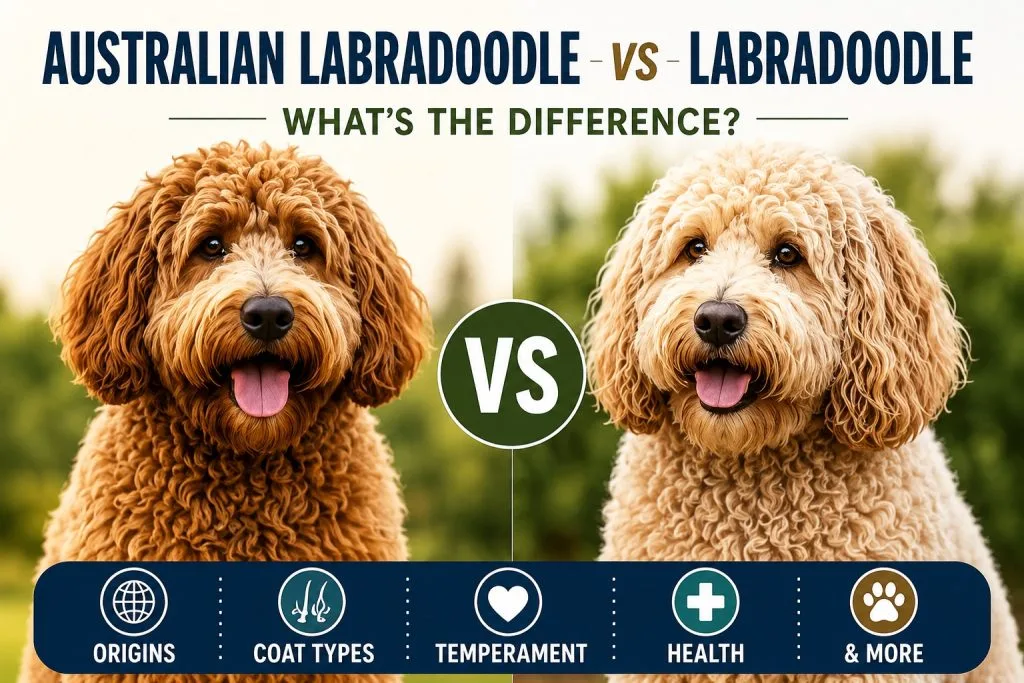
If you’ve started researching Labradoodles, you’ve probably come across the terms Australian Labradoodle and Labradoodle and wondered whether they’re the same dog or two different breeds.
The short answer is they’re related, but they’re not exactly the same.
While every Australian Labradoodle is a type of Labradoodle, not every Labradoodle is an Australian Labradoodle. The biggest difference lies in their breeding history and genetics.
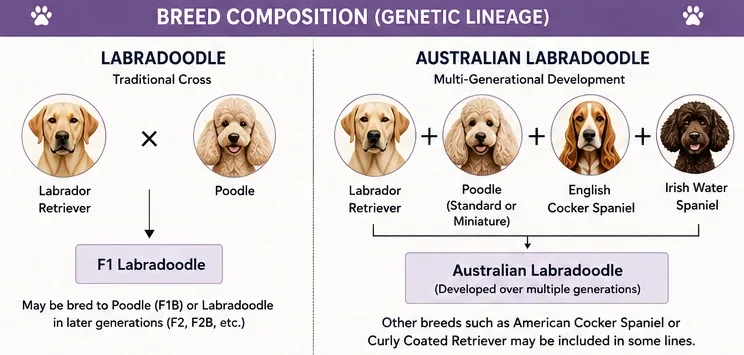
The original Labradoodle was created by crossing a Labrador Retriever with a Poodle. Australian Labradoodles, however, have been selectively developed over several generations and may include additional breeds, such as the English Cocker Spaniel, American Cocker Spaniel, and Irish Water Spaniel, depending on the breeding program.
These carefully planned breeding programs aimed to create dogs with more predictable temperaments, coats, and allergy-friendly traits.
Whether you’re looking for a family companion, a therapy dog, or your first puppy, understanding these differences will help you choose the dog that best fits your lifestyle.
In this guide, we’ll compare Australian Labradoodles and Labradoodles in terms of:
- Origins
- Genetics
- Appearance
- Size
- Coat types
- Temperament
- Intelligence
- Health
- Grooming
- Exercise needs
- Lifespan
- Cost
- Which one is better for families
By the end of this article, you’ll have a clear understanding of which type is right for you.
Table of Contents
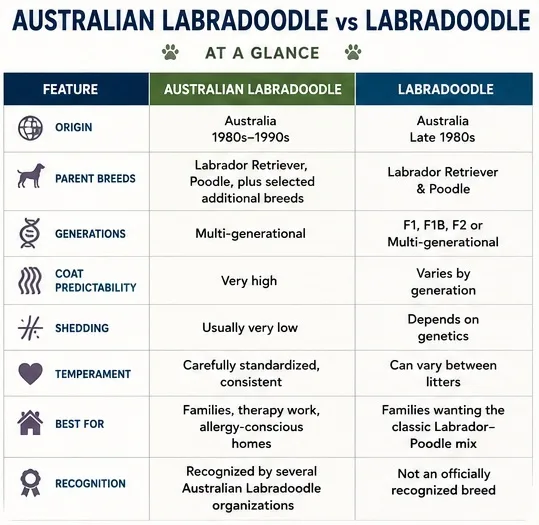
Australian Labradoodle vs Labradoodle at a Glance
What Is a Labradoodle?
A Labradoodle is a cross between a Labrador Retriever and a Poodle.
The cross was originally developed during the late 1980s to combine the Labrador’s friendly personality with the Poodle’s low-shedding coat and intelligence.
Since then, Labradoodles have become one of the world’s most popular designer dogs.
Depending on the breeding program, a Labradoodle may be:
- F1 (50% Labrador, 50% Poodle)
- F1B
- F2
- F2B
- Multi-generational
Because early-generation Labradoodles inherit genes from only two breeds, their appearance, coat type, and temperament can vary significantly—even among puppies from the same litter.
One puppy may have a shaggy, fleece-like coat, while another may have a short, Labrador-like coat that sheds heavily.
This genetic diversity is one reason Labradoodles remain so popular, but it also makes them less predictable than Australian Labradoodles.
What Is an Australian Labradoodle?
Despite the name, an Australian Labradoodle is not simply a Labradoodle born in Australia.
Instead, it refers to a carefully developed, multi-generational line of Labradoodles that has been selectively bred for several decades.
Rather than repeatedly crossing only Labrador Retrievers and Poodles, dedicated breeders introduced a small number of additional breeds to improve consistency in temperament, coat quality, structure, and trainability.
Depending on the breeding line, these breeds may include:
- Labrador Retriever
- Poodle
- English Cocker Spaniel
- American Cocker Spaniel
- Irish Water Spaniel
- Curly Coated Retriever (rarely)
- Soft Coated Wheaten Terrier (historically in some lines)
Today’s reputable Australian Labradoodle breeders focus on maintaining these carefully established bloodlines rather than introducing new breeds.
As a result, Australian Labradoodles generally have:
- More predictable coats
- More consistent temperaments
- Better uniformity in appearance
- Excellent trainability
- Reliable family-friendly personalities
Many are bred specifically for therapy work, assistance work, and emotional support roles.
History and Development
Although many people assume both dogs were developed the same way, their histories differ significantly.
The Original Labradoodle
The Labradoodle’s story began in Australia during the late 1980s.
A breeder working with a guide dog program sought to create a service dog suitable for individuals with dog allergies. The idea was to combine the Labrador Retriever’s dependable temperament with the Poodle’s low-shedding coat.
The first crosses attracted worldwide attention, and demand for Labradoodles quickly grew.
Soon, breeders across the United States, Australia, Canada, and Europe began producing Labradoodles.
However, because many focused on first-generation crosses, coat types and temperaments remained highly variable.
The Development of the Australian Labradoodle
Rather than stopping at the first cross, several Australian breeding programs continued refining the Labradoodle.
Their goal was ambitious:
Create a dog with:
- predictable temperament,
- consistent coat quality,
- excellent health,
- reliable trainability,
- and suitability for therapy and assistance work.
Over many generations, carefully selected dogs were bred together while maintaining detailed pedigrees and health testing.
The result became known as the Australian Labradoodle—a dog that differs from the original Labradoodle not because it comes from Australia, but because it belongs to these established multigenerational breeding programs.
Today, responsible Australian Labradoodle breeders continue following strict breeding standards designed to preserve these characteristics.
Are Australian Labradoodles and Labradoodles Different Breeds?
This is one of the most common questions prospective owners ask.
The answer is not exactly.
Both dogs belong to the Labradoodle family and share Labrador Retriever and Poodle ancestry.
The difference lies in how they are bred.
Think of it this way:
- A traditional Labradoodle is often a direct Labrador-Poodle cross or an early-generation mix.
- An Australian Labradoodle comes from carefully developed, multigenerational bloodlines that prioritize consistency in health, temperament, and coat quality.
As a result, Australian Labradoodles tend to be more predictable in both appearance and personality.
That doesn’t necessarily make one “better” than the other. Instead, it gives prospective owners more information to choose the dog that best matches their expectations and lifestyle.
Appearance
At first glance, Australian Labradoodles and Labradoodles look remarkably similar. Both have expressive eyes, floppy ears, athletic bodies, and a friendly, teddy bear-like appearance that has made them one of the world’s most popular family dogs.
However, when you compare them side by side, some noticeable differences begin to emerge.
Because traditional Labradoodles are often first- or second-generation crosses, their appearance can vary widely. Puppies from the same litter may inherit different traits from their Labrador Retriever or Poodle parents. One puppy may have a straighter coat and a broader Labrador-like head, while another may closely resemble a Poodle with tighter curls and a narrower muzzle.
Australian Labradoodles, on the other hand, are bred over multiple generations with carefully selected bloodlines. This selective breeding has produced a more consistent look. Most Australian Labradoodles have a balanced body, a soft teddy bear face, expressive round eyes, and a well-proportioned muzzle. Their coats are generally more uniform, giving them the appearance many people associate with premium Labradoodles.
Although appearance alone shouldn’t determine your choice, buyers who value consistency often prefer Australian Labradoodles for this reason.
Size Comparison
Both Australian Labradoodles and Labradoodles are available in multiple sizes, making them suitable for different living situations.
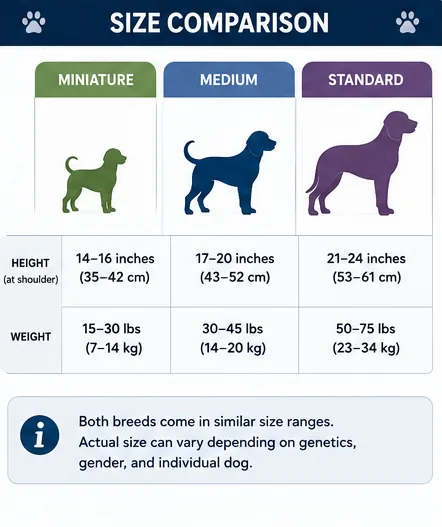
While both dogs can be similar in height and weight, Australian Labradoodles generally have more predictable adult sizes because of their established breeding lines.
With Labradoodles, especially early-generation crosses, adult size can sometimes surprise owners depending on which parent’s genes become more dominant.
Coat Types
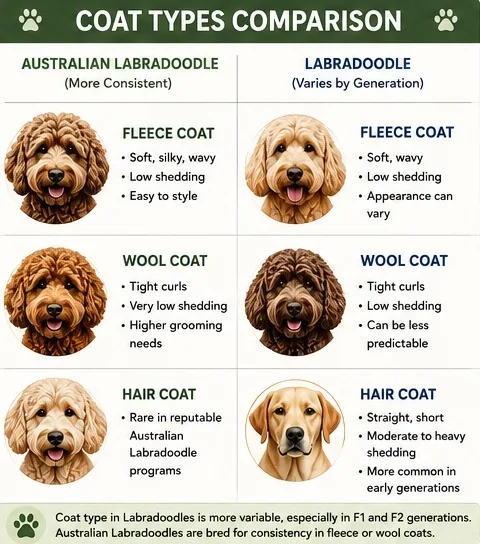
The coat is one of the biggest differences between these two dogs.
Labradoodle Coat
A Labradoodle’s coat depends largely on its generation and genetics.
Common coat types include:
Hair Coat
This coat closely resembles that of the Labrador Retriever.
Characteristics include:
- Short
- Straight
- Moderate to heavy shedding
- Easy to maintain
Wool Coat
This coat resembles the Poodle.
Characteristics include:
- Tight curls
- Minimal shedding
- High grooming requirements
Fleece Coat
A fleece coat falls somewhere between straight and curly.
Characteristics include:
- Soft texture
- Wavy appearance
- Low shedding
- Popular among families
Because Labradoodles inherit different combinations of genes, predicting coat type in early generations isn’t always possible.
Australian Labradoodle Coat
Australian Labradoodles are intentionally bred for consistency.
Most reputable breeders aim for either:
Fleece Coat
- Soft
- Silky
- Wavy
- Easy to style
- Low shedding
or
Wool Coat
- Dense curls
- Very low shedding
- Excellent for allergy-conscious households
Hair coats are uncommon in well-established Australian Labradoodle breeding programs because breeders selectively breed for fleece and wool textures.
This makes Australian Labradoodles much more predictable in appearance and maintenance.
Coat Colors
Both varieties come in an impressive range of colours.
Common colours include:
- Cream
- Chalk
- White
- Apricot
- Gold
- Red
- Caramel
- Chocolate
- Black
- Blue
- Silver
- Lavender
- Café
- Parti
- Phantom
- Sable
- Merle (less common and not accepted by some breeding programs)
Australian Labradoodle breeding programs often produce colours more consistently because generations of selective breeding have stabilised colour genetics.
Traditional Labradoodles can display greater variation depending on the parent dogs.
Shedding
One of the main reasons many families choose a Labradoodle is the hope of finding a dog that sheds very little.
However, shedding isn’t guaranteed.
Labradoodle
Shedding depends on several factors:
- Generation
- Coat type
- Genetics
An F1 Labradoodle, which is an even mix of Labrador Retriever and Poodle, may inherit more Labrador characteristics and shed considerably more than expected.
F1B and multigenerational Labradoodles generally shed less.
Australian Labradoodle
Australian Labradoodles are typically bred for their low-shedding coats.
While no dog is completely non-shedding or completely hypoallergenic, Australian Labradoodles tend to offer more consistency for people who prefer minimal hair around the home.
This predictability is one reason they are often chosen as therapy and assistance dogs.
Grooming Requirements
Neither dog can be described as “low maintenance.”
Both require regular coat care to stay healthy and comfortable.
Brushing
Brush:
- 3–5 times per week for fleece coats.
- Daily for dense wool coats.
Regular brushing prevents painful mats and keeps the coat clean.
Professional Grooming
Most owners schedule grooming every:
6–8 weeks
Professional grooming usually includes:
- Bath
- Blow dry
- Coat trimming
- Ear cleaning
- Nail trimming
- Sanitary trim
Ear Care
Because both dogs have floppy ears, moisture can become trapped inside the ear canal.
Weekly ear checks help reduce the risk of infections.
Nail Care
Trim nails approximately every:
3–4 weeks
Overgrown nails can affect posture and make walking uncomfortable.
Dental Care
Brush teeth several times each week and provide appropriate dental chews to help reduce plaque buildup.
Temperament
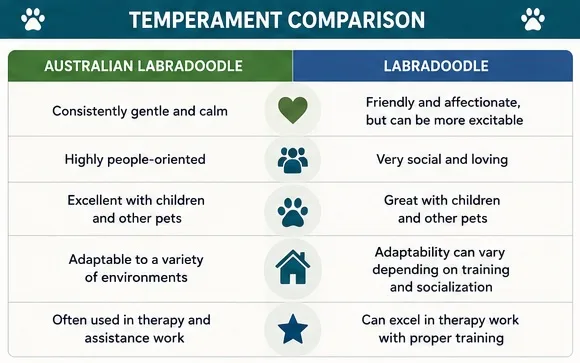
Both dogs are known for their friendly personalities, but Australian Labradoodles are generally more consistent because of decades of selective breeding.
Labradoodle Personality
A Labradoodle often inherits the best qualities of both parent breeds.
Typical traits include:
- Affectionate
- Playful
- Loyal
- Intelligent
- Outgoing
- Social
However, temperament can vary considerably.
Some puppies inherit the Labrador’s energetic, food-driven personality, while others display more of the Poodle’s sensitivity and focus.
Proper socialisation during puppyhood plays a major role in shaping adult behaviour.
Australian Labradoodle Personality
Australian Labradoodles are bred with temperament as a primary goal.
Responsible breeders prioritise dogs that are:
- Calm
- Gentle
- Friendly
- Patient
- Adaptable
- Highly trainable
These qualities have made Australian Labradoodles popular choices for:
- Therapy work
- Emotional support
- Assistance dog programs
- Schools
- Hospitals
- Families with children
Their predictable temperament is often one of their biggest advantages over early-generation Labradoodles.
Intelligence and Trainability
Both Australian Labradoodles and Labradoodles are exceptionally intelligent dogs.
Thanks to their Labrador Retriever and Poodle ancestry, they learn quickly and generally enjoy working with people.
They excel in activities such as:
- Obedience
- Agility
- Scent work
- Rally
- Trick training
- Therapy work
Australian Labradoodles often have a slight advantage in trainability because generations of selective breeding have emphasised calmness, focus, and willingness to please.
Traditional Labradoodles can be equally intelligent, but their behaviour may be somewhat less predictable, particularly in early generations where inherited traits vary more widely.
Regardless of which type you choose, both benefit from:
- Positive reinforcement training
- Early socialisation
- Consistent routines
- Daily mental stimulation
- Regular exercise
A bored Labradoodle of any type is likely to invent its own entertainment, which may include excessive barking, chewing, or digging.
Exercise Needs
Australian Labradoodles and Labradoodles are active, intelligent dogs that thrive when they have both physical exercise and mental stimulation. While they aren’t as demanding as some working breeds, they aren’t couch potatoes either.
Without enough activity, either dog may develop unwanted behaviours such as excessive barking, chewing, digging, or jumping.
Labradoodle Exercise Requirements
Most Labradoodles need 60–90 minutes of exercise each day.
Suitable activities include:
- Daily walks
- Fetch
- Swimming
- Hiking
- Agility training
- Puzzle toys
- Obedience sessions
- Scent games
Because Labradoodles can inherit the Labrador Retriever’s enthusiasm and the Poodle’s intelligence, they generally enjoy learning new activities.
Australian Labradoodle Exercise Requirements
Australian Labradoodles have similar exercise needs but are often bred to have a more balanced energy level.
Many owners describe them as energetic outdoors yet calm and relaxed indoors once their daily exercise needs have been met.
They excel in:
- Therapy work
- Canine sports
- Family adventures
- Obedience competitions
- Trick training
Regardless of which type you choose, regular exercise should be combined with mental enrichment to keep your dog happy and healthy.
Health Problems
Neither Australian Labradoodles nor Labradoodles are immune to inherited health conditions. Responsible breeders reduce these risks by performing health testing before breeding.
Common Health Problems in Labradoodles
Potential health issues include:
- Hip dysplasia
- Elbow dysplasia
- Progressive Retinal Atrophy (PRA)
- Cataracts
- Addison’s disease
- Epilepsy
- Ear infections
- Allergies
- Gastric Dilatation-Volvulus (Bloat), particularly in larger dogs
- Obesity
The likelihood of developing these conditions depends largely on genetics, breeding practices, diet, exercise, and routine veterinary care.
Common Health Problems in Australian Labradoodles
Australian Labradoodles may also experience many of the same conditions, including:
- Hip dysplasia
- Elbow dysplasia
- Eye disorders
- Ear infections
- Allergies
- Patellar luxation (in some smaller dogs)
However, reputable Australian Labradoodle breeding programs often maintain extensive health testing protocols and detailed pedigree records, helping to reduce the prevalence of inherited diseases over time.
This doesn’t eliminate health risks, but it does highlight the importance of choosing an ethical breeder who performs recommended health screenings.
Lifespan
Both dogs are generally long-lived companions.
Australian Labradoodle average lifespan: 13–15 years
Labradoodle average lifespan: 12–15 years
Factors that influence lifespan include:
- Genetics
- Nutrition
- Weight management
- Exercise
- Preventive veterinary care
- Dental health
- Overall lifestyle
Dogs from health-tested parents and responsible breeding programs generally have a better chance of living long, healthy lives.
Cost Comparison
The purchase price varies significantly depending on the breeder, location, pedigree, and demand.
| Expense | Australian Labradoodle | Labradoodle |
|---|---|---|
| Puppy Price | Typically higher | Usually lower |
| Grooming | Similar | Similar |
| Food | Similar | Similar |
| Insurance | Similar | Similar |
| Veterinary Care | Similar | Similar |
Australian Labradoodles often cost more because they come from carefully managed, multigenerational breeding programs that involve extensive health testing, pedigree management, and selective breeding.
Regardless of which puppy you choose, remember that the purchase price is only a small part of the overall cost of dog ownership. Food, grooming, training, veterinary care, insurance, and supplies will far exceed the initial purchase price over your dog’s lifetime.
Australian Labradoodle vs Labradoodle: Pros and Cons
Australian Labradoodle
Pros
- More predictable appearance
- Consistent temperament
- Usually lower shedding
- Excellent family companion
- Frequently used as therapy and assistance dogs
- Well-established multigenerational breeding programs
Cons
- Higher purchase price
- Waiting lists are common
- Fewer reputable breeders compared to traditional Labradoodles
Labradoodle
Pros
- Friendly and affectionate
- Highly intelligent
- Excellent family pet
- More widely available
- Often less expensive
- Wide variety of colours and coat types
Cons
- Coat and temperament can vary significantly
- Shedding is less predictable in early generations
- Adult appearance may be difficult to predict
- Quality varies greatly depending on the breeder
Which Dog Is Better for Families?
For most households, both Australian Labradoodles and Labradoodles make wonderful family companions.
If you’re looking for a dog with a more predictable temperament, coat, and appearance, an Australian Labradoodle may be the better choice.
If you’re comfortable with a little more variation and simply want a friendly, intelligent companion, a well-bred Labradoodle can be equally rewarding.
Both generally get along well with:
- Children
- Other dogs
- Cats (when properly introduced)
- Active families
- Seniors
- First-time dog owners
Early socialisation, positive training, and responsible ownership are just as important as genetics.
Which One Is Better for Allergy Sufferers?
No dog is truly hypoallergenic.
However, Australian Labradoodles are often bred specifically for consistently low-shedding fleece or wool coats, making them a more predictable option for people with mild dog allergies.
Traditional Labradoodles can also be low-shedding, particularly F1B and multigenerational dogs, but coat type is generally less predictable.
If allergies are a concern, spend time with the individual dog before making a decision, as allergic reactions vary from person to person.
Which One Should You Choose?
The right choice depends on your priorities.
Choose an Australian Labradoodle if you want:
- Greater consistency
- A predictable coat
- Lower shedding
- A dog from an established multigenerational breeding program
- A potential therapy or assistance dog
Choose a Labradoodle if you want:
- The classic Labrador–Poodle mix
- More breeder options
- Potentially lower purchase costs
- A friendly, active family companion
Rather than focusing solely on the label, pay close attention to the breeder. A responsibly bred Labradoodle from health-tested parents is almost always a better choice than an Australian Labradoodle from an irresponsible breeder.
Frequently Asked Questions
Is an Australian Labradoodle a purebred dog?
No. Australian Labradoodles are multigenerational designer dogs developed from several carefully selected breeds. They are not recognised as a purebred breed by major kennel clubs.
Do Australian Labradoodles shed less than Labradoodles?
Generally, yes. Because Australian Labradoodles are selectively bred for fleece and wool coats, they tend to have more predictable low-shedding coats than early-generation Labradoodles.
Are Australian Labradoodles calmer?
Many owners and breeders report that Australian Labradoodles have a more consistent and balanced temperament. However, individual personality, training, and socialisation also play major roles.
Which dog is easier to train?
Both are highly intelligent and eager to learn. Australian Labradoodles are often considered slightly more consistent in trainability due to generations of selective breeding for temperament.
Which one is more expensive?
Australian Labradoodles usually cost more because of their established breeding programs, health testing, and carefully maintained bloodlines.
Final Verdict
Australian Labradoodles and Labradoodles share many of the qualities that have made them among the world’s most popular family dogs. Both are intelligent, affectionate, active, and capable of forming strong bonds with their owners.
The main difference lies in predictability.
Australian Labradoodles have been carefully developed over multiple generations to produce consistent temperaments, coats, and overall appearance. Traditional Labradoodles, particularly first-generation crosses, can vary more widely in these characteristics.
That doesn’t mean one is inherently better than the other. A well-bred Labradoodle and a well-bred Australian Labradoodle can both become exceptional companions.
Ultimately, your decision should be based less on the name and more on the breeder’s commitment to health testing, responsible breeding, early socialisation, and lifelong support. Choosing an ethical breeder gives you the best chance of welcoming a healthy, well-adjusted dog into your family—regardless of whether you bring home an Australian Labradoodle or a Labradoodle.