

Wondering Which Labradoodle Size Is Right for You?
One of the biggest surprises for first-time Labradoodle owners is discovering that Labradoodles don’t come in just one size. Depending on their breeding, they can range from compact dogs weighing under 20 pounds to large companions tipping the scales at more than 70 pounds.
This variation is one of the reasons Labradoodles have become so popular. Whether you live in a city apartment, a suburban family home, or a rural property with plenty of space, there’s often a Labradoodle size that fits your lifestyle.
Generally, Labradoodles are divided into three categories:
- Mini Labradoodles
- Medium Labradoodles
- Standard Labradoodles
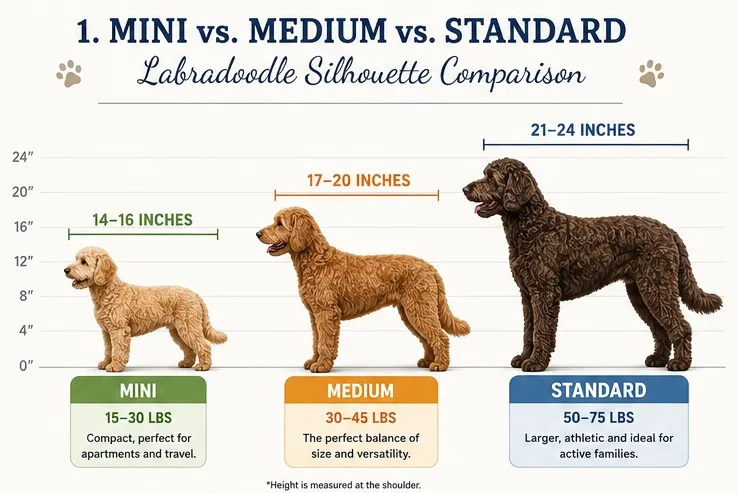
Each size has its own advantages. Mini Labradoodles are ideal for people with limited space or those wanting a more portable companion. Medium Labradoodles offer an excellent balance between size and versatility, making them one of the most popular choices for families. Standard Labradoodles are larger, more athletic dogs that thrive in active households and often excel as therapy, assistance, and service dogs.
Although size influences factors such as exercise requirements, grooming time, feeding costs, and available living space, it doesn’t determine a Labradoodle’s personality. Well-bred Labradoodles of all sizes are typically friendly, intelligent, affectionate, and eager to please.
In this guide, we’ll compare Mini, Medium, and Standard Labradoodles in detail, covering their height, weight, growth rate, temperament, exercise needs, grooming requirements, and which type may be the best fit for your lifestyle.
Table of Contents
Labradoodle Size at a Glance
| Size | Height | Weight | Best For |
|---|---|---|---|
| Mini Labradoodle | 14–16 inches (35–42 cm) | 15–30 lbs (7–14 kg) | Apartments, singles, couples, seniors |
| Medium Labradoodle | 17–20 inches (43–52 cm) | 30–45 lbs (14–20 kg) | Families, first-time owners, active homes |
| Standard Labradoodle | 21–24 inches (53–61 cm) | 50–75 lbs (23–34 kg) | Larger homes, active families, therapy and service work |
Related: If you’re still deciding between different Labradoodle types, read our guide comparing Australian Labradoodle vs. Labradoodle.
Why Do Labradoodles Come in Different Sizes?
Unlike many purebred dogs, Labradoodles aren’t limited to a single breed standard. Their size depends largely on the type of Poodle used in the breeding program, as well as genetics inherited from both parents.
For example:
- A Mini Labradoodle is usually produced by crossing a Labrador Retriever with a Miniature Poodle or by breeding established multigenerational Labradoodle lines that consistently produce smaller dogs.
- A Medium Labradoodle often comes from Medium Poodles or carefully planned multigenerational breeding programs.
- A Standard Labradoodle is typically bred using a Standard Poodle, resulting in the largest variety.
Responsible breeders carefully select parent dogs to produce puppies within a predictable size range, although individual dogs may still vary slightly.
Other factors that influence adult size include:
- Genetics
- Nutrition during puppyhood
- Overall health
- Sex (males are often slightly larger than females)
- Whether the dog was desexed before reaching maturity
Understanding these factors can help set realistic expectations, but remember that every Labradoodle is an individual and may mature differently.
Mini Labradoodle
Mini Labradoodles are the smallest of the three recognised size categories and have become increasingly popular among apartment dwellers, retirees, and families looking for a compact companion.
Although smaller in stature, Mini Labradoodles retain the intelligence, affectionate personality, and playful nature that have made the breed famous.
Size
- Height: 14–16 inches (35–42 cm)
- Weight: 15–30 pounds (7–14 kg)
Because of their manageable size, Mini Labradoodles are easier to lift, transport, and travel with than larger varieties.
Personality
Mini Labradoodles are often:
- Affectionate
- Intelligent
- Playful
- Friendly with children
- Sociable with other pets
- Eager to learn
Despite their smaller size, they remain energetic dogs that benefit from regular walks, games, and training sessions.
Exercise Requirements
Mini Labradoodles typically need 45 to 60 minutes of exercise each day.
Suitable activities include:
- Daily walks
- Fetch
- Puzzle toys
- Basic agility
- Interactive games
Mental stimulation is just as important as physical exercise.
Best For
Mini Labradoodles are an excellent choice for:
- Apartment living
- Smaller homes
- Singles
- Couples
- Seniors
- First-time dog owners
Provided they receive enough exercise, they adapt well to a variety of living environments.
Pros
- Easier to travel with
- Require less living space
- Lower food costs
- Great for smaller homes
- Friendly and adaptable
Cons
- Still requires regular grooming
- May be more delicate around very young children
- Can develop separation anxiety if left alone too long
Medium Labradoodle
Medium Labradoodles are often considered the “best of both worlds.” They combine the portability of a Mini Labradoodle with much of the athleticism and versatility of a Standard Labradoodle. For many families, this size offers an ideal balance between companionship, manageability, and outdoor activity.
Because they’re neither too small nor too large, Medium Labradoodles are among the most popular choices for first-time dog owners and growing families.
Size
- Height: 17–20 inches (43–52 cm)
- Weight: 30–45 pounds (14–20 kg)
Their medium build makes them sturdy enough to enjoy hiking, swimming, and outdoor adventures while remaining easy to manage at home.
Personality
Medium Labradoodles are typically:
- Friendly and affectionate
- Highly intelligent
- Confident
- Playful
- Gentle with children
- Social with people and other dogs
Like all Labradoodles, early training and socialisation help them develop into well-mannered adult dogs.
Exercise Requirements
Most Medium Labradoodles require approximately 60 minutes of exercise each day.
Activities they enjoy include:
- Walking
- Running
- Swimming
- Fetch
- Agility
- Obedience training
- Puzzle toys
Without enough physical and mental stimulation, they may become bored and develop undesirable behaviours such as chewing or excessive barking.
Best For
Medium Labradoodles are well suited to:
- Families with children
- First-time dog owners
- Active couples
- Suburban homes
- Owners wanting an all-round companion
Pros
- Excellent balance between size and manageability
- Great with children
- Highly trainable
- Suitable for many lifestyles
- Easier to handle than Standard Labradoodles
Cons
- Requires daily exercise
- Needs regular grooming
- May become bored if left alone too often
Standard Labradoodle
The Standard Labradoodle is the largest variety and is often the closest in size to the Labrador Retriever. These dogs are athletic, intelligent, and incredibly versatile, making them popular choices for active families as well as therapy, assistance, and service work.
Despite their larger size, Standard Labradoodles are typically gentle and affectionate companions that enjoy spending time with their families.
Size
- Height: 21–24 inches (53–61 cm)
- Weight: 50–75 pounds (23–34 kg)
Some individuals may exceed these ranges depending on genetics and breeding lines.
Personality
Standard Labradoodles are generally:
- Loyal
- Gentle
- Intelligent
- Outgoing
- Confident
- Highly trainable
- People-oriented
Their combination of intelligence and eagerness to please makes them excellent candidates for advanced obedience, therapy work, and canine sports.
Exercise Requirements
Standard Labradoodles are energetic dogs that typically require 60 to 90 minutes of exercise every day.
Popular activities include:
- Long walks
- Hiking
- Swimming
- Running
- Agility
- Dock diving
- Advanced obedience
- Scent work
These dogs thrive in homes where they’re included in everyday family activities.
Best For
Standard Labradoodles are ideal for:
- Active families
- Homes with larger yards
- Outdoor enthusiasts
- Therapy and assistance work
- Experienced or committed first-time owners
Pros
- Athletic and versatile
- Excellent family companion
- Great for outdoor lifestyles
- Highly intelligent
- Often excels in working roles
Cons
- Requires more space
- Higher food costs
- Larger grooming commitment
- Can accidentally knock over small children during play
Mini vs Medium vs Standard Labradoodle
If you’re unsure which Labradoodle size is right for you, comparing their key characteristics side by side can make the decision much easier.
| Feature | Mini | Medium | Standard |
|---|---|---|---|
| Height | 14–16 in | 17–20 in | 21–24 in |
| Weight | 15–30 lbs | 30–45 lbs | 50–75 lbs |
| Exercise | 45–60 min | Around 60 min | 60–90 min |
| Grooming | High | High | High |
| Apartment Friendly | Excellent | Good | Fair |
| Family Friendly | Excellent | Excellent | Excellent |
| Travel Friendly | Excellent | Good | Moderate |
| Food Costs | Lower | Moderate | Highest |
| Best For | Apartments & smaller homes | Most families | Active homes with more space |
Male vs Female Labradoodle Size
Although individual dogs can vary, male Labradoodles are generally slightly larger than females of the same size category.
| Characteristic | Male | Female |
|---|---|---|
| Height | Slightly taller | Slightly shorter |
| Weight | Heavier | Lighter |
| Build | More muscular | More refined |
| Maturity | May mature slightly later | Often matures a little earlier |
These differences are usually modest, and temperament is influenced far more by genetics, breeding, training, and socialisation than by gender alone.
Does Size Affect Temperament?
This is one of the most common questions prospective Labradoodle owners ask.
The simple answer is not significantly.
Mini, Medium, and Standard Labradoodles all inherit many of the same personality traits from their Labrador Retriever and Poodle ancestry. They are generally:
- Friendly
- Intelligent
- Affectionate
- Playful
- Eager to please
- Social
However, there are a few practical differences.
Mini Labradoodles may be slightly more energetic indoors and enjoy staying close to their owners. Standard Labradoodles often have greater endurance and may be better suited to active lifestyles that include hiking, running, or therapy work. Medium Labradoodles tend to offer a balance between the two.
Ultimately, a Labradoodle’s personality depends far more on responsible breeding, early socialisation, and ongoing training than on its size.
Labradoodle Growth Chart
One of the most common questions new owners ask is, “How big will my Labradoodle get?” While every puppy develops at its own pace, most Labradoodles follow a fairly predictable growth pattern based on their expected adult size.
The chart below provides a general guide. Individual dogs may mature slightly faster or slower depending on genetics, nutrition, and overall health.
| Age | Mini Labradoodle | Medium Labradoodle | Standard Labradoodle |
|---|---|---|---|
| Birth | 0.5–1 lb | 0.7–1.2 lbs | 0.8–1.5 lbs |
| 8 Weeks | 5–10 lbs | 8–15 lbs | 12–18 lbs |
| 3 Months | 10–15 lbs | 15–25 lbs | 20–30 lbs |
| 6 Months | 15–22 lbs | 25–35 lbs | 35–50 lbs |
| 9 Months | 18–26 lbs | 30–40 lbs | 45–60 lbs |
| 12 Months | 20–30 lbs | 35–45 lbs | 50–70 lbs |
| 18–24 Months | Adult Size | Adult Size | Fully Mature |
Note: These figures are averages. Some Labradoodles may fall slightly outside these ranges.
When Is a Labradoodle Fully Grown?
The age at which a Labradoodle reaches full size depends largely on whether it’s a Mini, Medium, or Standard.
Generally:
- Mini Labradoodles reach their adult height by around 10 to 12 months.
- Medium Labradoodles are usually fully grown between 12 and 15 months.
- Standard Labradoodles may continue developing until 18 to 24 months, especially when it comes to muscle and overall body condition.
Although physical growth eventually slows, many Labradoodles retain their playful, puppy-like personalities well into adulthood.
Which Labradoodle Size Is Best for Apartments?
Contrary to popular belief, a smaller dog isn’t always easier to own. What matters most is whether you can meet your dog’s exercise and mental stimulation needs.
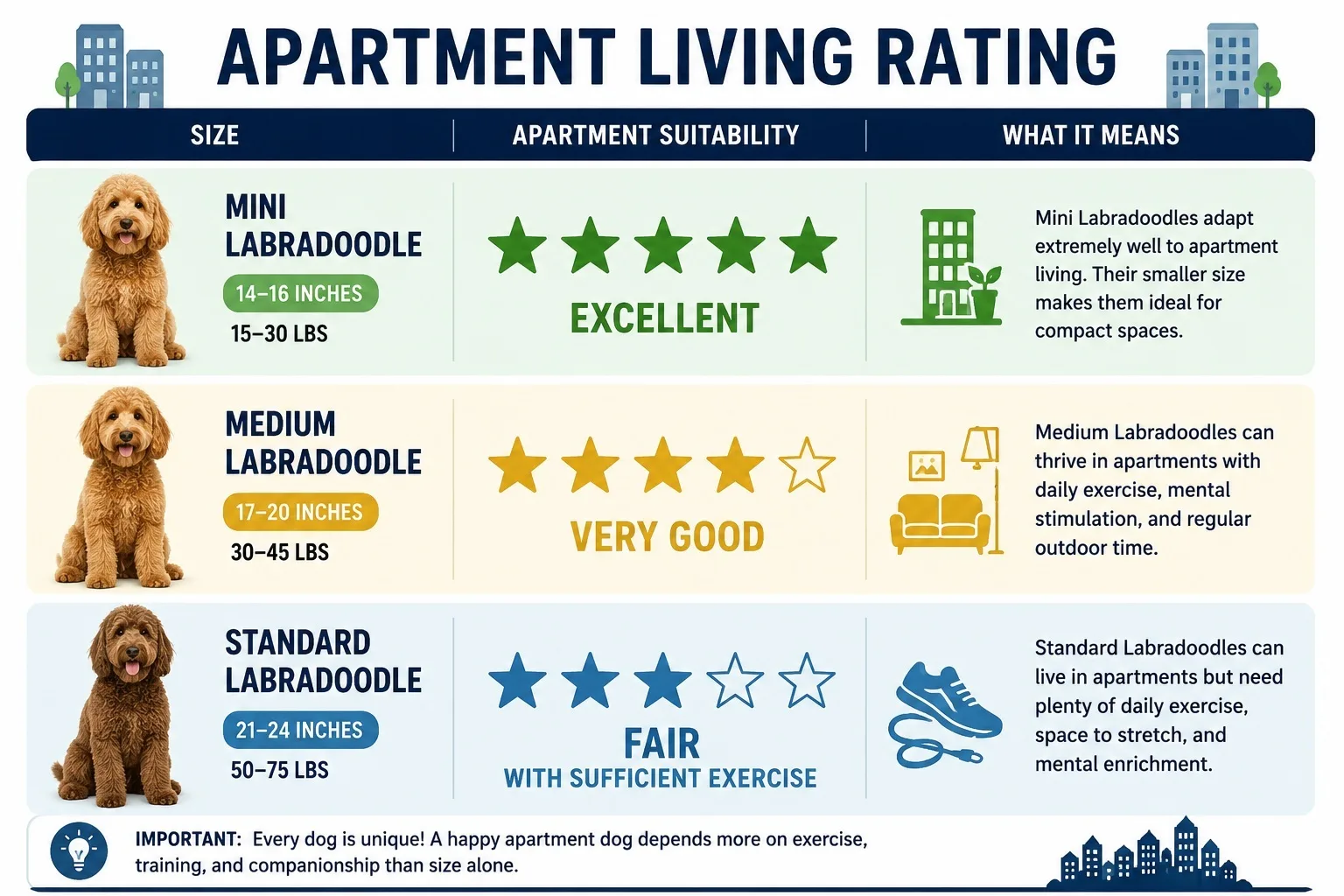
That said, Mini Labradoodles generally adapt best to apartment living due to their compact size. Medium Labradoodles can also thrive in apartments if they receive daily walks, playtime, and regular opportunities to explore outdoors.
Standard Labradoodles usually appreciate more living space, but they can also do well in apartments if their exercise requirements are consistently met. Regardless of size, Labradoodles are companion dogs that prefer spending time with their families rather than being left alone for long periods.
Which Labradoodle Size Is Best for Families?
All three sizes make wonderful family companions, but the right choice depends on your household and lifestyle.
Mini Labradoodles are a great option for couples, retirees, or families with older children. Their smaller size makes them easier to travel with and manage, though they can be more delicate around toddlers.
Medium Labradoodles are often considered the ideal all-round family dog. They are sturdy enough to enjoy active play with children while remaining manageable in most homes.
Standard Labradoodles are best suited to active families with larger homes or yards. Their athletic build and gentle nature make them fantastic companions for outdoor adventures, although their size means they may accidentally knock over very young children during energetic play.
Which Labradoodle Size Is Best for First-Time Owners?
All Labradoodles are intelligent and eager to please, making them suitable for many first-time dog owners. However, each size comes with different considerations.
Mini Labradoodle
Best for owners who want a compact companion that fits comfortably into smaller homes or apartments. Their manageable size makes everyday handling easier, though they still need regular grooming and exercise.
Medium Labradoodle
Often the easiest choice for first-time owners. They offer an excellent balance between size, energy, and adaptability, making them suitable for a wide range of households.
Standard Labradoodle
A great option for first-time owners who enjoy an active lifestyle and have enough space to accommodate a larger dog. Their intelligence and trainability are major advantages, but they require more food, more room, and more physical exercise than smaller Labradoodles.
Which Labradoodle Size Is Right for You?
Choosing the right Labradoodle isn’t about finding the “best” size—it’s about finding the size that best suits your lifestyle.
Here’s a quick comparison.
| Your Lifestyle | Recommended Size |
|---|---|
| Apartment living | Mini |
| Small home | Mini or Medium |
| Active family | Medium or Standard |
| First-time owner | Medium |
| Frequent traveller | Mini |
| Therapy or service work | Standard |
| Seniors | Mini |
| Hiking and outdoor adventures | Standard |
| Balanced family companion | Medium |
No matter which size you choose, a well-bred Labradoodle will need regular exercise, ongoing training, grooming, and plenty of companionship.
Frequently Asked Questions
What is the most popular Labradoodle size?
Medium Labradoodles are often considered the most popular because they offer a balance between the compact size of a Mini and the athletic ability of a Standard. They adapt well to a wide variety of homes and lifestyles.
Which Labradoodle size sheds the least?
Shedding is influenced more by coat type and genetics than by size. Mini, Medium, and Standard Labradoodles can all have low-shedding fleece or wool coats.
Does a larger Labradoodle live longer?
Generally, smaller dogs tend to have slightly longer lifespans than larger dogs. Mini Labradoodles may live 13 to 16 years, while Standard Labradoodles typically live 12 to 15 years, although genetics and overall care have a much greater influence than size alone.
Which Labradoodle size is easiest to train?
All Labradoodles are highly intelligent and respond well to positive reinforcement. Their trainability is largely influenced by breeding, consistency, and early socialisation rather than size.
Can a Mini Labradoodle become larger than expected?
Yes. While responsible breeders carefully select parent dogs to produce predictable sizes, genetics can occasionally surprise you. Some Mini Labradoodles grow slightly larger than expected, particularly if they inherit more Labrador Retriever traits.
Is a Standard Labradoodle too big for children?
Not at all. Standard Labradoodles are generally gentle and affectionate with children. However, because of their size and enthusiasm, young dogs should always be supervised around toddlers to prevent accidental bumps or knocks during play.
Final Thoughts
Whether you choose a Mini, Medium, or Standard Labradoodle, you’ll be welcoming one of the most intelligent, affectionate, and versatile companion dogs into your home. Each size has its own advantages, and none is inherently better than the others. The right choice depends on your living space, activity level, family situation, and personal preferences.
If you live in an apartment or travel frequently, a Mini Labradoodle may be the perfect fit. Medium Labradoodles are an excellent all-round choice for most families, while Standard Labradoodles shine in active households where they have plenty of room to exercise and explore.
Before bringing home a puppy, speak with reputable breeders about the expected adult size of their litters and learn as much as you can about the parents. Responsible breeders can usually provide a realistic estimate of your puppy’s future size based on their breeding lines and previous litters.
No matter which size you choose, proper nutrition, regular exercise, routine veterinary care, grooming, and consistent training will help your Labradoodle grow into a healthy, confident, and well-mannered companion.