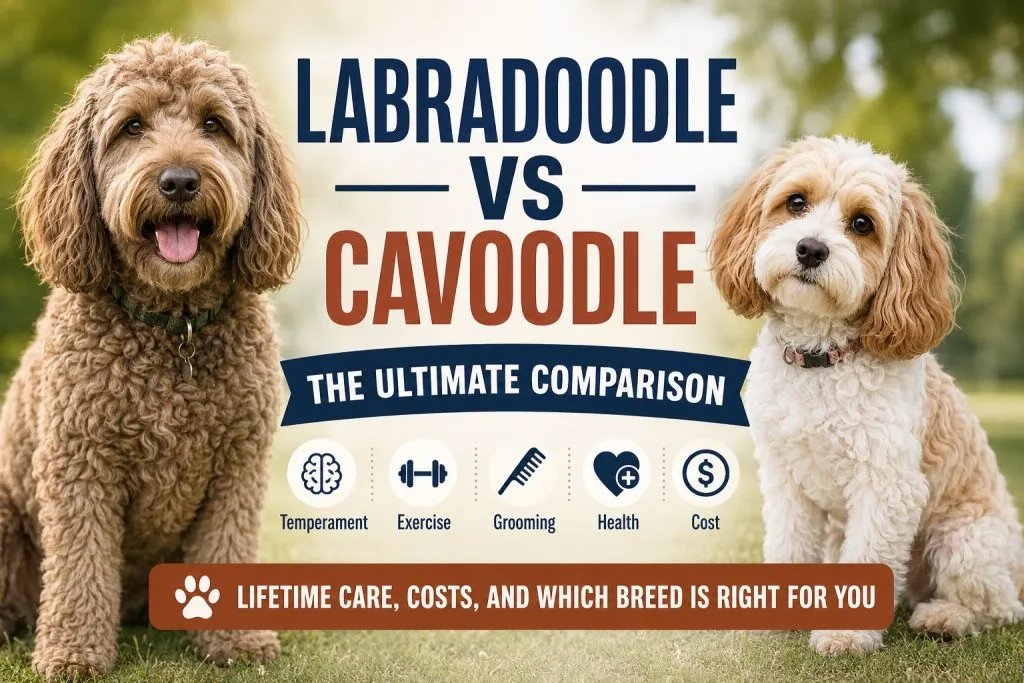
Choosing between a Labradoodle and a Cavoodle (Cavapoo) isn’t easy. Both are affectionate, intelligent, and low-shedding Poodle mixes that have become incredibly popular with families around the world. However, despite sharing Poodle genetics, these two breeds differ significantly in terms of size, energy levels, exercise needs, and the type of lifestyle they best suit.
A Labradoodle combines a Labrador Retriever with a Poodle, resulting in a medium to large dog known for its athleticism, trainability, and outgoing personality. A Cavoodle (also called a Cavapoo), on the other hand, is a cross between a Cavalier King Charles Spaniel and a Poodle. It is considerably smaller and is often chosen by apartment dwellers, retirees, and families looking for a compact companion.
So, which breed is the better choice for you?
The answer depends on your lifestyle. If you enjoy outdoor adventures, have plenty of space, and want an energetic companion, a Labradoodle may be the better fit. If you’re looking for a smaller dog that’s adaptable, affectionate, and easier to manage in a smaller home, a Cavoodle could be the ideal choice.
In this comprehensive comparison, we’ll examine everything from appearance and temperament to grooming, health, trainability, exercise requirements, costs, and family suitability to help you decide which breed deserves a place in your home.
Table of Contents
Quick Answer
If you’re short on time, here’s the key difference:
| Feature | Labradoodle | Cavoodle |
|---|---|---|
| Parent Breeds | Labrador Retriever × Poodle | Cavalier King Charles Spaniel × Poodle |
| Typical Size | Mini, Medium & Standard | Toy & Mini |
| Energy Level | High | Moderate |
| Exercise Needs | High | Moderate |
| Grooming | High | High |
| Intelligence | Excellent | Excellent |
| Apartment Living | Good | Excellent |
| Family Friendly | Excellent | Excellent |
| Good for First-Time Owners | Very Good | Excellent |
| Best For | Active families and outdoor lifestyles | Apartments, smaller homes, companionship |
Winner Scorecard
| Category | Winner | Why |
|---|---|---|
| Apartment Living | 🏆 Cavoodle | Smaller size and lower exercise requirements |
| Active Families | 🏆 Labradoodle | Higher stamina and enjoys outdoor activities |
| First-Time Owners | 🏆 Cavoodle | Easier to manage due to its size and temperament |
| Families with Children | 🤝 Tie | Both are affectionate and gentle companions |
| Intelligence | 🤝 Tie | Both inherit the Poodle's exceptional intelligence |
| Trainability | 🏆 Labradoodle | Excels in advanced obedience, therapy, and service work |
| Shedding | 🤝 Tie | Generally low-shedding, though coat type varies |
| Grooming | 🤝 Tie | Both require regular brushing and professional grooming |
| Travel Friendliness | 🏆 Cavoodle | Compact size makes travelling easier |
| Outdoor Adventures | 🏆 Labradoodle | Better suited to hiking, running, and swimming |
What Is a Labradoodle?
A Labradoodle is a cross between a Labrador Retriever and a Poodle, originally developed in Australia during the late 1980s. The goal was to combine the Labrador’s friendly, dependable temperament with the Poodle’s intelligence and lower-shedding coat.
Today, Labradoodles are among the world’s most popular designer dogs. They come in three common sizes—Miniature, Medium, and Standard—and are valued for their versatility. Many work as therapy dogs, assistance dogs, emotional support animals, and active family companions.
Labradoodles are energetic, highly trainable, and thrive in homes where they receive plenty of exercise, mental stimulation, and social interaction. While they’re generally friendly with children and other pets, they need more daily activity than many other Poodle crosses.
What Is a Cavoodle?
A Cavoodle, known as a Cavapoo in the United States and many other countries, is a cross between a Cavalier King Charles Spaniel and a Poodle. Bred primarily for companionship, the Cavoodle has become one of Australia’s most beloved designer dogs thanks to its affectionate nature and manageable size.
Most Cavoodles are Toy or Miniature-sized, making them well-suited to apartments, townhouses, and smaller family homes. They typically inherit the gentle, people-oriented personality of the Cavalier along with the intelligence and low-shedding qualities of the Poodle.
Although smaller than Labradoodles, Cavoodles are playful and enjoy daily walks, games, and family activities. Their adaptable temperament makes them a popular choice for first-time dog owners, seniors, families with children, and anyone looking for a loving companion that doesn’t require the same level of exercise as larger doodle breeds.
Labradoodle vs Cavoodle at a Glance
| Feature | Labradoodle | Cavoodle |
|---|---|---|
| Parent Breeds | Labrador Retriever × Poodle | Cavalier King Charles Spaniel × Poodle |
| Height | 14–24 inches | 9–14 inches |
| Weight | 15–65 pounds | 8–25 pounds |
| Common Sizes | Mini, Medium, Standard | Toy, Mini |
| Coat Types | Fleece, Wool, Hair | Wavy or Curly |
| Shedding | Low to Moderate | Low |
| Grooming Needs | High | High |
| Energy Level | High | Moderate |
| Exercise Needs | 60–90 minutes daily | 30–60 minutes daily |
| Trainability | Excellent | Excellent |
| Barking | Low to Moderate | Moderate |
| Apartment Suitability | Good (Mini) | Excellent |
| Good with Children | Excellent | Excellent |
| Good with Other Pets | Excellent | Excellent |
| First-Time Owners | Very Good | Excellent |
| Life Expectancy | 12–15 years | 12–16 years |
Appearance Comparison
At first glance, Labradoodles and Cavoodles share the adorable “teddy bear” look that has made Poodle crosses so popular. However, once you compare them side by side, the differences become much more noticeable. Labradoodles are larger, more athletic dogs with longer legs and a sturdier build, while Cavoodles are smaller, lighter, and bred primarily as companion dogs.
If you’re choosing between these breeds, appearance isn’t just about looks—it also affects your living space, travel plans, grooming routine, and overall lifestyle.
Size
One of the biggest differences between these breeds is their size.
Labradoodles come in three recognised sizes depending on the size of the Poodle parent:
- Mini Labradoodle: 14–16 inches (35–41 cm), 15–30 pounds (7–14 kg)
- Medium Labradoodle: 17–20 inches (43–51 cm), 30–45 pounds (14–20 kg)
- Standard Labradoodle: 21–24 inches (53–61 cm), 50–65 pounds (23–29 kg)
Cavoodles are much smaller and are usually bred from Toy or Miniature Poodles:
- Toy Cavoodle: 9–12 inches (23–30 cm), 8–15 pounds (4–7 kg)
- Mini Cavoodle: 12–14 inches (30–36 cm), 15–25 pounds (7–11 kg)
Even a Standard Labradoodle can weigh three to four times more than a Toy Cavoodle. If you’re looking for a dog that’s easy to lift, carry, or travel with, the Cavoodle has a clear advantage. If you prefer a larger companion for outdoor activities, the Labradoodle is the better choice.
Winner: 🏆 Depends on your lifestyle
- Labradoodle for those wanting a medium or large dog.
- Cavoodle for people seeking a compact companion.
Build and Body Structure
Labradoodles inherit the athletic frame of the Labrador Retriever, giving them a lean, muscular body built for endurance. Their longer legs and deeper chest make them excellent companions for hiking, jogging, swimming, and other outdoor activities.
Cavoodles inherit the softer features of the Cavalier King Charles Spaniel. They have a smaller frame, shorter legs, and a more delicate appearance. Their compact size makes them ideal lap dogs and easy companions for everyday life.
Although both breeds are agile, Labradoodles generally have greater stamina and physical strength.
Coat Types
Both breeds may inherit different coat types depending on their genetics.
Labradoodle coats
- Hair Coat (more Labrador-like)
- Fleece Coat (soft, wavy, low-shedding)
- Wool Coat (tight curls, similar to a Poodle)
Cavoodle coats
- Soft wavy coat
- Loose curly coat
- Occasionally straighter coats
Most Cavoodles have a silky, slightly wavy coat that feels softer than the average Labradoodle, while many Labradoodles—particularly Australian Labradoodles—develop a dense fleece or wool coat.
Neither breed is guaranteed to be hypoallergenic, but dogs with fleece or wool coats generally shed less.
Coat Colours
Both breeds are available in a wide variety of colours, although Labradoodles typically offer more variety due to their broader breeding history.
Common Labradoodle colours
- Cream
- Gold
- Apricot
- Red
- Chocolate
- Black
- Caramel
- Café
- Silver
- Blue
- Parti
- Phantom
- Merle (less common and controversial)
Common Cavoodle colours
- Ruby
- Blenheim
- Black
- Chocolate
- Cream
- Gold
- Apricot
- Red
- Black & Tan
- Tri-colour
- Parti
If colour is a major factor in your decision, Labradoodles provide slightly more options, especially among Australian Labradoodle breeding programs.
Winner: 🏆 Labradoodle
Facial Features
Both breeds are famous for their expressive “teddy bear” faces, but they have distinct characteristics.
Labradoodles usually have:
- Longer muzzles
- Broader heads
- Athletic expression
- Larger paws
- Longer legs
Cavoodles typically have:
- Rounder faces
- Larger, expressive eyes
- Shorter muzzle
- Soft, floppy ears
- Compact proportions
Many people find Cavoodles especially appealing because they retain the sweet, puppy-like expression of the Cavalier King Charles Spaniel well into adulthood.
Which Breed Is More Attractive?
Beauty is subjective, and both breeds have devoted fans.
If you prefer a larger, sporty dog with an elegant, athletic appearance, the Labradoodle is likely to appeal to you.
If you’re drawn to smaller, cuddly dogs with large eyes and a classic teddy bear look, the Cavoodle is hard to beat.
Neither breed wins outright—your preference will largely depend on whether you’re looking for an active adventure companion or a compact family pet.
Temperament Comparison
Both Labradoodles and Cavoodles are known for their friendly, affectionate personalities. Thanks to their Poodle heritage, they are intelligent, eager to please, and highly social. However, their personalities are influenced by very different companion breeds, giving each one a unique temperament.
Affection and Bonding
Both breeds thrive on human companionship and enjoy spending time with their families. However, Cavoodles are generally more people-oriented and often become true “velcro dogs,” following their owners from room to room and happily curling up on the sofa or your lap.
Labradoodles are equally loving but usually express their affection through play, outdoor adventures, and interactive activities rather than constant cuddling.
If you’re looking for a dog that loves being close to you throughout the day, the Cavoodle has the edge.
Winner: 🏆 Cavoodle
Energy Levels
This is one of the biggest personality differences.
Labradoodles inherit the Labrador Retriever’s enthusiasm for activity and typically require plenty of daily exercise and mental stimulation. They enjoy:
- Running
- Hiking
- Swimming
- Fetch
- Dog sports
- Agility
- Advanced training
Cavoodles are playful but have more moderate exercise needs. Most are happy with daily walks, interactive games, and indoor play sessions.
For highly active households, Labradoodles often fit naturally into an adventurous lifestyle. Families seeking a calmer companion may find the Cavoodle easier to manage.
Winner: 🏆 Labradoodle (for active owners)
Friendliness with Strangers
Both breeds are generally welcoming and sociable when properly socialised.
Labradoodles often greet new people with excitement and enthusiasm, while Cavoodles tend to be gentle, polite, and eager for attention. Neither breed typically makes an effective guard dog because both are naturally friendly.
Winner: 🤝 Tie
Confidence and Adaptability
Labradoodles tend to be more confident in unfamiliar environments and adapt well to busy households, outdoor adventures, and frequent changes in routine.
Cavoodles are adaptable too, but some may inherit a slightly more sensitive nature from the Cavalier King Charles Spaniel and prefer predictable routines.
For families who travel frequently or enjoy an active lifestyle, Labradoodles often adjust more readily.
Winner: 🏆 Labradoodle
Independence
Neither breed enjoys being left alone for long periods, but Cavoodles are generally more prone to developing separation anxiety because they form exceptionally close bonds with their owners.
Labradoodles also dislike solitude, yet many cope slightly better when their physical and mental needs are consistently met.
If your household is empty for much of the day, neither breed is ideal without appropriate enrichment, companionship, or a gradual training plan.
Winner: 🏆 Labradoodle
Temperament Verdict
Both breeds are affectionate, intelligent, and wonderful family companions, but they shine in different situations.
Choose a Labradoodle if you want an energetic, confident dog that enjoys adventures, learning new skills, and staying active.
Choose a Cavoodle if you want a smaller companion that thrives on close human interaction, adapts well to apartment living, and is happiest by your side.
For most families, neither breed has the “better” temperament—it simply depends on the lifestyle you can offer.
Intelligence & Trainability
Both Labradoodles and Cavoodles are highly intelligent dogs thanks to their Poodle ancestry. They learn quickly, enjoy solving problems, and generally respond well to positive reinforcement. However, Labradoodles tend to excel in advanced training and working roles, while Cavoodles are often easier for first-time owners to train for everyday family life.
Intelligence
Poodles consistently rank among the world’s most intelligent dog breeds, and both Labradoodles and Cavoodles inherit much of this intelligence.
Labradoodles also benefit from the Labrador Retriever’s willingness to work alongside people. This combination creates a dog that not only learns commands quickly but also enjoys having a job to do.
Cavoodles inherit the gentle, eager-to-please personality of the Cavalier King Charles Spaniel. While equally bright, they are typically more focused on companionship than complex tasks.
Both breeds can learn:
- Basic obedience
- House training
- Trick training
- Recall
- Agility fundamentals
- Interactive puzzle games
Winner: 🤝 Tie
Ease of Training
Both breeds respond best to:
- Positive reinforcement
- Consistency
- Short, engaging training sessions
- Early socialisation
- Food rewards and praise
Labradoodles often have longer attention spans and greater enthusiasm for advanced training. They usually enjoy learning complex commands, scent work, agility, and retrieving games.
Cavoodles are extremely eager to please but can occasionally become distracted by people or seek affection instead of focusing on training. For everyday obedience, however, they are often slightly easier to manage because of their calmer temperament.
Winner
Basic obedience: 🏆 Cavoodle
Advanced training: 🏆 Labradoodle
Suitability for Therapy and Assistance Work
One area where Labradoodles have a clear advantage is working ability.
Originally developed with assistance work in mind, Labradoodles are commonly used as:
- Therapy dogs
- Emotional support animals
- Service dogs
- Facility dogs
- Reading companions
- Search and scent detection dogs
Their combination of intelligence, confidence, athleticism, and trainability makes them excellent working dogs.
Cavoodles also make wonderful therapy and emotional support dogs, particularly for seniors, hospitals, and individuals seeking a smaller companion. However, their compact size limits the types of assistance work they can perform.
Winner: 🏆 Labradoodle
Socialisation
Both breeds benefit from early exposure to:
- Different people
- Children
- Other dogs
- Cats and household pets
- Busy environments
- Car rides
- Grooming routines
Early socialisation helps prevent fearfulness and builds confidence throughout adulthood.
Because Cavoodles can be slightly more sensitive, consistent socialisation during puppyhood is especially valuable.
Winner: 🤝 Tie
Intelligence & Training Verdict
If your goal is to have an exceptionally trainable dog for advanced obedience, therapy work, or outdoor activities, the Labradoodle comes out ahead.
If you’re looking for a companion that’s quick to learn household manners and easy to train as a family pet, the Cavoodle is equally rewarding.
For most owners, both breeds are among the easiest designer dogs to train.
Exercise Requirements
Although both breeds enjoy daily activity, their exercise needs differ significantly because of their parent breeds.
Labradoodles inherit the Labrador Retriever’s athletic nature and require much more physical and mental stimulation than the average Cavoodle.
Labradoodle Exercise Needs
Most healthy adult Labradoodles require:
- 60–90 minutes of exercise every day
- Off-leash play in secure areas
- Long walks
- Running or hiking
- Swimming
- Fetch
- Interactive training sessions
Without enough activity, Labradoodles may become bored and develop unwanted behaviours such as:
- Excessive barking
- Digging
- Chewing furniture
- Jumping
- Hyperactivity
Mental stimulation is just as important as physical exercise. Puzzle toys, scent games, obedience practice, and food-dispensing toys help keep them mentally satisfied.
Cavoodle Exercise Needs
Cavoodles have more moderate exercise requirements.
Most adult Cavoodles are happy with:
- 30–60 minutes of exercise daily
- One or two walks
- Indoor play
- Fetch
- Puzzle toys
- Short training sessions
Because of their smaller size, they often burn energy more quickly indoors and don’t require the same level of vigorous activity as Labradoodles.
However, regular exercise remains important to prevent obesity and keep them mentally stimulated.
Apartment Living
Both breeds can adapt to apartment life, but one clearly has the advantage.
Labradoodle
Mini Labradoodles can live happily in apartments if they receive plenty of outdoor exercise every day.
Medium and Standard Labradoodles generally do better in homes with a backyard, especially if their owners lead active lifestyles.
Cavoodle
Cavoodles are among the best designer dogs for apartment living.
Their compact size and moderate exercise needs make them well suited to:
- Apartments
- Townhouses
- Retirement communities
- Smaller suburban homes
As long as they receive regular walks and attention, they usually adapt extremely well.
Winner: 🏆 Cavoodle
Which Breed Fits an Active Lifestyle?
If you love:
- Hiking
- Camping
- Running
- Beach trips
- Swimming
- Long outdoor adventures
the Labradoodle is usually the better companion. Their stamina, enthusiasm, and athletic build make them ideal for owners who enjoy staying active.
Cavoodles certainly enjoy outings too, but they generally tire more quickly and are better suited to moderate daily activity.
Exercise Verdict
The better breed depends entirely on your lifestyle.
Choose a Labradoodle if you want an energetic companion that can keep up with long walks, outdoor adventures, and regular exercise.
Choose a Cavoodle if you prefer a dog that enjoys daily walks and playtime without demanding hours of physical activity.
For highly active owners, the Labradoodle is the clear winner. For apartment dwellers and families seeking a lower-maintenance exercise routine, the Cavoodle is hard to beat.
Grooming Requirements
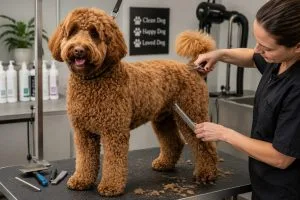
Whether you choose a Labradoodle or a Cavoodle, be prepared to spend time on coat care. Although both breeds are often marketed as “low-shedding,” neither is a low-maintenance dog when it comes to grooming. Regular brushing, professional grooming appointments, and routine ear, nail, and dental care are essential to keep them looking and feeling their best.
Brushing
Both breeds should be brushed several times a week to prevent tangles and mats. Dogs with curlier coats require more frequent grooming than those with loose, wavy coats.
Labradoodle
Depending on coat type, most Labradoodles need brushing 3–5 times per week, with curly wool coats often benefiting from daily brushing. Their larger body also means grooming sessions take longer.
Neglecting regular brushing can quickly lead to painful matting, particularly behind the ears, under the legs, around the collar, and on the tail.
Cavoodle
Cavoodles also require frequent brushing, but because they’re much smaller, grooming usually takes less time. A thorough brushing 3–4 times per week is sufficient for most Cavoodles, although curlier coats may need daily attention.
Winner: 🏆 Cavoodle
Smaller size makes home grooming quicker and easier.
Professional Grooming
Both breeds benefit from professional grooming every 6–8 weeks, depending on coat length and lifestyle.
Professional grooming typically includes:
- Bathing
- Blow drying
- Brushing and de-matting
- Hair trimming
- Nail clipping
- Ear cleaning
- Hygiene trimming
Since Labradoodles are larger, grooming appointments usually cost more than those for Cavoodles.
Winner: 🏆 Cavoodle
Lower grooming costs due to its smaller size.
Shedding
Neither breed is completely non-shedding.
The amount of hair your dog sheds depends on genetics and coat type rather than the breed alone.
Labradoodle
- Hair coats may shed moderately.
- Fleece coats are usually low-shedding.
- Wool coats generally shed the least.
Cavoodle
Most Cavoodles inherit a low-shedding coat, although those with more Cavalier genetics may shed a little more than expected.
Even low-shedding dogs lose some hair naturally throughout the year.
Winner: 🤝 Tie
Both breeds can be excellent choices for owners wanting less hair around the home, but individual coat genetics matter more than the breed itself.
Are They Hypoallergenic?
Neither Labradoodles nor Cavoodles are truly hypoallergenic.
However, dogs with fleece or wool coats often produce less loose hair and dander, making them more suitable for some allergy sufferers.
If allergies are a concern:
- Spend time with the breed before committing.
- Meet the puppy’s parents if possible.
- Remember that individual dogs vary significantly.
It’s important to note that allergies are usually triggered by proteins found in saliva and skin cells rather than the hair itself.
Winner: 🤝 Tie
Ear Care
Both breeds have floppy ears that reduce airflow to the ear canal, making them more susceptible to ear infections.
Weekly ear checks are recommended.
Look for:
- Redness
- Unpleasant odour
- Excess wax
- Frequent scratching
- Head shaking
Keeping the ears clean and dry—especially after swimming or bathing—can help reduce the risk of infection.
Winner: 🤝 Tie
Nail, Teeth, and Coat Maintenance
In addition to brushing, both breeds need routine care.
Nails
Trim every 3–6 weeks, or whenever you hear them clicking on hard floors.
Teeth
Brush 2–3 times per week, ideally daily, to reduce plaque buildup and lower the risk of dental disease.
Eyes
Gently wipe away tear stains or discharge as needed, particularly in lighter-coloured dogs.
Routine maintenance helps both breeds stay comfortable and can prevent more serious health problems later in life.
Grooming Costs
Grooming costs vary depending on where you live, your dog’s size, coat condition, and the groomer’s experience.
Generally, you’ll spend more grooming a Labradoodle because:
- They have a larger body.
- Grooming takes longer.
- More product and drying time are required.
A Cavoodle’s smaller size usually translates into shorter appointments and lower grooming bills.
Grooming Verdict
Both Labradoodles and Cavoodles require a consistent grooming routine, so neither should be considered a “wash-and-go” breed.
Choose a Labradoodle if you’re comfortable spending more time—and often more money—maintaining a larger coat.
Choose a Cavoodle if you want the same low-shedding benefits in a smaller dog that’s quicker and less expensive to groom.
For most owners, the Cavoodle has a slight advantage simply because its compact size makes grooming more manageable.
Health Comparison
Both Labradoodles and Cavoodles are generally healthy, long-lived dogs when they come from responsible breeders who perform appropriate health testing. However, because each breed inherits genes from two different purebred parents, they can also inherit some of the health conditions commonly seen in those breeds.
The good news is that many hereditary diseases can be screened for before breeding, making breeder selection one of the most important decisions you’ll make.
Common Health Problems in Labradoodles
Labradoodles inherit health risks from both the Labrador Retriever and the Poodle.
Some of the more common conditions include:
- Hip dysplasia
- Elbow dysplasia
- Progressive Retinal Atrophy (PRA)
- Exercise-Induced Collapse (EIC)
- Addison’s disease
- Sebaceous adenitis
- Allergies
- Ear infections
- Gastric Dilatation-Volvulus (bloat), particularly in Standard Labradoodles
Large Labradoodles may also be more susceptible to joint problems because of their size and rapid growth during puppyhood.
Fortunately, reputable breeders routinely screen for many of these conditions through health and DNA testing.
Common Health Problems in Cavoodles
Cavoodles inherit different health concerns due to their Cavalier King Charles Spaniel heritage.
Common issues include:
- Mitral Valve Disease (MVD)
- Syringomyelia (SM)
- Patellar luxation
- Progressive Retinal Atrophy (PRA)
- Cataracts
- Hip dysplasia (less common than in Labradoodles)
- Dental disease
- Ear infections
Heart disease deserves particular attention. Mitral Valve Disease is one of the most significant inherited conditions affecting Cavalier King Charles Spaniels, making responsible breeding especially important for Cavoodles.
Because Cavoodles have smaller mouths, they are also more prone to dental crowding and periodontal disease than Labradoodles.
Shared Health Conditions
Despite their differences, both breeds share several potential health concerns due to their Poodle ancestry.
These include:
- Progressive Retinal Atrophy (PRA)
- Cataracts
- Ear infections
- Allergies
- Skin conditions
- Obesity (if overfed and under-exercised)
Routine veterinary care, a balanced diet, regular exercise, and maintaining a healthy weight can significantly reduce the risk of many preventable health problems.
Lifespan
Both breeds enjoy relatively long lifespans.
Average Lifespan:
- Labradoodle 12–15 years
- Cavoodle 12–16 years
Cavoodles often live slightly longer, largely because smaller dogs tend to have longer life expectancies than medium and large breeds.
Winner: 🏆 Cavoodle
Preventive Healthcare
Regardless of which breed you choose, preventive care plays a major role in longevity.
Your dog should receive:
- Annual veterinary examinations
- Vaccinations as recommended
- Year-round parasite prevention
- Dental care
- Routine grooming
- Weight management
- Daily exercise
- Mental enrichment
Early detection allows many conditions to be managed before they become serious.
Choosing a Responsible Breeder
The healthiest puppies usually come from breeders who prioritise health over appearance.
Look for breeders who perform appropriate health screening on their breeding dogs, including:
Labradoodle
An ethical Labradoodle breeder should do the following:
- Hip evaluation
- Elbow evaluation
- Eye examinations
- DNA testing for inherited diseases
- PRA testing
Cavoodle
An ethical Cavoodle breeder should do the following:
- Heart examinations
- Eye examinations
- Patella evaluation
- DNA testing
- PRA testing
A reputable breeder should be willing to discuss the health history of both parents and provide copies of relevant health certificates where available.
Health Verdict
Neither breed is inherently healthier than the other—they simply face different inherited risks.
Labradoodles are more prone to orthopedic conditions and certain immune-mediated diseases, particularly in larger dogs. Cavoodles are more likely to experience heart disease, dental problems, and patellar luxation.
With responsible breeding, proper nutrition, regular exercise, and routine veterinary care, both breeds can enjoy long, healthy lives.
Winner: 🤝 Tie
The healthiest dog isn’t determined by breed alone—it’s determined by genetics, responsible breeding, and lifelong care.
Which Breed Is Better for Different Lifestyles?
Choosing between a Labradoodle and a Cavoodle ultimately comes down to your lifestyle rather than which breed is objectively “better.” While both make wonderful companions, they excel in different environments and suit different types of owners.
Families with Children
Both Labradoodles and Cavoodles are affectionate, patient, and playful with children when properly socialised.
Labradoodles are ideal for families with older children who enjoy outdoor activities, sports, and interactive play. Their larger size also makes them more robust around energetic kids.
Cavoodles are often better suited to families with younger children because of their gentle temperament and smaller size. However, young children should always be taught how to handle small dogs respectfully to avoid accidental injuries.
Winner: 🤝 Tie
Apartment Living
While Mini Labradoodles can adapt well to apartment life with sufficient daily exercise, Cavoodles are naturally better suited to smaller homes.
Their compact size and moderate exercise needs make them one of the best companion breeds for:
- Apartments
- Units
- Townhouses
- Retirement villages
Winner: 🏆 Cavoodle
Active Lifestyles
If you enjoy hiking, jogging, camping, beach trips, or long walks, a Labradoodle is likely to keep pace with your lifestyle.
Their athletic build, endurance, and love of outdoor activities make them outstanding companions for active owners.
Cavoodles enjoy adventures too but generally prefer shorter outings and moderate daily exercise.
Winner: 🏆 Labradoodle
Seniors and Retirees
Many retirees appreciate the Cavoodle’s manageable size, affectionate personality, and lower exercise requirements.
They’re easier to lift, travel with, and care for while still providing plenty of companionship.
Winner: 🏆 Cavoodle
First-Time Dog Owners
Both breeds are intelligent and eager to please, making them suitable for novice owners.
However, the Cavoodle’s smaller size, calmer temperament, and lower exercise requirements often make it slightly easier for first-time owners to manage.
Winner: 🏆 Cavoodle
Homes with Other Pets
When properly introduced and socialised, both breeds usually get along well with:
- Other dogs
- Cats
- Smaller household pets
Neither breed has a particularly strong prey drive compared to many working or hunting breeds.
Winner: 🤝 Tie
Lifestyle Match Table
| Your Lifestyle | Better Choice | Why |
|---|---|---|
| Apartment or townhouse | 🏆 Cavoodle | Compact size and moderate exercise needs |
| Active outdoor family | 🏆 Labradoodle | Athletic, energetic, and loves adventure |
| First-time dog owner | 🏆 Cavoodle | Easier to manage and highly adaptable |
| Family with children | 🤝 Either | Both are affectionate and child-friendly |
| Seniors or retirees | 🏆 Cavoodle | Gentle temperament and manageable size |
| Therapy or assistance work | 🏆 Labradoodle | Excels in advanced training and working roles |
| Frequent travellers | 🏆 Cavoodle | Smaller and easier to transport |
| Large home with backyard | 🏆 Labradoodle | Benefits from extra space and vigorous exercise |
Cost of Ownership
Bringing home either a Labradoodle or a Cavoodle is a long-term financial commitment. Beyond the initial purchase price, you’ll need to budget for food, grooming, veterinary care, insurance, toys, training, and other ongoing expenses throughout your dog’s life.
While costs vary depending on your location and the breeder you choose, Labradoodles are generally more expensive to own because of their larger size and higher food, grooming, and healthcare costs.
Initial Purchase Price
Puppy prices depend on several factors, including:
- Breeder reputation
- Health testing
- Bloodlines
- Generation (F1, F1B, Multigenerational)
- Coat quality
- Colour
- Location
Both breeds are popular designer dogs, so responsibly bred puppies often command premium prices.
In general:
Labradoodles tend to be slightly more expensive, particularly Australian Labradoodles from established breeding programs.
Cavoodles are also in high demand and can cost just as much in some regions. Check out the difference between Labradoodles and Australian Labradoodles.
Rather than choosing the cheapest puppy, prioritise a breeder who performs comprehensive health testing and raises puppies in a healthy environment.
Food Costs
This is where the size difference becomes obvious.
Labradoodle
A medium or Standard Labradoodle consumes considerably more food than a Cavoodle.
Expect higher annual costs for:
- Premium kibble
- Fresh food
- Treats
- Supplements
- Cavoodle
Because of their smaller size, Cavoodles eat much less, making them significantly cheaper to feed throughout their lives.
Winner: 🏆 Cavoodle
Grooming Costs
Both breeds require professional grooming approximately every 6–8 weeks.
However, Labradoodles generally cost more because:
- Grooming sessions take longer.
- Larger dogs require more shampoo and drying time.
- Coat maintenance is more labour-intensive.
A Cavoodle’s smaller size often means shorter appointments and lower grooming bills.
Winner: 🏆 Cavoodle
Veterinary Expenses
Routine veterinary care is similar for both breeds and includes:
- Vaccinations
- Annual health checks
- Flea, tick, and worm prevention
- Dental care
- Emergency treatment when required
However, larger dogs often require:
- Larger medication doses
- Higher anaesthetic costs
- More expensive surgeries
- Larger quantities of prescription food
As a result, Labradoodles typically cost more to treat over their lifetime.
Winner: 🏆 Cavoodle
Pet Insurance
Insurance premiums vary depending on:
- Country
- Provider
- Dog’s age
- Breed
- Coverage level
Because Labradoodles are larger and may face more costly orthopedic procedures, premiums can sometimes be slightly higher than for Cavoodles.
Regardless of breed, taking out pet insurance while your puppy is young can help cover unexpected veterinary expenses later in life.
Training and Equipment
Both breeds benefit from puppy classes and obedience training.
Initial expenses may include:
- Crate
- Bed
- Collar and lead
- Harness
- Food and water bowls
- Toys
- Puppy training classes
- Grooming supplies
Labradoodles often require larger (and therefore more expensive) crates, beds, harnesses, and travel equipment.
Lifetime Cost Comparison
| Expense | Labradoodle | Cavoodle |
|---|---|---|
| Purchase Price | High | High |
| Food | $$$$ | $$ |
| Grooming | $$$$ | $$$ |
| Routine Veterinary Care | $$$ | $$ |
| Insurance | $$$ | $$ |
| Equipment | $$$ | $$ |
| Overall Lifetime Cost | Higher | Lower |
Cost Verdict
If you’re looking to minimise ongoing expenses, the Cavoodle is usually the more economical choice.
Their smaller size reduces costs in almost every category, from food and grooming to equipment and veterinary care.
Labradoodles cost more to own, but many owners feel their versatility, athleticism, and larger size justify the additional expense.
Winner: 🏆 Cavoodle
Pros & Cons
Every breed has strengths and weaknesses. Understanding both sides can help you decide which dog best matches your expectations and lifestyle.
Labradoodle Pros
- Highly intelligent and eager to learn
- Excellent family companion
- Great with children and other pets
- Thrives in active households
- Excels in therapy, service, and assistance work
- Available in Mini, Medium, and Standard sizes
- Generally friendly with strangers
- Low-shedding coat (depending on genetics)
Labradoodle Cons
- Requires significant daily exercise
- Grooming can be time-consuming and expensive
- Larger dogs need more living space
- Eats more food than a Cavoodle
- Can become destructive if bored
- May be prone to joint problems and bloat
Cavoodle Pros
- Ideal size for apartments and smaller homes
- Extremely affectionate and people-oriented
- Excellent for first-time dog owners
- Good with children and other pets
- Lower food and maintenance costs
- Easier to travel with
- Moderate exercise needs
- Low-shedding coat (depending on genetics)
Cavoodle Cons
- Can develop separation anxiety
- Requires regular professional grooming
- May be prone to dental disease
- Heart health should be carefully considered
- Smaller size makes them more delicate around rough play
- Less suited to strenuous outdoor adventures
Choose a Labradoodle If…
A Labradoodle may be the better fit if you:
- Enjoy hiking, jogging, camping, or other outdoor adventures.
- Want a medium or large dog.
- Have a home with a secure backyard.
- Are interested in advanced obedience, agility, or therapy work.
- Can provide 60–90 minutes of daily exercise.
- Don’t mind higher grooming and food costs.
- Want a versatile companion that enjoys both family life and active pursuits.
Choose a Cavoodle If…
A Cavoodle may be the better choice if you:
- Live in an apartment, townhouse, or smaller home.
- Prefer a small dog that’s easy to carry and travel with.
- Want a gentle, affectionate lap dog.
- Are a first-time dog owner.
- Have a more relaxed lifestyle with moderate daily exercise.
- Want lower ongoing costs for food and grooming.
- Prefer a dog that’s happiest spending time close to its family.
Decision Summary
There isn’t a universal winner because these breeds were developed for different purposes.
Choose the Labradoodle if your priority is an active, intelligent companion that can keep up with outdoor adventures and advanced training.
Choose the Cavoodle if you want a smaller, adaptable companion that’s easier to manage in everyday family life and well suited to apartments or less active households.
For many prospective owners, the right choice comes down to one simple question:
Do you want an energetic adventure partner or a compact companion that fits almost any home?
Frequently Asked Questions
Is a Labradoodle or Cavoodle better for first-time dog owners?
Both breeds are suitable for first-time owners thanks to their intelligence and friendly personalities. However, Cavoodles generally have the edge because they’re smaller, require less exercise, and are easier to handle on a day-to-day basis. Labradoodles are equally trainable but need more physical activity and mental stimulation.
Which breed sheds less?
Neither breed is completely non-shedding. Labradoodles and Cavoodles with fleece or wool coats usually shed very little, while those with straighter or hair-type coats may shed more. Coat genetics play a bigger role than the breed itself.
Which breed is more hypoallergenic?
Neither Labradoodles nor Cavoodles are truly hypoallergenic. However, many people with mild dog allergies find them easier to live with because they often produce less loose hair and dander. Spending time with the breed before bringing home a puppy is always recommended.
Are Labradoodles bigger than Cavoodles?
Yes. Labradoodles are significantly larger.
A Standard Labradoodle can weigh 50–65 pounds (23–29 kg) or more, while most Cavoodles weigh 8–25 pounds (4–11 kg). If size is an important factor, this is one of the biggest differences between the two breeds.
Which breed requires more exercise?
Labradoodles require considerably more daily exercise.
Most adult Labradoodles need 60–90 minutes of activity each day, while most Cavoodles are happy with 30–60 minutes of walks, playtime, and mental stimulation.
Which breed lives longer?
Both breeds have relatively long lifespans.
Labradoodle: 12–15 years
Cavoodle: 12–16 years
Because smaller dogs often live longer than larger breeds, Cavoodles tend to have a slight advantage.
Which breed is more expensive to own?
Labradoodles generally cost more over their lifetime because they:
- Eat more food
- Cost more to groom
- Require larger equipment
- Often have higher veterinary and insurance costs
Cavoodles are typically more affordable to care for, although both breeds represent a significant long-term financial commitment.
Final Verdict
Both Labradoodles and Cavoodles are wonderful Poodle crosses with affectionate personalities, impressive intelligence, and low-shedding coats. Neither breed is objectively better—the right choice depends entirely on your lifestyle, living space, and expectations.
A Labradoodle is an excellent choice if you’re looking for an energetic, highly trainable companion that enjoys outdoor adventures, advanced training, and an active family lifestyle. They thrive in homes where they receive plenty of exercise, mental stimulation, and opportunities to be part of everyday activities.
A Cavoodle, on the other hand, is ideal for those who want a smaller, adaptable companion that fits comfortably into apartments, smaller homes, or quieter households. Their affectionate nature, moderate exercise needs, and manageable size make them a favourite among first-time owners, retirees, and families alike.
Whichever breed you choose, your experience will depend far more on responsible breeding, early socialisation, consistent training, and lifelong care than on the breed itself. Investing time in choosing a reputable breeder and meeting your dog’s physical and emotional needs will help ensure a happy, healthy companion for years to come.